Shop No.20, Aurobindo Palace Market, Hauz Khas, Near Church +91 9818282497 | 011 26867121 110016 New Delhi IN
Midland The Book Shop ™
Shop No.20, Aurobindo Palace Market, Hauz Khas, Near Church +91 9818282497 | 011 26867121 New Delhi, IN
+919871604786 https://www.midlandbookshop.com/s/607fe93d7eafcac1f2c73ea4/69591829db7aed90e0608dfb/without-tag-line-480x480.png" [email protected]
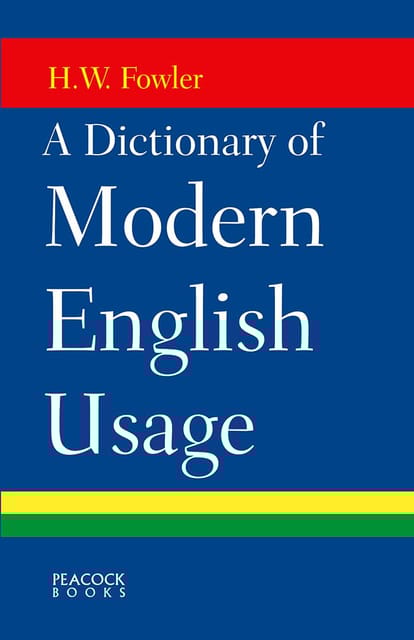
9788124805268 69e0cc85bf4aab281e9524f4 A Dictionary Of Modern English Usage https://www.midlandbookshop.com/s/607fe93d7eafcac1f2c73ea4/69e0cc87bf4aab281e952501/517iqdbh75l-_sl1080_.jpg
A Dictionary of Modern English Usage is a guide to the rules of good written British English including British English usage, pronunciation, and writing. It covers topics such as plurals and literary technique, distinctions among like words (homonyms and synonyms), and the use of foreign terms. It was first published in 1926 and became one of the standard reference books on the English language for the correct use of English in terms of choice of words, grammar, and style. It gives comprehensive and practical advice on complex points of grammar, syntax, punctuation, style, and word choice. It is often referred to as Modern English Usage, or simply Fowler. Much loved for firm opinions, passion, and dry humour, Fowler has stood the test of time and is still considered the best arbiter of good practice. The book s general approach encourages a direct, vigorous writing style, and opposes all artificiality, by firmly advising against convoluted sentence construction, the use of foreign words and phrases, and the use of archaisms. It opposed pedantry and ridiculed artificial grammar rules unwarranted by natural English usage, such as bans on ending a sentence with a preposition, rules on the placement of the word only, and rules distinguishing between which and that . It classified and condemned every clich , in the course of which it coined and popularized the terms battered ornament, vogue words, and worn-out humour, while defending useful distinctions between words whose meanings were coalescing in practice, thereby guiding the speaker and the writer away from illogical sentence construction, and the misuse of words.

About the Author

H.W. Fowler (10th March, 1858, Tonbridge, Kent, England 26th December, 1933, Hinton St. George, Somerset), was an English schoolmaster, lexicographer, philologist, and commentator on the usage of the English language whose works on the use and style of the English language had far-reaching influence. He was a man of moral and intellectual strength whose wit and grace were evident throughout his writings. He is notable for both A Dictionary of Modern English Usage and his work on the Concise Oxford Dictionary and was described by The Times as a lexicographical genius . Fowler was educated at Balliol College, Oxford, and taught at Sedbergh School until 1899 and then worked in London as a freelance writer and journalist. He lived in London from 1899 to 1903, supporting himself with a small inheritance and the income from essays published in journals. He then moved to Guernsey in the Channel Islands and began his collaboration with his younger brother F.G. Fowler. In partnership with his brother, he began publishing seminal grammar, style, and lexicography books. After his brother s death in 1918, he completed the works on which they had collaborated and edited additional works. Fowler s major work, planned with his brother, was A Dictionary of Modern English Usage (1926), which is an alphabetical listing of points of grammar, syntax, style, pronu
9788124805268
in stockINR 716
1 1
A Dictionary Of Modern English Usage

A Dictionary Of Modern English Usage

ISBN: 9788124805268
₹716
₹895   (20% OFF)


Details
  • ISBN: 9788124805268
  • Author: H W Fowler
  • Publisher: Peacock Books
  • Pages: 1080
  • Format: Paperback
SHARE PRODUCT

Book Description

A Dictionary of Modern English Usage is a guide to the rules of good written British English including British English usage, pronunciation, and writing. It covers topics such as plurals and literary technique, distinctions among like words (homonyms and synonyms), and the use of foreign terms. It was first published in 1926 and became one of the standard reference books on the English language for the correct use of English in terms of choice of words, grammar, and style. It gives comprehensive and practical advice on complex points of grammar, syntax, punctuation, style, and word choice. It is often referred to as Modern English Usage, or simply Fowler. Much loved for firm opinions, passion, and dry humour, Fowler has stood the test of time and is still considered the best arbiter of good practice. The book s general approach encourages a direct, vigorous writing style, and opposes all artificiality, by firmly advising against convoluted sentence construction, the use of foreign words and phrases, and the use of archaisms. It opposed pedantry and ridiculed artificial grammar rules unwarranted by natural English usage, such as bans on ending a sentence with a preposition, rules on the placement of the word only, and rules distinguishing between which and that . It classified and condemned every clich , in the course of which it coined and popularized the terms battered ornament, vogue words, and worn-out humour, while defending useful distinctions between words whose meanings were coalescing in practice, thereby guiding the speaker and the writer away from illogical sentence construction, and the misuse of words.

About the Author

H.W. Fowler (10th March, 1858, Tonbridge, Kent, England 26th December, 1933, Hinton St. George, Somerset), was an English schoolmaster, lexicographer, philologist, and commentator on the usage of the English language whose works on the use and style of the English language had far-reaching influence. He was a man of moral and intellectual strength whose wit and grace were evident throughout his writings. He is notable for both A Dictionary of Modern English Usage and his work on the Concise Oxford Dictionary and was described by The Times as a lexicographical genius . Fowler was educated at Balliol College, Oxford, and taught at Sedbergh School until 1899 and then worked in London as a freelance writer and journalist. He lived in London from 1899 to 1903, supporting himself with a small inheritance and the income from essays published in journals. He then moved to Guernsey in the Channel Islands and began his collaboration with his younger brother F.G. Fowler. In partnership with his brother, he began publishing seminal grammar, style, and lexicography books. After his brother s death in 1918, he completed the works on which they had collaborated and edited additional works. Fowler s major work, planned with his brother, was A Dictionary of Modern English Usage (1926), which is an alphabetical listing of points of grammar, syntax, style, pronu

User reviews

  0/5