'He who fights with monsters should look to it that he himself does not become a monster.'
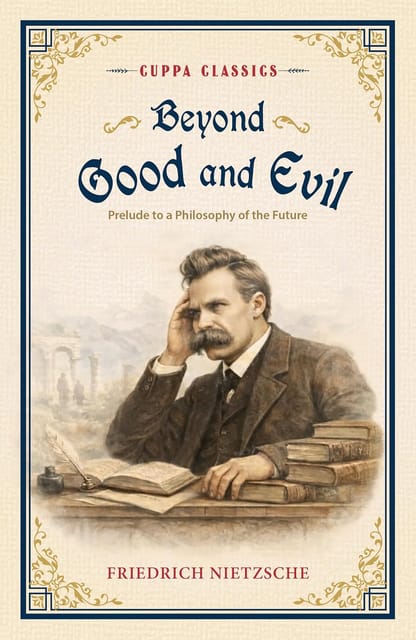
What would it mean to think for yourself truly, completely, without the guardrails of inherited belief? Friedrich Nietzsche's Beyond Good and Evil is one of philosophy's great invitations: to question everything you have been handed, from the nature of morality to the foundations of truth itself. Published in 1886, it remains one of the most electrifying and consequential books ever written.
Nietzsche writes not in dense academic argument but in aphorisms that are sharp, surprising, and sometimes maddening, and the experience of reading him is unlike that of any other philosopher. There are passages that will stop you cold and others you will need to sit with for days. But that, perhaps, is precisely the point. Beyond Good and Evil does not offer answers so much as the courage to ask better questions.
About the Author
Friedrich Nietzsche (1844 1900) was a German philosopher, cultural critic, and poet whose provocative ideas reshaped modern thought. Writing in the late nineteenth century, he challenged conventional morality, religion, and philosophy, advancing concepts such as the will to power, the bermensch, and the proclamation that God is dead. His most influential works include Thus Spoke Zarathustra (1883 1885), Beyond Good and Evil (1886), and On the Genealogy of Morality (1887). Marked by aphoristic style, passionate intensity, and radical critique, Nietzsche s writing continues to inspire and challenge readers across philosophy, literature, and the arts.





 +91 9818282497
(2).png)