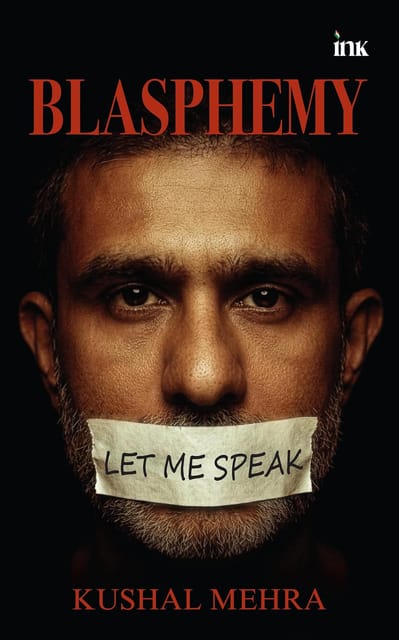
In today s India, two words can end careers, ignite mobs, and silence debate: hurt sentiments. But when did questioning become a crime? And how did a civilisation that once celebrated fearless philosophical debate become a society walking on eggshells? In Blasphemy: Let Me Speak, Kushal Mehra takes on one of the most contentious issues of our time the idea of blasphemy itself. Drawing from history, philosophy, law, and contemporary politics, Mehra argues that the very notion of blasphemy is fundamentally alien to India s indigenous intellectual traditions. For millennia, Indian thought thrived on argument, scepticism, and dissent from the audacious materialism of the Carvakas to the pluralism of the dharmic darsanas. Questioning was not punished; it was celebrated.
So how did a culture of open inquiry transform into a culture of outrage? Through a sharp and provocative analysis, this book traces the historical roots of blasphemy, its entry into India s legal framework under colonial rule, and its modern use as a tool to silence free speech. Examining landmark legal cases, religious sensitivities, and the growing climate of censorship, Mehra confronts a difficult question: Can a society truly progress if its ideas cannot be challenged?
Bold, unapologetic, and intellectually fearless, Blasphemy: Let Me Speak is not an attack on faith it is a defence of freedom. It is a call to reclaim India s ancient spirit of debate, where ideas were tested through dialogue, not suppressed through intimidation. Because a civilisation that stops questioning eventually stops thinking.
About the Author
Kushal Mehra is a former textile entrepreneur turned podcaster based in Mumbai. He is a dharmic sceptic and believes that scepticism is elevating. His principal interest lies in articulating Indian skepticism using Indian epistemological frameworks. Kushal is the host of the hugely popular Carvaka Podcast, where he discusses sports, philosophy, public policy, current affairs, history, economics, etc., with his guests. Kushal holds a master s degree in philosophy and draws heavily from it for his podcast, where he engages an eclectic list of guests on a wide range of topics. Today, when society is deeply polarised and discussions cantankerous, Kushal brings a breath of fresh air by conducting debates in a civilised manner. Through his podcast and writing, Kushal attempts to answer some of contemporary s most vexing topics in a freewheeling chat.


 +91 9818282497
(2).png)