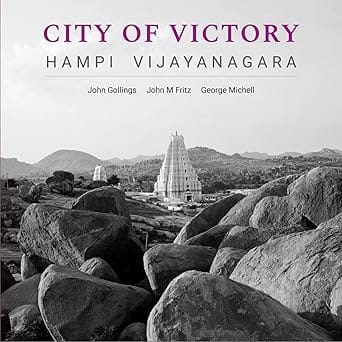
Vijayanagara was the capital of the greatest Hindu kingdom of Southern India between the 14th and 16th centuries. Contemporary Persian and Portuguese travellers testify to the power of its emperors and the splendour of their court, the grand scale of the city and its imposing architecture, and the wealth of its markets where diamonds could be purchased. The remains of the central part of Vijayanagara give the best possible idea of the magnificence of a medieval Hindu city. Covering a vast area of more than 30 square kilometres, the ruins are set in an astonishingly rugged landscape of granite boulders through which flows the Tungabhadra River. Since 1980 the authors have mapped Vijayanagara’s layout and documented its standing structures. As specialists they have authored a definitive text intended for general readers and travellers, as well as scholars and students. Award-winning photographer John Gollings has worked closely with Fritz and Michell. His superb black and white photographs capture the drama of Vijayanagara’s landscape as well as the architectural forms of its principal monuments and the details of their sculpted reliefs. Additional data is provided by descriptions of individual monuments, accompanied by photographs, site maps and building plans. In 1986, Hampi was declared a World Heritage Site by UNESCO, which included it on its list of antiquities of global significance. The city’s extraordinary religious and courtly ruins that include more than a thousand structures continue to draw pilgrims, artists, scholars and scientists from around the world.