‘It is perfectly possible to pervert the Constitution, without changing its form, by merely changing the form of the administration.’—B.R. Ambedkar
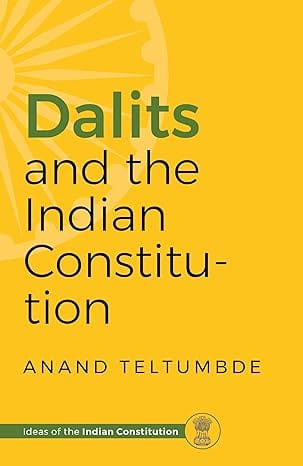
Dalits and the Indian Constitution asks a stark question: what has the Constitution actually done for the community most closely identified with its emancipatory promise—and where has it failed? In the lucid, argument-led cadence of this series, Anand Teltumbde moves from nationalist politics and the making of the Constitution to its most consequential provisions—abolition of untouchability; reservations in representation, education, and public employment; secularism and the everyday realities of impunity. He shows how constitutional ideals met entrenched social power, and why formal safeguards, without structural change, could not deliver substantive equality.
Refusing fatalism and nostalgia alike, Teltumbde insists that ‘constitutional morality’ must be cultivated through institutions that check arbitrary power and transform social habits, not merely recite pieties. Drawing on historical debate and contemporary evidence of discrimination, this compact monograph sets out first principles and practicable directions to turn rights into realities.
Clear-eyed, rigorous, and deeply committed to the Preamble’s promise, Dalits and the Indian Constitution is essential reading for citizens, students, and policymakers who want to recover the moral centre of India’s democratic project.
Anand Teltumbde is a leading public intellectual and is known for his critical insights on many a contemporary issue. A civil rights activist of long standing, he is currently General Secretary of the Committee for Protection of Democratic Rights (CPDR). He is also associated with the All India Forum for Rights to Education (AIFRTE), which is spearheading the movement for a common school system, as a member of its Presidium, and many other peoples’ movements. Some of his recent books are Dalits: Past, Present and Future (Routledge, 2016), Mahad: Making of the First Dalit Revolt (Aakar, 2016), Persistence of Caste (Zed Books, 2010), Khairlanji: A Strange and Bitter Crop (Navayana, 2008), Anti-Imperialism and Annihilation of Castes (Ramai, 2005), and Hindutva and Dalits: Perspectives for Understanding Communal Praxis, (Ed) (Samya, 2005). He is widely translated into most Indian languages.

‘It is perfectly possible to pervert the Constitution, without changing its form, by merely changing the form of the administration.’—B.R. Ambedkar
Dalits and the Indian Constitution asks a stark question: what has the Constitution actually done for the community most closely identified with its emancipatory promise—and where has it failed? In the lucid, argument-led cadence of this series, Anand Teltumbde moves from nationalist politics and the making of the Constitution to its most consequential provisions—abolition of untouchability; reservations in representation, education, and public employment; secularism and the everyday realities of impunity. He shows how constitutional ideals met entrenched social power, and why formal safeguards, without structural change, could not deliver substantive equality.
Refusing fatalism and nostalgia alike, Teltumbde insists that ‘constitutional morality’ must be cultivated through institutions that check arbitrary power and transform social habits, not merely recite pieties. Drawing on historical debate and contemporary evidence of discrimination, this compact monograph sets out first principles and practicable directions to turn rights into realities.
Clear-eyed, rigorous, and deeply committed to the Preamble’s promise, Dalits and the Indian Constitution is essential reading for citizens, students, and policymakers who want to recover the moral centre of India’s democratic project.
Anand Teltumbde is a leading public intellectual and is known for his critical insights on many a contemporary issue. A civil rights activist of long standing, he is currently General Secretary of the Committee for Protection of Democratic Rights (CPDR). He is also associated with the All India Forum for Rights to Education (AIFRTE), which is spearheading the movement for a common school system, as a member of its Presidium, and many other peoples’ movements. Some of his recent books are Dalits: Past, Present and Future (Routledge, 2016), Mahad: Making of the First Dalit Revolt (Aakar, 2016), Persistence of Caste (Zed Books, 2010), Khairlanji: A Strange and Bitter Crop (Navayana, 2008), Anti-Imperialism and Annihilation of Castes (Ramai, 2005), and Hindutva and Dalits: Perspectives for Understanding Communal Praxis, (Ed) (Samya, 2005). He is widely translated into most Indian languages.
Subscribe to get Email Updates!
Thanks for subscribing.
Your response has been recorded.

"We Believe In The Power of Books" Our mission is to make books accessible to everyone, and to cultivate a culture of reading and learning. We strive to provide a wide range of books, from classic literature, sci-fi and fantasy, to graphic novels, biographies and self-help books, so that everyone can find something to read.
Whether you’re looking for your next great read, a gift for someone special, or just browsing, Midland is here to make your book-buying experience easy and enjoyable.