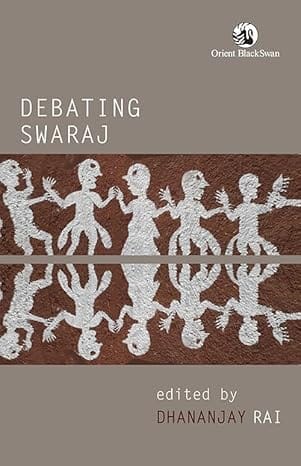
Debating Swaraj studies Gandhiji’s notion of swaraj as a ‘living concept’, and extends it to various aspects of the political community. The book tries to understand political community by juxtaposing the state/government with the increasingly blurred distinction between peoples’ participation and decision-making on behalf of the people. Studying Gandhi’s view of swaraj as a ‘living alternative’ for current times, Debating Swaraj offers a detailed interpretation in a manner that reclaims the centrality of the people in a nation-state. Gandhi believed that real swaraj is not majoritarianism; it is rule by the people for justice. Taking this as the point of departure, the authors, who hail from diverse fields in the social sciences and Gandhian Studies, construe swaraj as a shared responsibility for collective living. The authors study swaraj in the context of: the early dissenting tradition of the Radical Enlightenment; the significance of non-violence; the primacy of civil society over sovereignty; the dichotomy between the economic agent and the political citizen; understanding technology, science and experience in the context of spinning swaraj; Nayi Talim and self-sufficiency; and the Ambedkar–Gandhi debate concerning texts and traditions.
9789354428272Debating Swaraj studies Gandhiji’s notion of swaraj as a ‘living concept’, and extends it to various aspects of the political community. The book tries to understand political community by juxtaposing the state/government with the increasingly blurred distinction between peoples’ participation and decision-making on behalf of the people. Studying Gandhi’s view of swaraj as a ‘living alternative’ for current times, Debating Swaraj offers a detailed interpretation in a manner that reclaims the centrality of the people in a nation-state. Gandhi believed that real swaraj is not majoritarianism; it is rule by the people for justice. Taking this as the point of departure, the authors, who hail from diverse fields in the social sciences and Gandhian Studies, construe swaraj as a shared responsibility for collective living. The authors study swaraj in the context of: the early dissenting tradition of the Radical Enlightenment; the significance of non-violence; the primacy of civil society over sovereignty; the dichotomy between the economic agent and the political citizen; understanding technology, science and experience in the context of spinning swaraj; Nayi Talim and self-sufficiency; and the Ambedkar–Gandhi debate concerning texts and traditions.

Subscribe to get Email Updates!
Thanks for subscribing.
Your response has been recorded.

"We Believe In The Power of Books" Our mission is to make books accessible to everyone, and to cultivate a culture of reading and learning. We strive to provide a wide range of books, from classic literature, sci-fi and fantasy, to graphic novels, biographies and self-help books, so that everyone can find something to read.
Whether you’re looking for your next great read, a gift for someone special, or just browsing, Midland is here to make your book-buying experience easy and enjoyable.