Shop No.20, Aurobindo Palace Market, Hauz Khas, Near Church +91 9818282497 | 011 26867121 110016 New Delhi IN
Midland The Book Shop ™
Shop No.20, Aurobindo Palace Market, Hauz Khas, Near Church +91 9818282497 | 011 26867121 New Delhi, IN
+919871604786 https://www.midlandbookshop.com/s/607fe93d7eafcac1f2c73ea4/69591829db7aed90e0608dfb/without-tag-line-480x480.png" [email protected]
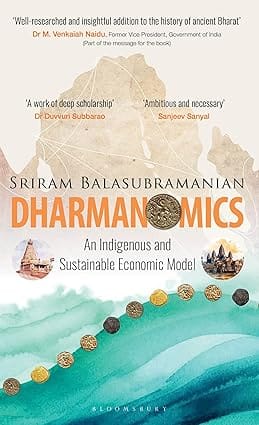
9789356409699 675c25453bac76002be89741 Dharmanomics An Indigenous And Sustainable Economic Model https://www.midlandbookshop.com/s/607fe93d7eafcac1f2c73ea4/675c25463bac76002be89749/81jb8cycbel-_sy425_.jpg

Did Rajaraja Chola, who built the world-renowned Brihadisvara temple in Tanjore, and Suryavarman II of Kambuja Desa (Cambodia), who built the world’s largest temple complex, Angkor Wat, erect these enduring marvels with a magic wand? Surely not. How did they nurture prosperity? What were the economic models that enabled them to leave the world awestruck? Sriram Balasubramanian’s sequel to the pathbreaking Kautilyanomics answers these questions by examining Common Era empires and kingdoms ranging from the Cholas, Pallavas, Pandyas and Vijayanagara to Southeast Asian kingdoms. Balasubramanian audaciously puts forward a novel, indigenous and sustainable framework called Dharmanomics—a function of Kautilyan Dharmic capitalism, of a Dharmic ecosystem driven by temples and Sreni (corporate guilds) Dharma—that spans thousands of years. It was put into practice much before the likes of Adam Smith and modern economic thinkers. It is a book for all ages—gutsy, thought­provoking and meticulously researched.


Book Description

Dharmanomics seeks to present a coherent and structured economic framework based on the idea of Dharma for at least 2500 years. The book argues that Dharma was the central interface for economic policy along with the presence of Kautilyan Dharmic capitalism, Dharmic ecosystem and the role of Srenis in economic policies. With both inscriptive and anectodal evidence, it tries to showcase the continuity of Bharatiya economic policy prescriptions based on the idea of Dharma for thousands of years much ahead of the likes of Adam Smith off the modern world.

About the Author

Sriram Balasubramanian is a well-known economist and bestselling author based at one of the leading international monetary institutions in the world. He has worked for several global organizations including the International Monetary Fund (IMF) in the past. His areas of expertise include global macroeconomics, socio-economic trends in emerging markets and conic Indic and dharmic culture in the context of economics. He has written for several international publications such as Bloomberg, Foreign Policy, The Wall Street Journal and Vox EU among others, as an independent columnist and has been an independent panelist on CNBC TV18. Besides authoring the pathbreaking Kautilyanomics for Modern Times, he has authored two other books, JAMBA: The Joint Family (shortlisted for the Third Annual IAAC Literary Festival organised by the Indo-American Arts Council) and The Wizards, which has been featured in varied publications, including The Hindu. He is an alumnus of Columbia University, New York

9789356409699
in stockINR 479
1 1
Dharmanomics An Indigenous And Sustainable Economic Model

Dharmanomics An Indigenous And Sustainable Economic Model

ISBN: 9789356409699
₹479
₹599   (20% OFF)


Details
  • ISBN: 9789356409699
  • Author: Sriram Balasubramanian
  • Publisher: Bloomsbury
  • Pages: 298
  • Format: Paperback
SHARE PRODUCT

Book Description

Did Rajaraja Chola, who built the world-renowned Brihadisvara temple in Tanjore, and Suryavarman II of Kambuja Desa (Cambodia), who built the world’s largest temple complex, Angkor Wat, erect these enduring marvels with a magic wand? Surely not. How did they nurture prosperity? What were the economic models that enabled them to leave the world awestruck? Sriram Balasubramanian’s sequel to the pathbreaking Kautilyanomics answers these questions by examining Common Era empires and kingdoms ranging from the Cholas, Pallavas, Pandyas and Vijayanagara to Southeast Asian kingdoms. Balasubramanian audaciously puts forward a novel, indigenous and sustainable framework called Dharmanomics—a function of Kautilyan Dharmic capitalism, of a Dharmic ecosystem driven by temples and Sreni (corporate guilds) Dharma—that spans thousands of years. It was put into practice much before the likes of Adam Smith and modern economic thinkers. It is a book for all ages—gutsy, thought­provoking and meticulously researched.


Book Description

Dharmanomics seeks to present a coherent and structured economic framework based on the idea of Dharma for at least 2500 years. The book argues that Dharma was the central interface for economic policy along with the presence of Kautilyan Dharmic capitalism, Dharmic ecosystem and the role of Srenis in economic policies. With both inscriptive and anectodal evidence, it tries to showcase the continuity of Bharatiya economic policy prescriptions based on the idea of Dharma for thousands of years much ahead of the likes of Adam Smith off the modern world.

About the Author

Sriram Balasubramanian is a well-known economist and bestselling author based at one of the leading international monetary institutions in the world. He has worked for several global organizations including the International Monetary Fund (IMF) in the past. His areas of expertise include global macroeconomics, socio-economic trends in emerging markets and conic Indic and dharmic culture in the context of economics. He has written for several international publications such as Bloomberg, Foreign Policy, The Wall Street Journal and Vox EU among others, as an independent columnist and has been an independent panelist on CNBC TV18. Besides authoring the pathbreaking Kautilyanomics for Modern Times, he has authored two other books, JAMBA: The Joint Family (shortlisted for the Third Annual IAAC Literary Festival organised by the Indo-American Arts Council) and The Wizards, which has been featured in varied publications, including The Hindu. He is an alumnus of Columbia University, New York

User reviews

  0/5