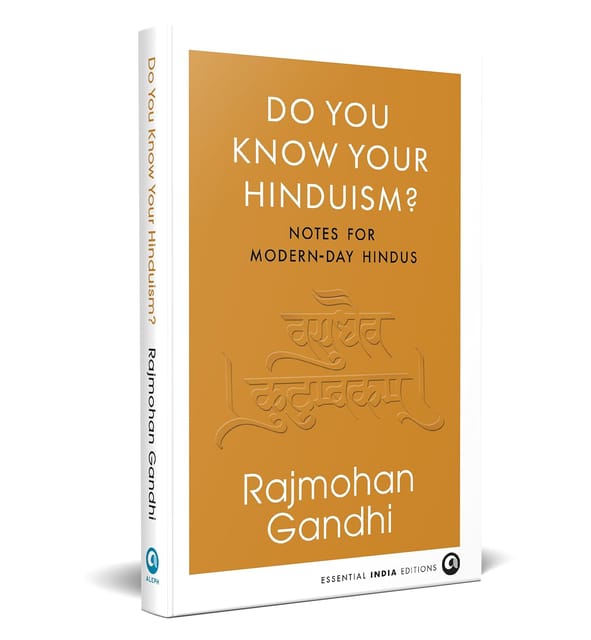
Hinduism is one of the world’s oldest living religions. Its beliefs, practices, iconography, and symbols permeate the lives of millions of Indians. Importantly, Hinduism, both as a religion and a constellation of beliefs, operates across multiple registers—from the deeply intimate arena of personal faith to expansive political claims.
In this thoughtful and illuminating book, Rajmohan Gandhi, one of India’s greatest living historians and public intellectuals, puts Hinduism under the microscope and sees it not as a monolith, but as an evolving civilizational entity. Drawing on history, philosophy, politics, and lived practice, he traces its multiple strands, explores how its ideas have been interpreted and reinterpreted over time, and reflects on the moral and social questions they raise.
Hinduism, Gandhi shows, has never spoken in a single voice. Its strength lies in debate, dissent, and ethical inquiry. At a time when the Hindu tradition is too often reduced to slogans or weaponized for narrow political ends, this book restores our belief in Hinduism’s intellectual richness and its remarkable capacity for self-criticism. Above all, it reinstates an enduring ethical vision, one that carries particular urgency in our present fractured age: Vasudhaiva Kutumbakam, the idea that the world is one family.
About the Author
Rajmohan Gandhi’s last two books are India after 1947: Reflections & Recollections and Modern South India: A History from the 17th Century. He has taught political science and history at the University of Illinois at Urbana Champaign and also at the Indian Institute of Technology, Gandhinagar, IIT-Bombay, and Michigan State University.





 +91 9818282497
(2).png)