Shop No.20, Aurobindo Palace Market, Hauz Khas, Near Church +91 9818282497 | 011 26867121 110016 New Delhi IN
Midland The Book Shop ™
Shop No.20, Aurobindo Palace Market, Hauz Khas, Near Church +91 9818282497 | 011 26867121 New Delhi, IN
+919871604786 https://www.midlandbookshop.com/s/607fe93d7eafcac1f2c73ea4/69591829db7aed90e0608dfb/without-tag-line-480x480.png" [email protected]
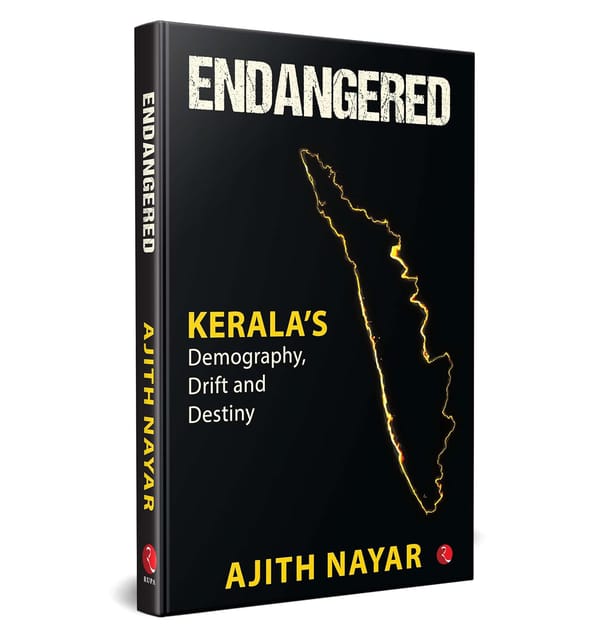
9789376460243 69f4a079023356496e38fbf8 Endangered Keralas Demography, Drift And Destiny https://www.midlandbookshop.com/s/607fe93d7eafcac1f2c73ea4/69f4a07a023356496e38fc00/71829vgne1l-_sl1500_.jpg
I commend this book to all who are invested in Kerala s continued advancement and its meaningful contribution to India s evolving story.

Shri C.P. Radhakrishnan
Vice President of India

Kerala is widely admired as a model of human development literate, politically aware, socially progressive and globally connected. But success carries its own risks. What happens when the very conditions that created progress begin to change?

In Endangered: Kerala s Demography, Drift and Destiny, entrepreneur and institution-builder Ajith Nayar examines the quiet structural shifts shaping Kerala s future. As demographic arithmetic tightens, the working-age population shrinks while social commitments expand without matching productivity.

Drawing parallels with ageing societies such as Japan, Italy, South Korea and Lebanon, the book argues that decline in advanced societies is rarely dramatic. It is gradual, orderly and often hidden beneath pride in past achievements.

At the heart of Endangered lies a troubling paradox: a society that produces capable citizens for the world, yet struggles to absorb them at home.

?? What You ll Discover Inside
?? Kerala s demographic turning point: How ageing, migration and a shrinking workforce could reshape the state s economic future.
?? Lessons from ageing societies: What Kerala can learn from countries like Japan, Italy and South Korea that faced similar structural transitions.
?? Institutions versus public debate: Why argument alone cannot replace institutional redesign and economic innovation.
? The paradox of the Kerala model: A society that produces global talent but struggles to create opportunity at home.
?? How successful societies drift: Why decline in advanced societies is often slow, orderly and difficult to recognise.
?? The

9789376460243
in stockINR 476
1 1
Endangered Keralas Demography, Drift And Destiny

Endangered Keralas Demography, Drift And Destiny

ISBN: 9789376460243
₹476
₹595   (20% OFF)


Details
  • ISBN: 9789376460243
  • Author: Ajith Nayar
  • Publisher: Rupa
  • Pages: 272
  • Format: Hardback
SHARE PRODUCT

Book Description

I commend this book to all who are invested in Kerala s continued advancement and its meaningful contribution to India s evolving story.

Shri C.P. Radhakrishnan
Vice President of India

Kerala is widely admired as a model of human development literate, politically aware, socially progressive and globally connected. But success carries its own risks. What happens when the very conditions that created progress begin to change?

In Endangered: Kerala s Demography, Drift and Destiny, entrepreneur and institution-builder Ajith Nayar examines the quiet structural shifts shaping Kerala s future. As demographic arithmetic tightens, the working-age population shrinks while social commitments expand without matching productivity.

Drawing parallels with ageing societies such as Japan, Italy, South Korea and Lebanon, the book argues that decline in advanced societies is rarely dramatic. It is gradual, orderly and often hidden beneath pride in past achievements.

At the heart of Endangered lies a troubling paradox: a society that produces capable citizens for the world, yet struggles to absorb them at home.

?? What You ll Discover Inside
?? Kerala s demographic turning point: How ageing, migration and a shrinking workforce could reshape the state s economic future.
?? Lessons from ageing societies: What Kerala can learn from countries like Japan, Italy and South Korea that faced similar structural transitions.
?? Institutions versus public debate: Why argument alone cannot replace institutional redesign and economic innovation.
? The paradox of the Kerala model: A society that produces global talent but struggles to create opportunity at home.
?? How successful societies drift: Why decline in advanced societies is often slow, orderly and difficult to recognise.
?? The

User reviews

  0/5