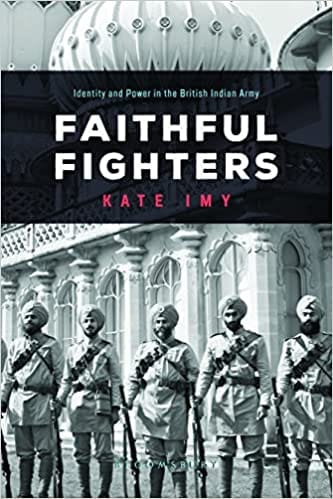
During the first four decades of the twentieth century, the British Indian Army projected an illusion of racial and religious inclusivity. The army recruited diverse soldiers, called ‘Martial Races,’ including British Christians, Punjabi Sikhs, Hindu Rajputs, Muslims from northwestern India and Afghanistan, and ‘Gurkhas’ from Nepal. They incorporated some of these soldiers' traditions into the army to keep them disciplined and loyal. This included allowing Muslims to fast during Ramzan, mandating purification ceremonies for Nepali Hindus, and enabling Sikhs to carry religious swords. Military officials hoped that bringing these practices into the army would undermine criticisms of imperial military service within communities where anti-colonial sentiment grew stronger. Instead, as Faithful Fighters shows, it created unintended dialogues between soldiers and civilians while hardening differences between and among communities. Though the illusion of soldiers' detachment from anticolonialism crumbled during World War II, Kate Imy argues that the army militarized racial and religious difference, creating lasting legacies for the violent partition and independence of India, and the endemic violence of the postcolonial world. Faithful Fightersreceived the NACBS Stansky prize and the Pacific Coast Branch Book Award of the American Historical Association.
Review
"Faithful Fighters is an important addition to the growing body of scholarly work on the colonial Indian army, and the project of global militarization that underwrote modern European imperialism. Through new materials and archives, Imy's major contribution is to the overlooked imbrication of anti-colonialism and military culture in these contexts" - Leela Gandhi, John Hawkes Professor of Humanities and English, Brown University "This astute cultural history moves beyond the binary of loyalty and rebellion to track the beliefs and practices at stake in war and peace. No other book captures so well the psychic life of war’s devotional cultures, whether on the colonial battlefield or off." - Antoinette Burton, University of Illinois, Urbana-Champaign
About the Author
Kate Imyis a screenwriter and tenured historian of culture and war in British colonial Asia. She is a recipient of a Fulbright fellowship, two CLS awards (Hindi and Urdu), a fellowship from the Institute of Historical Research (London), and a Bernadotte E. Schmitt grant from the American Historical Association. In 2021, she was the Lee Kong Chian NUS-Stanford Fellow on Southeast Asia to complete her second book, entitled Losing Hearts and Minds: Race, War, and Empire in Singapore and Malaya, 1915-1960.



 +91 9818282497
(2).png)