A timely account of India s federal crisis from the Emergency and misuse of Article 356 to GST, the abrogation of Article 370, delimita tion anxieties and aggressive centralization of power after 2014.
At a time when the Indian Constitution is under sustained strain, this incisive monograph turns to one of its most foundational ideas: federalism. Although the word itself finds no place in the text of the Constitution, it has shaped the Republic s attempt to reconcile unity with an extraordinary diversity of language, region, culture and political aspiration.
Drawing on the Constituent Assembly debates shaped by earlier constitutional arrangements as well as the upheaval of Partition Avinash Kumar traces how India s distinctive federal arrangement, a Union of States with a marked tilt to the Centre, came into being, and follows its evolution through the subsequent history of the Republic. He shows how this structure has been continually tested: through linguistic reorganization, the use and misuse of Article 356, the deepening of decentralization through the 73rd and 74th Amendments, and the persistent contestations between Central authority and State autonomy, nowhere sharper than in fiscal federalism.
The book argues that the post-2014 phase of aggressive centralization, driven by Hindutva ideology, is a challenge to the plural and negotiated character of the Indian Union, and raises urgent questions about the future of federal democracy in India.
Historical in scope and contemporary in its concerns, this monograph invites readers to rethink federalism not as a technical arrangement, but as a living constitutional principle one that remains essential to sustaining India s democratic and inclusive order.

Dr Avinash Kumar is a historian and civil society leader whose work bridges academic scholarship with policy and advocacy. He holds a PhD and MPhil in Modern History from Jawaharlal Nehru University and was a Charles Wallace Fellow at SOAS, University of London. Over two decades, he has held senior leadership roles at Amnesty International, WaterAid and Oxfam. He is currently a Distinguished Fellow at the Centre for Equity Studies and works with Focus on the Global South, an activist think tank.
A timely account of India s federal crisis from the Emergency and misuse of Article 356 to GST, the abrogation of Article 370, delimita tion anxieties and aggressive centralization of power after 2014.
At a time when the Indian Constitution is under sustained strain, this incisive monograph turns to one of its most foundational ideas: federalism. Although the word itself finds no place in the text of the Constitution, it has shaped the Republic s attempt to reconcile unity with an extraordinary diversity of language, region, culture and political aspiration.
Drawing on the Constituent Assembly debates shaped by earlier constitutional arrangements as well as the upheaval of Partition Avinash Kumar traces how India s distinctive federal arrangement, a Union of States with a marked tilt to the Centre, came into being, and follows its evolution through the subsequent history of the Republic. He shows how this structure has been continually tested: through linguistic reorganization, the use and misuse of Article 356, the deepening of decentralization through the 73rd and 74th Amendments, and the persistent contestations between Central authority and State autonomy, nowhere sharper than in fiscal federalism.
The book argues that the post-2014 phase of aggressive centralization, driven by Hindutva ideology, is a challenge to the plural and negotiated character of the Indian Union, and raises urgent questions about the future of federal democracy in India.
Historical in scope and contemporary in its concerns, this monograph invites readers to rethink federalism not as a technical arrangement, but as a living constitutional principle one that remains essential to sustaining India s democratic and inclusive order.
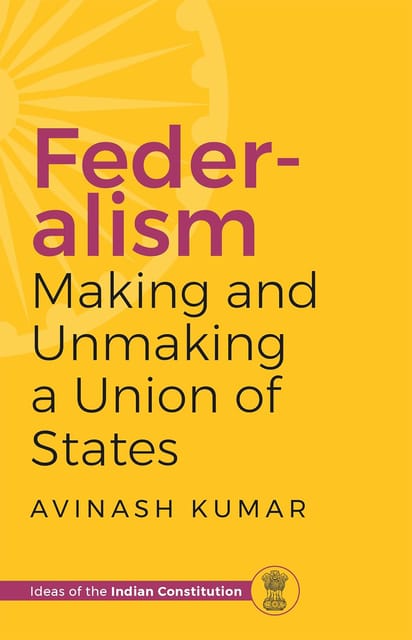
Dr Avinash Kumar is a historian and civil society leader whose work bridges academic scholarship with policy and advocacy. He holds a PhD and MPhil in Modern History from Jawaharlal Nehru University and was a Charles Wallace Fellow at SOAS, University of London. Over two decades, he has held senior leadership roles at Amnesty International, WaterAid and Oxfam. He is currently a Distinguished Fellow at the Centre for Equity Studies and works with Focus on the Global South, an activist think tank.
Subscribe to get Email Updates!
Thanks for subscribing.
Your response has been recorded.

"We Believe In The Power of Books" Our mission is to make books accessible to everyone, and to cultivate a culture of reading and learning. We strive to provide a wide range of books, from classic literature, sci-fi and fantasy, to graphic novels, biographies and self-help books, so that everyone can find something to read.
Whether you’re looking for your next great read, a gift for someone special, or just browsing, Midland is here to make your book-buying experience easy and enjoyable.