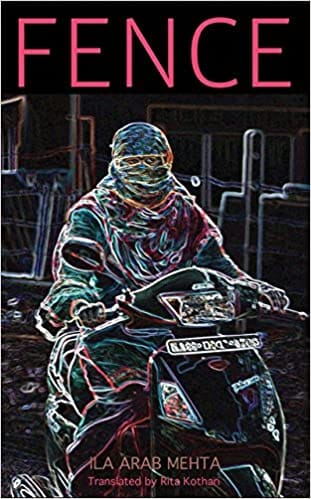
Fateema opened her diary and began writing: “Jihad as mentioned by the Prophet is a war against injustice and oppression. Islam means peace and surrender. Islam does not recommend killing innocent people. The Prophet released hundreds of slaves from bondage and sent themback to their native land.”There was a lot more she could write. She would one day. Not for others, but to her own people she would explain the meaning of the word ‘Islam’. For a bright young woman like Fateema Lokhandwala, the idea that one day she might own her own house is a daring dream. Her father has spent his life, slaving away selling scrap metal so that his children might ‘jump the fence of poverty and illiteracy’. Fateema dreams not only of owning her own house, but of higher education, a better job, a wider world. Her brother, Kareem, is persuaded down a very different path – to join the jihad, to become a holy warrior.Ila Arab Mehta’s moving and sharply observed novel follows one woman’s struggle to find her way in a world torn by communal violence, to reconcile her conflicting loyalties to her family and friends, to find a place that she can ultimately call ‘home’, a place where fences –between communities, between people – are no longer necessary. A novel on a controversial and topical theme by one of Gujarat’s best known writers The story of a young Muslim woman caught in the world of identity politics
About the Author
ILA ARAB MEHTA is one of Gujarat’s most renowned authors and the recipient of several prestigious awards. She has many short story collections and novels to her credit. She is most noted for her Batris Putlini Vedano and Paanch Pagla Prithvi Par, examples of feminist thinking in the literary sphere of Gujarat. RITA KOTHARI is an author, translator and academic associated with the Humanities department at the Indian Institute of Technology, Gandhinagar. She is author of The Burden of Refuge, a study of the Sindhi experience of Partition, and has translated several books from Gujarati to English.











 +91 9818282497
(2).png)