Shop No.20, Aurobindo Palace Market, Hauz Khas, Near Church +91 9818282497 | 011 26867121 110016 New Delhi IN
Midland The Book Shop ™
Shop No.20, Aurobindo Palace Market, Hauz Khas, Near Church +91 9818282497 | 011 26867121 New Delhi, IN
+919871604786 https://www.midlandbookshop.com/s/607fe93d7eafcac1f2c73ea4/69591829db7aed90e0608dfb/without-tag-line-480x480.png" [email protected]
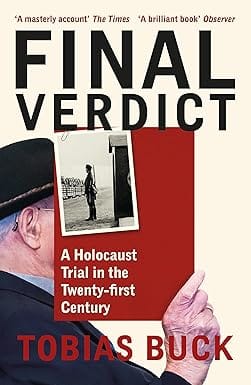
9781399604277 67f51db2196160eba2138c3c Final Verdict A Holocaust Trial In The Twenty-first Century https://www.midlandbookshop.com/s/607fe93d7eafcac1f2c73ea4/67f51db3196160eba2138c44/81lxyyjftrl-_sy385_.jpg

On 17 October 2019, in Hamburg's imposing criminal justice building, a trial laden with extraordinary historical weight begins to unfold. Bruno Dey stands accused of being involved in a crime committed over seven decades ago: the murder of at least 5,230 inmates at Stutthof, the Nazi concentration camp in present-day Poland. Only seventeen at the time, Dey was a member of the SS unit responsible for administering the camp. Though he concedes to his role as a guard, he adamantly denies responsibility for the killings.

Dey's trial comes at a poignant moment. As the last members of the war generation - both victims and perpetrators - disappear, so does their first-hand knowledge of the Holocaust's horrors. Beyond its immediate legal implications, the trial stirs profound questions that resonate not only within the realms of German history, politics and collective memory but also within the author's own family. Tobias Buck revisits the silence that surrounds his family's experience during the Nazi period - and his German grandfather's role and responsibility.

Through the lens of this riveting courtroom drama, Final Verdict explores the trial's broader significance, both on a political and personal level, and invites us to grapple with the question of whether it is right to prosecute Bruno Dey more than seven decades after he stood guard at Stutthof, and, perhaps more importantly, what we might have done in his place.


Book Description

The story of an extraordinary trial - one of the last trials of a Nazi war criminal - and its wider implications for history, memory and justice, and the aut
9781399604277
in stockINR 559
1 1
Final Verdict A Holocaust Trial In The Twenty-first Century

Final Verdict A Holocaust Trial In The Twenty-first Century

ISBN: 9781399604277
₹559
₹699   (20% OFF)


Details
  • ISBN: 9781399604277
  • Author: Tobias Buck
  • Publisher: W&n
  • Pages: 320
  • Format: Paperback
SHARE PRODUCT

Book Description

On 17 October 2019, in Hamburg's imposing criminal justice building, a trial laden with extraordinary historical weight begins to unfold. Bruno Dey stands accused of being involved in a crime committed over seven decades ago: the murder of at least 5,230 inmates at Stutthof, the Nazi concentration camp in present-day Poland. Only seventeen at the time, Dey was a member of the SS unit responsible for administering the camp. Though he concedes to his role as a guard, he adamantly denies responsibility for the killings.

Dey's trial comes at a poignant moment. As the last members of the war generation - both victims and perpetrators - disappear, so does their first-hand knowledge of the Holocaust's horrors. Beyond its immediate legal implications, the trial stirs profound questions that resonate not only within the realms of German history, politics and collective memory but also within the author's own family. Tobias Buck revisits the silence that surrounds his family's experience during the Nazi period - and his German grandfather's role and responsibility.

Through the lens of this riveting courtroom drama, Final Verdict explores the trial's broader significance, both on a political and personal level, and invites us to grapple with the question of whether it is right to prosecute Bruno Dey more than seven decades after he stood guard at Stutthof, and, perhaps more importantly, what we might have done in his place.


Book Description

The story of an extraordinary trial - one of the last trials of a Nazi war criminal - and its wider implications for history, memory and justice, and the aut

User reviews

  0/5