Shop No.20, Aurobindo Palace Market, Hauz Khas, Near Church +91 9818282497 | 011 26867121 110016 New Delhi IN
Midland The Book Shop ™
Shop No.20, Aurobindo Palace Market, Hauz Khas, Near Church +91 9818282497 | 011 26867121 New Delhi, IN
+919871604786 https://www.midlandbookshop.com/s/607fe93d7eafcac1f2c73ea4/69591829db7aed90e0608dfb/without-tag-line-480x480.png" [email protected]
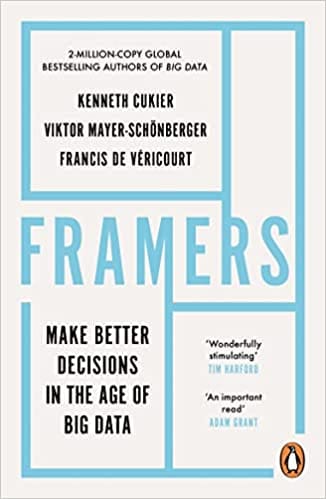
9780753555002 6288d5347dc3af839adeb84b Framers Make Better Decisions In The Age Of Big Data https://www.midlandbookshop.com/s/607fe93d7eafcac1f2c73ea4/6288d5357dc3af839adeb88c/41-djpdqlml-_sx324_bo1-204-203-200_.jpg

Financial Times and Economist Book of the Year
'Wonderfully stimulating... will teach you to see around corners' - TIM HARFORD
'A paean to cognitive agility and the elasticity of the imagination' - ECOMOMIST
'Captivating... will transform the way you think' MARISSA KING, PROFESSOR AT YALE SCHOOL OF MANAGEMENT


The power of mental models to make better decisions


We're often told that humans make bad decisions and that more data is better. But this is backwards: people are good at decisions precisely because we use mental models and can envision new realities outside of data. Great outcomes don't depend so much on the final moment of choosing but on generating better alternatives to choose between. That's framing. It's a cognitive muscle we can strengthen to improve our lives, work and future -- to meet this historical moment. Framers shows how.


Review

A tightly written prescription for smart thinking... A bold call to reinject pluralism and progressive human values into a decision-making process dominated by algorithms or gut instinct - Financial Times -- 2021 Summer Books List

A simply wonderful reimagining of human ingenuity. It will teach you to see around corners - Tim Harford, bestselling author of How To Make The World Add Up

Reveals how you can recognize the lenses that you're applying ... an important read -- a steady hand for our turbulent times - Adam Grant, #1 New York Times bestselling author of THINK AGAIN

A fascinating look at what makes humans special and how people can improve the way they think to stay ahead of the machines - Mustafa Suleyman, Co-founder of DeepMind, Vice-President of Google

A paean to cognitive agility and the elasticity of the imagination - The Economist

Packed with big ideas, great stories, values and verve that make it a delight to read. It will certainly change how you think-and might just change the world too - Annie Duke, best-selling author of THINKING IN BETS and former poker champion

A great book filled with fresh perspectives to help us out during the rise of AI so we can usher in the Age of Humanity - will.i.am, musician and entrepreneur

A captivating read... Framers will transform the way you think - Marissa King, Professor at Yale School of Management

Brilliantly shows that mental models are at the heart of creativity, critical thinking and innovation, and how we can get better at it to solve our toughest business and social challenges - Aaron Levie, CEO of Box

Provides insight into how we can all nurture more of a beginner's mind and manifest breakthrough ideas for building a better future - Marc Benioff, chairman and CEO, Salesforce

An appealing pop-science guide to creativity [and] an astute analysis of problem-solving - Kirkus Reviews

Humans today live a much easier, more comfortable, and more pleasant existence than ever before, but we also face our greatest existential challenges as a species, and in order to survive we will need not only cooperation, but a new and diverse set of cognitive frames ... [this book] teaches us how to better frame things for ourselves as individuals - Porchlight BOOK TO WATCH

About the Author

Kenneth Cukier is a Senior Editor at The Economist, and host of its weekly tech podcast. He is also an associate fellow at Saïd Business School at the University of Oxford, researching artificial intelligence. His TED Talk on AI and society has over 2 million views. Kenn was a foreign correspondent for two decades in Europe, Asia and America and a research fellow at Harvard's Kennedy School of Government. He serves on the board of Chatham House and is a member of the Council on Foreign Relations.

Viktor Mayer-Schönberger is Professor of Internet Governance and Regulation at the Oxford Internet Institute at Oxford University. He is also a faculty affiliate of the Belfer Center of Science and International Affairs at Harvard University. Viktor and his work have been featured in (among others) the New York Times, the Wall Street Journal, the Financial Times, The EconomistNatureScienceBBC and Wired Magazine. He is also on the boards of foundations, think tanks and organizations focused on studying the information economy, and advises governments, businesses and NGOs on new economy and information society issues.

Francis de Véricourt is Professor of Management Science at the European School of Management and Technology (ESMT) in Berlin. His current research explores how machine learning affects the way individuals frame their decisions and give rise to incentive problems. He has lived and worked in France, USA, Germany and Singapore. He has given talks at Yale University, Wharton School of Business, London Business School, Cambridge University, Tsinghua University, Singapore National University and many others, and has been the recipient of multiple teaching awards.

9780753555002
out of stock INR 479
1 1
Framers Make Better Decisions In The Age Of Big Data

Framers Make Better Decisions In The Age Of Big Data

ISBN: 9780753555002
₹479
₹599   (20% OFF)


Back In Stock Shortly - Fill The Book Request Form

Details
  • ISBN: 9780753555002
  • Author: Kenneth Cukier Viktor Mayer
  • Publisher: Penguin
  • Pages: 272
  • Format: Paperback
SHARE PRODUCT

Book Description

Financial Times and Economist Book of the Year
'Wonderfully stimulating... will teach you to see around corners' - TIM HARFORD
'A paean to cognitive agility and the elasticity of the imagination' - ECOMOMIST
'Captivating... will transform the way you think' MARISSA KING, PROFESSOR AT YALE SCHOOL OF MANAGEMENT


The power of mental models to make better decisions


We're often told that humans make bad decisions and that more data is better. But this is backwards: people are good at decisions precisely because we use mental models and can envision new realities outside of data. Great outcomes don't depend so much on the final moment of choosing but on generating better alternatives to choose between. That's framing. It's a cognitive muscle we can strengthen to improve our lives, work and future -- to meet this historical moment. Framers shows how.


Review

A tightly written prescription for smart thinking... A bold call to reinject pluralism and progressive human values into a decision-making process dominated by algorithms or gut instinct - Financial Times -- 2021 Summer Books List

A simply wonderful reimagining of human ingenuity. It will teach you to see around corners - Tim Harford, bestselling author of How To Make The World Add Up

Reveals how you can recognize the lenses that you're applying ... an important read -- a steady hand for our turbulent times - Adam Grant, #1 New York Times bestselling author of THINK AGAIN

A fascinating look at what makes humans special and how people can improve the way they think to stay ahead of the machines - Mustafa Suleyman, Co-founder of DeepMind, Vice-President of Google

A paean to cognitive agility and the elasticity of the imagination - The Economist

Packed with big ideas, great stories, values and verve that make it a delight to read. It will certainly change how you think-and might just change the world too - Annie Duke, best-selling author of THINKING IN BETS and former poker champion

A great book filled with fresh perspectives to help us out during the rise of AI so we can usher in the Age of Humanity - will.i.am, musician and entrepreneur

A captivating read... Framers will transform the way you think - Marissa King, Professor at Yale School of Management

Brilliantly shows that mental models are at the heart of creativity, critical thinking and innovation, and how we can get better at it to solve our toughest business and social challenges - Aaron Levie, CEO of Box

Provides insight into how we can all nurture more of a beginner's mind and manifest breakthrough ideas for building a better future - Marc Benioff, chairman and CEO, Salesforce

An appealing pop-science guide to creativity [and] an astute analysis of problem-solving - Kirkus Reviews

Humans today live a much easier, more comfortable, and more pleasant existence than ever before, but we also face our greatest existential challenges as a species, and in order to survive we will need not only cooperation, but a new and diverse set of cognitive frames ... [this book] teaches us how to better frame things for ourselves as individuals - Porchlight BOOK TO WATCH

About the Author

Kenneth Cukier is a Senior Editor at The Economist, and host of its weekly tech podcast. He is also an associate fellow at Saïd Business School at the University of Oxford, researching artificial intelligence. His TED Talk on AI and society has over 2 million views. Kenn was a foreign correspondent for two decades in Europe, Asia and America and a research fellow at Harvard's Kennedy School of Government. He serves on the board of Chatham House and is a member of the Council on Foreign Relations.

Viktor Mayer-Schönberger is Professor of Internet Governance and Regulation at the Oxford Internet Institute at Oxford University. He is also a faculty affiliate of the Belfer Center of Science and International Affairs at Harvard University. Viktor and his work have been featured in (among others) the New York Times, the Wall Street Journal, the Financial Times, The EconomistNatureScienceBBC and Wired Magazine. He is also on the boards of foundations, think tanks and organizations focused on studying the information economy, and advises governments, businesses and NGOs on new economy and information society issues.

Francis de Véricourt is Professor of Management Science at the European School of Management and Technology (ESMT) in Berlin. His current research explores how machine learning affects the way individuals frame their decisions and give rise to incentive problems. He has lived and worked in France, USA, Germany and Singapore. He has given talks at Yale University, Wharton School of Business, London Business School, Cambridge University, Tsinghua University, Singapore National University and many others, and has been the recipient of multiple teaching awards.

User reviews

  0/5