Shop No.20, Aurobindo Palace Market, Hauz Khas, Near Church +91 9818282497 | 011 26867121 110016 New Delhi IN
Midland The Book Shop ™
Shop No.20, Aurobindo Palace Market, Hauz Khas, Near Church +91 9818282497 | 011 26867121 New Delhi, IN
+919871604786 https://www.midlandbookshop.com/s/607fe93d7eafcac1f2c73ea4/69591829db7aed90e0608dfb/without-tag-line-480x480.png" [email protected]
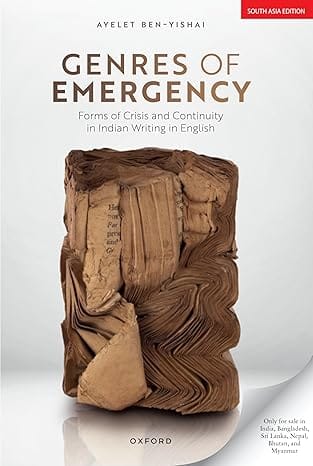
9780198929970 68c01451121c1e47ecbae9b4 Genres Of Emergency Forms Of Crisis And Continuity In Indian Writing In English https://www.midlandbookshop.com/s/607fe93d7eafcac1f2c73ea4/68c01453121c1e47ecbae9bc/710shvg-ggl-_sy466_.jpg
Genres of Emergency offers literary genre as a way to understand and negotiate the varied states of emergency and crisis that have become a fixture of our contemporary world. Building on a critical study of the literature written during and about the State of Emergency declared by Prime Minister Indira Gandhi in India (1975 - 1977), the study establishes emergency and its genres as an important interpretative site: an exceptionally violent episode marked as a one-off crisis, which also functions as a locus for an ongoing renegotiation of a modern polity and culture. Reading a wide-ranging archive of English-language texts - from prison memoir to popular magazine, from high-brow literary fiction to boilerplate thriller, from the unrelentingly realistic to the mythically allegorical - Genres of Emergency traces the tension between crisis and continuity that these genres mediate. In addressing this tension, the authors of Emergency fiction take seriously the genres in which they write and use them to mobilize literary conventions as political interventions. More specifically, these novels use the conventions of realism, epic, allegory, and the thriller to reach back in time and across cultures and languages, invoking past iterations of these genres and histories and anticipating those to come. Combining literary criticism with cultural history, Genres of Emergency thus has implications for the study of literary genre, for the historical events that these genres recount, and for understanding the politics of literary form.
 

About the Author

Ayelet Ben-Yishai, Chair, Department of English Language and Literature, University of Haifa


Ayelet Ben-Yishai is Chair of the English Department at the University of Haifa. A comparatist by training (PhD, UC Berkeley) she also has a degree in law (LLB, Hebrew U). Her work informs and is informed by the intersections of law and literature and by postcolonial and narrative theory, in relation to the modern British novel, world literature, and the Indian novel. She has been an Honorary Fellow at the IRH at UW-Madison, a Fellow at the Cornell Society of Fellows, and a recipient of two ISF grants for her research on the postcolonial novel in India.

9780198929970
in stockINR 1346
1 1
Genres Of Emergency Forms Of Crisis And Continuity In Indian Writing In English

Genres Of Emergency Forms Of Crisis And Continuity In Indian Writing In English

ISBN: 9780198929970
₹1,346
₹1,495   (10% OFF)


Details
  • ISBN: 9780198929970
  • Author: Ayelet Ben-yishai
  • Publisher: Oxford
  • Pages: 528
  • Format: Hardback
SHARE PRODUCT

Book Description

Genres of Emergency offers literary genre as a way to understand and negotiate the varied states of emergency and crisis that have become a fixture of our contemporary world. Building on a critical study of the literature written during and about the State of Emergency declared by Prime Minister Indira Gandhi in India (1975 - 1977), the study establishes emergency and its genres as an important interpretative site: an exceptionally violent episode marked as a one-off crisis, which also functions as a locus for an ongoing renegotiation of a modern polity and culture. Reading a wide-ranging archive of English-language texts - from prison memoir to popular magazine, from high-brow literary fiction to boilerplate thriller, from the unrelentingly realistic to the mythically allegorical - Genres of Emergency traces the tension between crisis and continuity that these genres mediate. In addressing this tension, the authors of Emergency fiction take seriously the genres in which they write and use them to mobilize literary conventions as political interventions. More specifically, these novels use the conventions of realism, epic, allegory, and the thriller to reach back in time and across cultures and languages, invoking past iterations of these genres and histories and anticipating those to come. Combining literary criticism with cultural history, Genres of Emergency thus has implications for the study of literary genre, for the historical events that these genres recount, and for understanding the politics of literary form.
 

About the Author

Ayelet Ben-Yishai, Chair, Department of English Language and Literature, University of Haifa


Ayelet Ben-Yishai is Chair of the English Department at the University of Haifa. A comparatist by training (PhD, UC Berkeley) she also has a degree in law (LLB, Hebrew U). Her work informs and is informed by the intersections of law and literature and by postcolonial and narrative theory, in relation to the modern British novel, world literature, and the Indian novel. She has been an Honorary Fellow at the IRH at UW-Madison, a Fellow at the Cornell Society of Fellows, and a recipient of two ISF grants for her research on the postcolonial novel in India.
User reviews

  0/5