The prevailing narrative and knowledge ecosystem, and most certainly newspaper and TV reporting, on the Himalaya is dominated by colonial and postcolonial situational exposés that are informed by the Centres’ perspectives. Hence, many writings suffer from the imperial gaze, on the one hand, and a recency bias on the other, while approaching the peripheries as either exotic destinations or military hotspots with red lines drawn on snow-capped peaks, crests and arid plateaus.
The Himalaya has always been a contested region and has gained even more political salience after the 1962 Sino-Indian border war and, more so in recent times, with the rise of India and China.
What gets lost are the voices and lives of the people who actually call the Himalaya home.
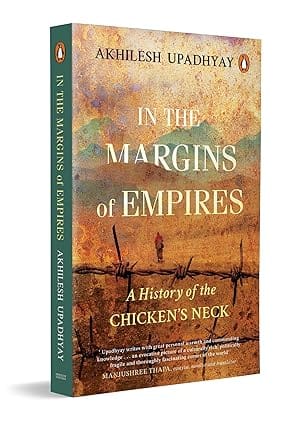
In the Margins of Empires documents the lives and livelihoods of the borderlands in the Eastern Himalayan region-Nepal, Bhutan, pre-1950 Tibet and the post-1950 Tibetan Autonomous Region, Sikkim, Darjeeling, and India’s North-East. The book is an effort to look at the region as an organic whole, from within the region, connected through centuries of transboundary traders, travellers, scholars, monastic exchanges, but also by missionaries, monks, and moles.
As border infrastructure across the Himalaya in TAR and India is being constantly upgraded, and as India and China play a cat-and-mouse game, smaller states and communities in the borderlands, including the Chicken’s Neck, find themselves caught up in the larger geopolitical arena. With fresh analysis, great insight, and on-the-ground reportage, Akhilesh Upadhyay tells the story of the region and of communities that remain wedged between giants, yet are also shaping their own futures in the shadow of the Himalaya’s peaks.
What does the future of the region look like? Perhaps it will follow the mystique of the Himalaya.

Akhilesh Upadhyay is the policy lead for the Center for Geostrategic Affairs at the Institute for Integrated Development Studies (IIDS), a Kathmandu-based think tank.
A Fulbright scholar, he received his MA from New York University, where he spent more of his time in South Asian and Hispanic working-class neighbourhoods in Brooklyn and Queens in his attempt to find pan-South Asian voices. Akhilesh developed deep empathy for people unlike his own and documented stories, big and small, of ordinary immigrants for New York newspapers. In Nepal, he led the Kathmandu Post as editor-in-chief from 2008 to 2018. His multicultural New York experiences echo in his stories of borderlands.
Born in Bhadrapur, a town bordering the Indian Chicken’s Neck, Akhilesh’s childhood and adolescence traversed Kathmandu and Darjeeling. He is a
The prevailing narrative and knowledge ecosystem, and most certainly newspaper and TV reporting, on the Himalaya is dominated by colonial and postcolonial situational exposés that are informed by the Centres’ perspectives. Hence, many writings suffer from the imperial gaze, on the one hand, and a recency bias on the other, while approaching the peripheries as either exotic destinations or military hotspots with red lines drawn on snow-capped peaks, crests and arid plateaus.
The Himalaya has always been a contested region and has gained even more political salience after the 1962 Sino-Indian border war and, more so in recent times, with the rise of India and China.
What gets lost are the voices and lives of the people who actually call the Himalaya home.
In the Margins of Empires documents the lives and livelihoods of the borderlands in the Eastern Himalayan region-Nepal, Bhutan, pre-1950 Tibet and the post-1950 Tibetan Autonomous Region, Sikkim, Darjeeling, and India’s North-East. The book is an effort to look at the region as an organic whole, from within the region, connected through centuries of transboundary traders, travellers, scholars, monastic exchanges, but also by missionaries, monks, and moles.
As border infrastructure across the Himalaya in TAR and India is being constantly upgraded, and as India and China play a cat-and-mouse game, smaller states and communities in the borderlands, including the Chicken’s Neck, find themselves caught up in the larger geopolitical arena. With fresh analysis, great insight, and on-the-ground reportage, Akhilesh Upadhyay tells the story of the region and of communities that remain wedged between giants, yet are also shaping their own futures in the shadow of the Himalaya’s peaks.
What does the future of the region look like? Perhaps it will follow the mystique of the Himalaya.
Akhilesh Upadhyay is the policy lead for the Center for Geostrategic Affairs at the Institute for Integrated Development Studies (IIDS), a Kathmandu-based think tank.
A Fulbright scholar, he received his MA from New York University, where he spent more of his time in South Asian and Hispanic working-class neighbourhoods in Brooklyn and Queens in his attempt to find pan-South Asian voices. Akhilesh developed deep empathy for people unlike his own and documented stories, big and small, of ordinary immigrants for New York newspapers. In Nepal, he led the Kathmandu Post as editor-in-chief from 2008 to 2018. His multicultural New York experiences echo in his stories of borderlands.
Born in Bhadrapur, a town bordering the Indian Chicken’s Neck, Akhilesh’s childhood and adolescence traversed Kathmandu and Darjeeling. He is a
Subscribe to get Email Updates!
Thanks for subscribing.
Your response has been recorded.

"We Believe In The Power of Books" Our mission is to make books accessible to everyone, and to cultivate a culture of reading and learning. We strive to provide a wide range of books, from classic literature, sci-fi and fantasy, to graphic novels, biographies and self-help books, so that everyone can find something to read.
Whether you’re looking for your next great read, a gift for someone special, or just browsing, Midland is here to make your book-buying experience easy and enjoyable.