
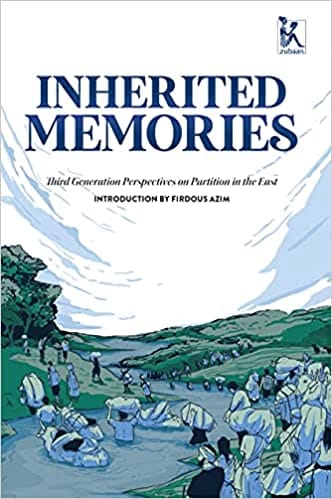
Inherited Memories: Third Generation Perspectives On Partition In The East
ISBN:
9789385932250
₹516
₹645
(20% OFF)
Details
- ISBN: 9789385932250
- Author: Firdous Azim
- Publisher: Zubaan Books
- Pages: 200
- Format: Hardback
Book Description
In 2015 the Goethe-Institute in Kolkata (India) and Dhaka (Bangladesh) began a collaborative project entitled ‘Inherited Memories’. The project began with a key question that grew out of discussions on memory and history: was there such a thing as a ‘culture of remembrance’ in India, something akin to the Erinnerungskultur in Germany? The question was asked specifically in relation to the Partition of India in 1947: why was it that such a major historical event found little reflection in public memory? Soon, other questions came up: why was it, for example, that whatever memorializing existed was largely in the West, in Punjab, and the Bengal region, which had lived through two partitions and a war that could be likened to a third partition, was given such little attention? At the time these discussions began, many, perhaps most, of the survivors of the 1947 Partition were no longer alive and their memories therefore lost to us. It is often said that memory jumps a generation, so a decision was taken to talk across borders with the children and grandchildren of Partition refugees in the Bengal region, to look at how memory is passed down, what is retained or lost, and how it is owned and shared by subsequent generations. This book, which comprises interviews from both Bangladesh and West Bengal, is the result of these discussions. Guided by a committed and engaged group of writers from both countries, the book explores the memories people carried with them, the things they never forgot, the yearnings that did not go away, the journeys that remained unfinished, and those that were accomplished. Through these, it examines how history simultaneously looks so similar and so different from either side.
About the Author
Firdous Azim is Professor of English at BRAC University in Dhaka, Bangladesh.
Related Books
₹1,199
₹1,499
(20% OFF)

₹959
₹1,199
(20% OFF)



 +91 9818282497
(2).png)