Review
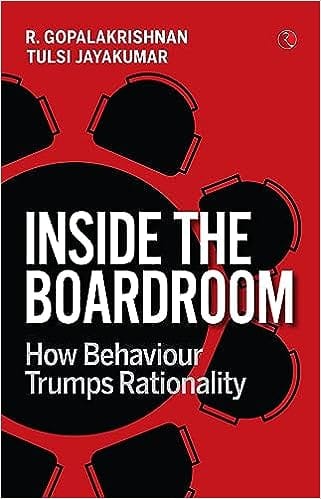
‘This book would be valuable for anyone looking to improve their understanding of corporate governance in the modern business world.’
—N. Chandrasekaran, VP, Chairman, Tata Group
‘Inside the Boardroom, in the inimitable and no-holds-barred style of the authors, has rightly placed behavioural aspects centre stage and established that absent this aspect, boards would continue to perform suboptimally.’
—TM . Damodaran, Chairperson, Excellence Enablers, and former chairman, SEBI, UTI and IDBI
‘An independent director must always remember that the adjective “independent” is valuable. Board members and practitioners will find this book worth their while.’
—Omkar Goswami, Founder and chairman, CERG Advisory Private Limited
‘With exciting anecdotes and insightful learnings, this is a book every leader across the spectrum from business corporations to public life—current or aspiring—should read.’
—Sanjiv Mehta, Former CEO and managing director, Hindustan Unilever Limited
About the Author
This is
R. Gopalakrishnan’s eighteenth book. Gopal has played every type of board role on more than twenty-five company boards over thirty-five years. In India and abroad. As CEO, executive director, non-executive director, board chairman, and as independent director. His board experience is rich and has provided him a ring-side view of corporate governance, as it has evolved since its nascent stirrings in the 1990s to its more exhaustive (and exhausting) avatar, now.
Governance tends to be obsessed with the technicalities and rules. Gopal believes governance— corporate or public—has as much to do with human behaviour as it is about rules and procedures; it is about neeti (conduct) and neeyat (intent), as much as about niyam (rules)!
Gopal welcomes reader feedback at
[email protected]Dr Tulsi Jayakumar is Professor of Finance & Economics and Executive Director, Centre for Family Business & Entrepreneurship at Bhavan’s S.P. Jain Institute of Management & Research (SPJIMR), Mumbai. Her research interests span various areas with special focus on behavioural economics and family business. She works extensively with family businesses and is a member of several industrial bodies. She is a thought leader and writes extensively in the media. She believes that most decisions are driven by either the sub-conscious or the unconscious, and a knowledge of the same can make all the difference in the boardroom, and indeed guide any management decision. This is her third book.








 +91 9818282497
(2).png)