Shop No.20, Aurobindo Palace Market, Hauz Khas, Near Church +91 9818282497 | 011 26867121 110016 New Delhi IN
Midland The Book Shop ™
Shop No.20, Aurobindo Palace Market, Hauz Khas, Near Church +91 9818282497 | 011 26867121 New Delhi, IN
+919871604786 https://www.midlandbookshop.com/s/607fe93d7eafcac1f2c73ea4/69591829db7aed90e0608dfb/without-tag-line-480x480.png" [email protected]
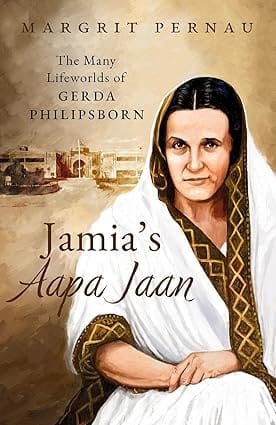
9789354478031 66b211e2e7e2c50024d508eb Jamias Aapa Jaan The Many Lifeworlds Of Gerda Philipsborn https://www.midlandbookshop.com/s/607fe93d7eafcac1f2c73ea4/66b211e5e7e2c50024d50901/71no0tmcw8l-_sy425_.jpg

Very little is known about the life of Gerda Philipsborn, one of the early contributors to the Jamia Millia Islamia. In this unusual biography, historian Margrit Pernau pieces together Gerda’s remarkable story, from the port city of Kiel in Germany to Okhla in Delhi in the 1940s.

A strange mix of political philosophies—from anarchism to a chauvinistic nationalism—thrived in Germany when Gerda was born to an affluent Jewish family in 1895. The growing suspicion of modernity led many Germans to look to the East for salvation, and new ideas about early education also began to take root. Into this German Reich arrived three students from India— Zakir Husain, Abid Husain and Muhammad Mujeeb. They had been deeply influenced by the Non-Cooperation and Khilafat Movements back home, and by Gandhi’s call for national education. Jamia, which had recently been founded, strove to realize that new vision. And the three students were determined to dedicate themselves to this university with the benefit of their education in Germany.

Gerda would befriend these young men, and by 1932, find herself in Delhi’s Karol Bagh, where Jamia was then located, working with the smallest children. She continued her discussions with Zakir Husain here, contributing to ideas which made their way into Gandhi’s Basic Education programme, expounded by Husain at Wardha in 1937. She would also write regularly for Jamia’s children’s magazine, Payam-e Ta’lim, and soon become a beloved Aapa Jaan, elder sister, to the entire Jamia biradari.

An absorbing biography, Jamia’s Aapa Jaan is also an important history. Through the life of one individual, it connects the history of the Weimar Republic with the national movement in India. It tells the story of not only the deep friendship between Gerda and Jamia’s founders, but also of the emergence of a radically new educational institution in India.

 

About the Author

Dr Margrit Pernau is Senior Researcher at the Center for the History of Emotions at the Max Planck Institute for Human Development and Extraordinary Professor at the Freie Universität Berlin. She is the author of several books, including Ashraf Into Middle Classes: Muslims in Nineteenth-Century Delhi and Emotions and Modernity in Colonial India.
 
9789354478031
out of stock INR 639
1 1
Jamias Aapa Jaan The Many Lifeworlds Of Gerda Philipsborn

Jamias Aapa Jaan The Many Lifeworlds Of Gerda Philipsborn

ISBN: 9789354478031
₹639
₹799   (20% OFF)


Back In Stock Shortly - Fill The Book Request Form

Details
  • ISBN: 9789354478031
  • Author: Margrit Pernau
  • Publisher: Speaking Tiger
  • Pages: 392
  • Format: Hardback
SHARE PRODUCT

Book Description

Very little is known about the life of Gerda Philipsborn, one of the early contributors to the Jamia Millia Islamia. In this unusual biography, historian Margrit Pernau pieces together Gerda’s remarkable story, from the port city of Kiel in Germany to Okhla in Delhi in the 1940s.

A strange mix of political philosophies—from anarchism to a chauvinistic nationalism—thrived in Germany when Gerda was born to an affluent Jewish family in 1895. The growing suspicion of modernity led many Germans to look to the East for salvation, and new ideas about early education also began to take root. Into this German Reich arrived three students from India— Zakir Husain, Abid Husain and Muhammad Mujeeb. They had been deeply influenced by the Non-Cooperation and Khilafat Movements back home, and by Gandhi’s call for national education. Jamia, which had recently been founded, strove to realize that new vision. And the three students were determined to dedicate themselves to this university with the benefit of their education in Germany.

Gerda would befriend these young men, and by 1932, find herself in Delhi’s Karol Bagh, where Jamia was then located, working with the smallest children. She continued her discussions with Zakir Husain here, contributing to ideas which made their way into Gandhi’s Basic Education programme, expounded by Husain at Wardha in 1937. She would also write regularly for Jamia’s children’s magazine, Payam-e Ta’lim, and soon become a beloved Aapa Jaan, elder sister, to the entire Jamia biradari.

An absorbing biography, Jamia’s Aapa Jaan is also an important history. Through the life of one individual, it connects the history of the Weimar Republic with the national movement in India. It tells the story of not only the deep friendship between Gerda and Jamia’s founders, but also of the emergence of a radically new educational institution in India.
 

About the Author

Dr Margrit Pernau is Senior Researcher at the Center for the History of Emotions at the Max Planck Institute for Human Development and Extraordinary Professor at the Freie Universität Berlin. She is the author of several books, including Ashraf Into Middle Classes: Muslims in Nineteenth-Century Delhi and Emotions and Modernity in Colonial India.
 

User reviews

  0/5