A sweeping historical novel about Adivasi displacement, colonial exploitation, and the making of Assam’s tea empire. A brilliant translation of an award-winning bestseller by one of the biggest names in Assamese writing.
In the lush yet brutal landscape of colonial Assam unfolds a haunting chapter of history—the rise of the tea plantations and the human cost that sustained them. Drawn by promises of Assam desh—a land of dignity, abundance, and fair wages— Adivasi families from central India are packed onto overcrowded steamers and sent upriver, where hunger, disease and death shadow every step of their journey. Among them is Durgi, a young woman whose resilience endures even in despair. With her, she carries a small bundle of marigold seeds, a fragile memory of the land of red earth she has left behind. At her side is her husband, Dosaru, the rebellious archer, bound to her by love and the shared hope of building a life of their own. However, what awaits them at Atharighat Tea Estate is no promised land. Labourers are stripped, disinfected, confined to barracks, and driven into relentless work, while sickness, fear, and muted defiance simmer beneath the ordered rows of tea bushes..
Durgi’s life takes a complicated turn over the years—an intimate affair with Fraser, the white manager of the tea garden, results in the birth of three mixedrace children. Their unequal relationship exposes another unspoken truth about plantation life—the generations of similar children, many of whom, abandoned by their white ancestors, still live in Assam’s tea gardens today.
Rooted in lived experience, Moonlight Saga gives voice to the forgotten men and women who built the empire’s ‘green gold’, bearing witness to their suffering, endurance, and fragile hopes—as the British Raj begins to crumble in the shadows of India’s Independence struggle.
Originally written in Assamese, the novel is a celebrated and much-discussed work in Assam, recognised for its unflinching portrayal of plantation life and its place in the region’s collective memory. Its translation into English opens up an essential regional story to a wider readership, ensuring that the sacrifices and struggles embedded in the tea gardens are not forgotten.

Arupa Kalita Patangia is one of the best-known Assamese writers of today. She has five novels, twelve short story collections, several novellas, books for children, and translations into Assamese to her credit. In 2014, she received the prestigious Sahitya Akademi Award for her book of short stories, Mariam Austin Othoba Hira Barua.
Ranjita Biswas is an independent journalist, fiction and travel writer, and translator. Ranjita has won the KATHA translation awards several times. She has also to her credit eight published works in translation.
A sweeping historical novel about Adivasi displacement, colonial exploitation, and the making of Assam’s tea empire. A brilliant translation of an award-winning bestseller by one of the biggest names in Assamese writing.
In the lush yet brutal landscape of colonial Assam unfolds a haunting chapter of history—the rise of the tea plantations and the human cost that sustained them. Drawn by promises of Assam desh—a land of dignity, abundance, and fair wages— Adivasi families from central India are packed onto overcrowded steamers and sent upriver, where hunger, disease and death shadow every step of their journey. Among them is Durgi, a young woman whose resilience endures even in despair. With her, she carries a small bundle of marigold seeds, a fragile memory of the land of red earth she has left behind. At her side is her husband, Dosaru, the rebellious archer, bound to her by love and the shared hope of building a life of their own. However, what awaits them at Atharighat Tea Estate is no promised land. Labourers are stripped, disinfected, confined to barracks, and driven into relentless work, while sickness, fear, and muted defiance simmer beneath the ordered rows of tea bushes..
Durgi’s life takes a complicated turn over the years—an intimate affair with Fraser, the white manager of the tea garden, results in the birth of three mixedrace children. Their unequal relationship exposes another unspoken truth about plantation life—the generations of similar children, many of whom, abandoned by their white ancestors, still live in Assam’s tea gardens today.
Rooted in lived experience, Moonlight Saga gives voice to the forgotten men and women who built the empire’s ‘green gold’, bearing witness to their suffering, endurance, and fragile hopes—as the British Raj begins to crumble in the shadows of India’s Independence struggle.
Originally written in Assamese, the novel is a celebrated and much-discussed work in Assam, recognised for its unflinching portrayal of plantation life and its place in the region’s collective memory. Its translation into English opens up an essential regional story to a wider readership, ensuring that the sacrifices and struggles embedded in the tea gardens are not forgotten.
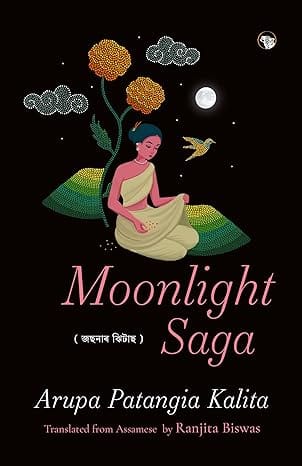
Arupa Kalita Patangia is one of the best-known Assamese writers of today. She has five novels, twelve short story collections, several novellas, books for children, and translations into Assamese to her credit. In 2014, she received the prestigious Sahitya Akademi Award for her book of short stories, Mariam Austin Othoba Hira Barua.
Ranjita Biswas is an independent journalist, fiction and travel writer, and translator. Ranjita has won the KATHA translation awards several times. She has also to her credit eight published works in translation.
Subscribe to get Email Updates!
Thanks for subscribing.
Your response has been recorded.

"We Believe In The Power of Books" Our mission is to make books accessible to everyone, and to cultivate a culture of reading and learning. We strive to provide a wide range of books, from classic literature, sci-fi and fantasy, to graphic novels, biographies and self-help books, so that everyone can find something to read.
Whether you’re looking for your next great read, a gift for someone special, or just browsing, Midland is here to make your book-buying experience easy and enjoyable.