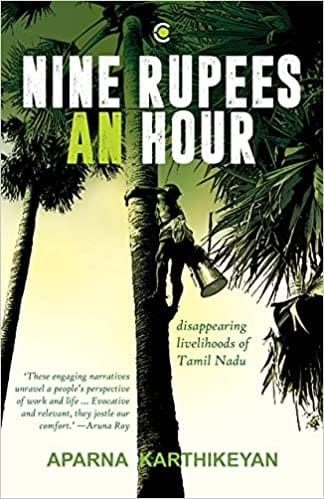
In a rapidly urbanising nation, rural India is being erased from the popular imagination. Through her five years of travelling across the villages of Tamil Nadu, Aparna Karthikeyan gets to know men and women who do exceptional—yet perfectly ordinary—things to earn a living. She documents, through ten of these stories, the transformations, aspirations and disruptions of the last twenty-five years. The people she meets force these questions of her, and her reader: What is the culture we seek to preserve? What will become of food security without farmers? How can ‘development’ exclude 833 million people?
Including interviews with journalist P. Sainath, musician T.M. Krishna and writer Bama, among others, Nine Rupees an Hour is a critical portrayal of the drastic and systematic erosion of traditional livelihoods.
These engaging narratives unravel a peoples’ perspective of work and life, where creative beauty and human dignity merge to matter, even if their worth in market-obsessed economics is merely nine rupees an hour. Evocative and relevant, they jostle our comfort. Statistics and economic analyses of wages and work, juxtaposed with the lives people lead, help us understand the situation on the ground. A book all of us must read’
—Aruna Roy, Social activist
Sustainable livelihoods provide the foundation for a happy life. We owe a deep sense of gratitude to Aparna Karthikeyan for bringing out this useful book based on real-life examples. I hope the book will be widely read.
—M.S. Swaminathan, plant geneticist and agricultural scientist
Aparna Karthikeyan’s Nine Rupees an Hour is a rich complex tapestry of honest stories from the interiors of Tamil Nadu, one of the top performing States in the country. – The Hindu
Nine Rupees An Hour contains the vestiges of dwindling livelihoods and dying cultures, narrated in the voices of the rural people engaged in these age-old artisanal occupations. – First post
Nine Rupees an Hour by Aparna Karthikeyan is an excellent and searing account of some of Tamil Nadu’s traditional but vanishing occupations. – The Telegraph
This is an important book. It provides an insight into agrarian distress, skewed policies, farmers’ changing lifestyles and disappearing livelihoods. – The Asian Age
Aparna Karthikeyan is a storyteller and an independent journalist. She volunteers for the People’s Archive of Rural India (PARI) and has written for them, as well as for The Hindu, The Caravan, The Wire, Scroll.in and other publications on culture, books and livelihoods. She has authored books for children, and published short fiction.
She lives in Mumbai with her husband, daughter and dogs.

In a rapidly urbanising nation, rural India is being erased from the popular imagination. Through her five years of travelling across the villages of Tamil Nadu, Aparna Karthikeyan gets to know men and women who do exceptional—yet perfectly ordinary—things to earn a living. She documents, through ten of these stories, the transformations, aspirations and disruptions of the last twenty-five years. The people she meets force these questions of her, and her reader: What is the culture we seek to preserve? What will become of food security without farmers? How can ‘development’ exclude 833 million people?
Including interviews with journalist P. Sainath, musician T.M. Krishna and writer Bama, among others, Nine Rupees an Hour is a critical portrayal of the drastic and systematic erosion of traditional livelihoods.
These engaging narratives unravel a peoples’ perspective of work and life, where creative beauty and human dignity merge to matter, even if their worth in market-obsessed economics is merely nine rupees an hour. Evocative and relevant, they jostle our comfort. Statistics and economic analyses of wages and work, juxtaposed with the lives people lead, help us understand the situation on the ground. A book all of us must read’
—Aruna Roy, Social activist
Sustainable livelihoods provide the foundation for a happy life. We owe a deep sense of gratitude to Aparna Karthikeyan for bringing out this useful book based on real-life examples. I hope the book will be widely read.
—M.S. Swaminathan, plant geneticist and agricultural scientist
Aparna Karthikeyan’s Nine Rupees an Hour is a rich complex tapestry of honest stories from the interiors of Tamil Nadu, one of the top performing States in the country. – The Hindu
Nine Rupees An Hour contains the vestiges of dwindling livelihoods and dying cultures, narrated in the voices of the rural people engaged in these age-old artisanal occupations. – First post
Nine Rupees an Hour by Aparna Karthikeyan is an excellent and searing account of some of Tamil Nadu’s traditional but vanishing occupations. – The Telegraph
This is an important book. It provides an insight into agrarian distress, skewed policies, farmers’ changing lifestyles and disappearing livelihoods. – The Asian Age
Aparna Karthikeyan is a storyteller and an independent journalist. She volunteers for the People’s Archive of Rural India (PARI) and has written for them, as well as for The Hindu, The Caravan, The Wire, Scroll.in and other publications on culture, books and livelihoods. She has authored books for children, and published short fiction.
She lives in Mumbai with her husband, daughter and dogs.
Subscribe to get Email Updates!
Thanks for subscribing.
Your response has been recorded.

"We Believe In The Power of Books" Our mission is to make books accessible to everyone, and to cultivate a culture of reading and learning. We strive to provide a wide range of books, from classic literature, sci-fi and fantasy, to graphic novels, biographies and self-help books, so that everyone can find something to read.
Whether you’re looking for your next great read, a gift for someone special, or just browsing, Midland is here to make your book-buying experience easy and enjoyable.