
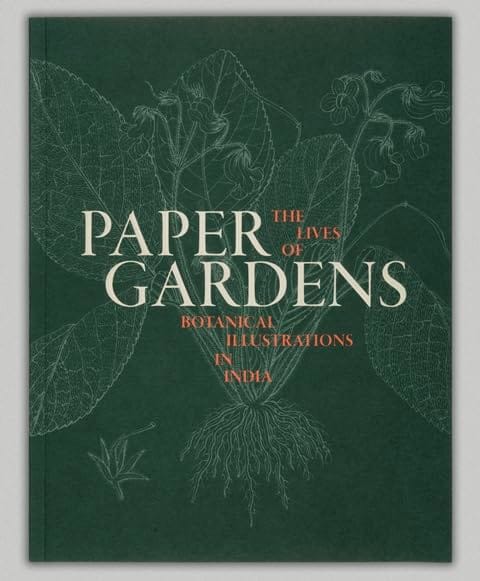
Paper Gardens The Lives Of Botanical Illustrations In India
ISBN:
9788195757688
₹2,000
₹2,500
(20% OFF)
Details
- ISBN: 9788195757688
- Author: Holly Shaffer
- Publisher: Map Books
- Pages: 168
- Format: Paperback
Book Description
Between the 17th and 20th centuries, the Indian subcontinent became a major site of botanical survey under colonial rule. British botanists set out to collect, classify, and circulate plant specimens in service of economic, scientific, and political aims. Central to this enterprise were thousands of botanical drawings produced by skilled and often uncredited Indian artists, which would go on to shape modern botany. Paper Gardens brings together hundreds of these illustrations, tracing encounters between plants, artists, and institutions, and reanimating the networks of labour and imagination that have built our understanding of the natural world. Featuring essays by art historian Dr Holly Shaffer, botanist Dr Henry J Noltie, and writer Sumana Roy, the book explores botanical drawings as living documents as portraits of relationships between artist and patron, empire and subject, human and non-human life.
About the Author
Holly Shaffer is an Associate Professor in the History of Art and Architecture Department at Brown University. She specialises in eighteenth and nineteenth-century South Asian and British art, and their intersections through empire. Her first book, Grafted Arts: Art Making and Taking in the Struggle for Western India, 1760 1910 (2022), won an American Institute of Indian Studies Edward C Dimock prize and an Historians of British Art book award. Currently, she is co curating an exhibition, Painters, Ports, and Profits: Artists and the East India Company, 1750 1850, on view at the Yale Center for British Art in Spring 2026; it will be accompanied by a catalogue published by Yale University Press. She is also working on a book on food, art, and the cultivation of taste in northern India in the nineteenth century.
Henry J Noltie is a botanist, curator, and historian. Having worked at the Royal Botanic Garden Edinburgh since 1986, he has had extraordinary access to the botanical illustrations held across major British institutions. He has meticulously identified, catalogued, and reordered long forgotten or dispersed collections of drawings, manuscripts, and ephemera, inviting renewed scholarly and public attention to the visual culture of colonial science, particularly the sophisticated work of Indian artists employed by British botanists. In recontextualising these archives, Noltie moves beyond botany and into art history. His work recovers the names and contributions of artists, recognising individual styles, critiques anonymisation of their labour, and re-reads botanical illustration archives as a rich site for critical inquiry in how archives are formed.
Sumana Roy is the author of two works of non fiction, How I Became a Tree (2017) and Provincials (2024); Plant Thinkers of Twentieth Century Bengal (2024), a work of literary criticism; Missing: A Novel (2018); My Mother s Lover and Other Stories (2019); and two collections of poems, Out of Syllabus (2019) and VIP: Very Important Plant (2022).
Related Books


₹1,359
₹1,699
(20% OFF)
₹2,506
₹3,133
(20% OFF)
₹2,960
₹3,700
(20% OFF)

 +91 9818282497
(2).png)