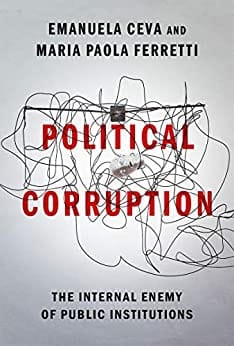
This timely, wonderful book illuminates the many faces of political corruption, from the 'bad apple' to the dysfunctional institution, through the unified framework of a public ethics of office. Emanuela Ceva and Maria Paola Ferretti's incisive philosophical analysis of political corruption as a deficit of office accountability reconciles the phenomenon's individual and institutional dimensions. The authors elucidate the deontic wrong of political corruption in terms of an 'interactive injustice,' which consists of officeholders' violation of their duty of office accountability, and identify the practice of answerability as the key to fostering an organizational culture of anticorruption.
Political Corruption's deeply significant contribution to political theory and public ethics is needed now more than ever. -
Candice Delmas, Associate Professor of Philosophy and Political Science, Northeastern UniversityPolitical Corruption: The Internal Enemy of Public Institutions offers an original account of political corruption which aims to understand how political corruption works and what is wrong with it. Restoring office accountability serves as a key focus which can help reorient anti-corruption efforts. This impressive work is essential reading for theorists interested in understanding why political corruption is problematic and how we might aim to combat it. -
Gillian Brock, Professor of Philosophy, University of Auckland, New ZealandIn this highly original study of political corruption, Ceva and Ferretti ask us to reflect on the wrong of corruption by looking beyond both individualist and structural accounts of institutional responsibility. Their analysis of corruption as an unaccountable use of the power conferred by holding public office is a crucial inter-disciplinary intervention. The book is essential reading for both an adequate diagnosis of the phenomenon, and identifying appropriate responses to it. -
Lea Ypi, Professor of Political Theory, London School of Economics --This text refers to the
hardcover edition.
Emanuela Ceva is Professor of Political Theory at the University of Geneva. She has held fellowships at the universities of Oxford, Hitotsubashi (Tokyo), St Andrews, Montréal, Hamburg, Harvard, and KU Leuven. In 2018, she was awarded a Fulbright Research Scholarship in Philosophy. She works primarily on the normative theory of institutions with a focus on conflict and justice, democracy, and corruption. She is the author of
Interactive Justice (Routledge, 2016), co-author of
Is Whistleblowing a Duty? (Polity, 2018), and has published articles in such journals as
The Journal of Political Philosophy,
Social Philosophy & Policy,
Politics, Philosophy & Economics, and
Philosophy Compass.
Maria Paola Ferretti is Professor ad interim of Political Theory and Philosophy and a member of the Normative Orders Research Center at the Goethe University of Frankfurt am Main. Her research interests include contemporary liberalism, democratic participation, and the ethics of public policy. She is the author of
The Public Perspective: Public Justification and the Ethics of Belief (Rowman and Littlefield). --This text refers to the
hardcover edition.







 +91 9818282497
(2).png)