Shop No.20, Aurobindo Palace Market, Hauz Khas, Near Church +91 9818282497 | 011 26867121 110016 New Delhi IN
Midland The Book Shop ™
Shop No.20, Aurobindo Palace Market, Hauz Khas, Near Church +91 9818282497 | 011 26867121 New Delhi, IN
+919871604786 https://www.midlandbookshop.com/s/607fe93d7eafcac1f2c73ea4/69591829db7aed90e0608dfb/without-tag-line-480x480.png" [email protected]
9789389931266 64b67e4f549e22284b4a9a9e Politics https://www.midlandbookshop.com/s/607fe93d7eafcac1f2c73ea4/64b67e50549e22284b4a9b09/71zqdrq3azl-_sy425_.jpg
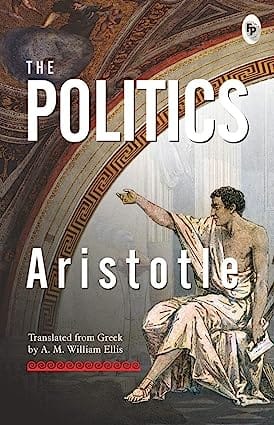
As indicated by Aristotle, the polis, or Greek city-state, is the most elevated type of political affiliation. Simply by being a resident of a polis can an individual completely seek after an existence of , which is the ultimate objective of human life. Since one can just accomplish this objective through political affiliation, Aristotle reasons that "man is a political creature." As well as shielding private property and censuring free enterprise, Aristotle famously views the foundation of subjection as important to the activities of society. Assessing and reprimanding different constitutions and established hypotheses, Aristotle presumes that no current city or hypothesis is great. He recognizes urban communities with their constitutions and arranges six various types of urban communities, three great and three awful. The three great sorts are politeia, or an established government; nobility; and authority.


About the Author

Aristotle was a Greek rationalist and polymath during the Classical time frame in Ancient Greece. Educated by Plato, was the organizer of the Lyceum, the Peripatetic school of reasoning, and the Aristotelian practice. His compositions cover numerous subjects including material science, science, zoology, transcendentalism, rationale, morals, feel verse, theater, music, way of talking, brain research, phonetics, financial matters, legislative issues, meteorology, topography, and government. Aristotle gave an intricate combination of the different methods of reasoning existing preceding him. Most importantly, from his lessons, the West acquired its scholarly vocabulary, just as issues and strategies for request. Accordingly, his way of thinking has applied an exceptional effect on pretty much every type of information in the West and it keeps on being a subject of contemporary philosophical conversation.

9789389931266
out of stock INR 183
1 1
Politics

Politics

ISBN: 9789389931266
₹183
₹229   (20% OFF)


Back In Stock Shortly - Fill The Book Request Form

Details
  • ISBN: 9789389931266
  • Author: Aristotle
  • Publisher: Finger Print Classic
  • Pages: 276
  • Format: Paperback
SHARE PRODUCT

Book Description

As indicated by Aristotle, the polis, or Greek city-state, is the most elevated type of political affiliation. Simply by being a resident of a polis can an individual completely seek after an existence of , which is the ultimate objective of human life. Since one can just accomplish this objective through political affiliation, Aristotle reasons that "man is a political creature." As well as shielding private property and censuring free enterprise, Aristotle famously views the foundation of subjection as important to the activities of society. Assessing and reprimanding different constitutions and established hypotheses, Aristotle presumes that no current city or hypothesis is great. He recognizes urban communities with their constitutions and arranges six various types of urban communities, three great and three awful. The three great sorts are politeia, or an established government; nobility; and authority.


About the Author

Aristotle was a Greek rationalist and polymath during the Classical time frame in Ancient Greece. Educated by Plato, was the organizer of the Lyceum, the Peripatetic school of reasoning, and the Aristotelian practice. His compositions cover numerous subjects including material science, science, zoology, transcendentalism, rationale, morals, feel verse, theater, music, way of talking, brain research, phonetics, financial matters, legislative issues, meteorology, topography, and government. Aristotle gave an intricate combination of the different methods of reasoning existing preceding him. Most importantly, from his lessons, the West acquired its scholarly vocabulary, just as issues and strategies for request. Accordingly, his way of thinking has applied an exceptional effect on pretty much every type of information in the West and it keeps on being a subject of contemporary philosophical conversation.

User reviews

  0/5