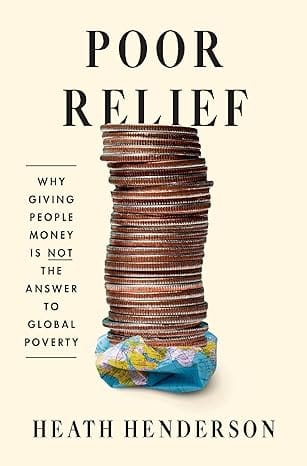
A simple notion has become increasingly widespread in recent years: to lift people out of poverty, just give them money. Leading international organizations like the World Bank and United Nations endorse the use of cash transfers. So do Bill Gates, Mark Zuckerberg, and everyday philanthropists—the charity GiveDirectly has raised more than $800 million to distribute to households in a dozen countries.
Challenging this emergent wisdom, Heath Henderson argues that cash transfers—whether one-off grants or a “basic income” provided over a stretch of time—are a flawed response to global poverty. They risk displacing interventions that recipients themselves might prefer: if a community lacks access to clean water or high-quality healthcare, for instance, giving cash to households will not address the problem, which can be solved only by putting those funds toward public infrastructure. Cash transfers have also been linked to more direct harms, including increases in domestic violence, child labor, inflation, and even mortality.
The appeal of cash transfers is rooted in the idea that they avoid paternalism, letting the recipients of the money, rather than faraway donors, make choices for themselves. But as Henderson points out, such transfers substitute one form of paternalism for another, by assuming that markets know best. Poor Relief instead proposes looking beyond one-size-fits-all solutions toward a truly bottom-up alternative. Fixing global poverty is not just a matter of giving people money—it requires giving communities democratic power.
“A cogent critique of a trendy philanthropic tool.” -Publishers Weekly
“It was the best of schemes, it was the worst of schemes-there are cash transfers of both types, and more in between. The devil is in details that may be hard to fathom in advance. Drawing on a wealth of experience worldwide, Heath Henderson’s Poor Relief raises sharp questions about this deceptively simple approach to poverty reduction, and presents some insightful answers too.” -Jean Drèze, coauthor of An Uncertain Glory: India and Its Contradictions
“In Poor Relief, Heath Henderson argues that cash transfers shouldn’t be mere handouts from the rich. Instead, he advocates for involving local communities directly in designing these programs. By focusing on boosting capabilities rather than just incomes, he presents a persuasive and passionate case for a more empowering and dignified approach to poverty alleviation.” -Yuen Yuen Ang, author of How China Escaped the Poverty Trap
“Poor Relief combines case studies in Tanzania, Ghana, Uganda, and beyond with the theory of deliberative democracy. I recommend this book for its ver

A simple notion has become increasingly widespread in recent years: to lift people out of poverty, just give them money. Leading international organizations like the World Bank and United Nations endorse the use of cash transfers. So do Bill Gates, Mark Zuckerberg, and everyday philanthropists—the charity GiveDirectly has raised more than $800 million to distribute to households in a dozen countries.
Challenging this emergent wisdom, Heath Henderson argues that cash transfers—whether one-off grants or a “basic income” provided over a stretch of time—are a flawed response to global poverty. They risk displacing interventions that recipients themselves might prefer: if a community lacks access to clean water or high-quality healthcare, for instance, giving cash to households will not address the problem, which can be solved only by putting those funds toward public infrastructure. Cash transfers have also been linked to more direct harms, including increases in domestic violence, child labor, inflation, and even mortality.
The appeal of cash transfers is rooted in the idea that they avoid paternalism, letting the recipients of the money, rather than faraway donors, make choices for themselves. But as Henderson points out, such transfers substitute one form of paternalism for another, by assuming that markets know best. Poor Relief instead proposes looking beyond one-size-fits-all solutions toward a truly bottom-up alternative. Fixing global poverty is not just a matter of giving people money—it requires giving communities democratic power.
“A cogent critique of a trendy philanthropic tool.” -Publishers Weekly
“It was the best of schemes, it was the worst of schemes-there are cash transfers of both types, and more in between. The devil is in details that may be hard to fathom in advance. Drawing on a wealth of experience worldwide, Heath Henderson’s Poor Relief raises sharp questions about this deceptively simple approach to poverty reduction, and presents some insightful answers too.” -Jean Drèze, coauthor of An Uncertain Glory: India and Its Contradictions
“In Poor Relief, Heath Henderson argues that cash transfers shouldn’t be mere handouts from the rich. Instead, he advocates for involving local communities directly in designing these programs. By focusing on boosting capabilities rather than just incomes, he presents a persuasive and passionate case for a more empowering and dignified approach to poverty alleviation.” -Yuen Yuen Ang, author of How China Escaped the Poverty Trap
“Poor Relief combines case studies in Tanzania, Ghana, Uganda, and beyond with the theory of deliberative democracy. I recommend this book for its ver
Subscribe to get Email Updates!
Thanks for subscribing.
Your response has been recorded.

"We Believe In The Power of Books" Our mission is to make books accessible to everyone, and to cultivate a culture of reading and learning. We strive to provide a wide range of books, from classic literature, sci-fi and fantasy, to graphic novels, biographies and self-help books, so that everyone can find something to read.
Whether you’re looking for your next great read, a gift for someone special, or just browsing, Midland is here to make your book-buying experience easy and enjoyable.