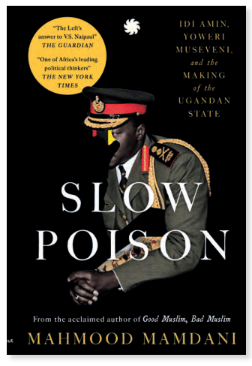
Slow Poison: Idi Amin, Yoweri Museveni, and the Making of the Ugandan State by Mahmood Mamdani is a compelling blend of political treatise, personal memoir, and postcolonial history that examines Uganda's complex journey from colonial rule to independence and the turbulent political struggles that shaped its modern state. Drawing on his firsthand experiences and deep understanding of East African politics, Mamdani explores the tragic unraveling of Uganda's struggle for decolonization, examining the rise and rule of Idi Amin, the political evolution of Yoweri Museveni, and the influence of international powers that exploited and manipulated the country before and after independence. Challenging conventional portrayals of Amin as merely a ruthless and unpredictable dictator, the author presents a more nuanced account of him as a shrewd political operator who understood the fears, expectations, and aspirations of the people. Through a critical comparison of Amin and Museveni, the book investigates authoritarianism, political power, colonial legacies, exile, nationalism, and the continuing challenges of building an independent African state. It also weaves together Uganda's political history with Mamdani's family story of exile and his eventual return to his homeland, offering a deeply personal perspective on the country's struggles and transformations. Rich in historical detail and political insight, Slow Poison is an extraordinary exploration of postcolonial governance, dictatorship, identity, and the enduring complexities of Uganda's national journey.
About the Author:
Mahmood Mamdani is Herbert Lehman Professor of Government and Professor of Anthropology and Middle Eastern, South Asian, and African Studies at Columbia University. He served as Director of the Makerere Institute of Social Research in Kampala from 2010 to 2022. Widely recognised as one of the leading political thinkers and scholars of postcolonial studies, his work examines colonialism, political identity, state power, violence, and the relationship between citizens and governments. His notable books include Neither Settler nor Native, Citizen and Subject, When Victims Become Killers, and Good Muslim, Bad Muslim.
Subscribe to get Email Updates!
Thanks for subscribing.
Your response has been recorded.
"We Believe In The Power of Books" Our mission is to make books accessible to everyone, and to cultivate a culture of reading and learning. We strive to provide a wide range of books, from classic literature, sci-fi and fantasy, to graphic novels, biographies and self-help books, so that everyone can find something to read.
Whether you’re looking for your next great read, a gift for someone special, or just browsing, Midland is here to make your book-buying experience easy and enjoyable.
(2).png)