Shop No.20, Aurobindo Palace Market, Hauz Khas, Near Church +91 9818282497 | 011 26867121 110016 New Delhi IN
Midland The Book Shop ™
Shop No.20, Aurobindo Palace Market, Hauz Khas, Near Church +91 9818282497 | 011 26867121 New Delhi, IN
+919871604786 https://www.midlandbookshop.com/s/607fe93d7eafcac1f2c73ea4/69591829db7aed90e0608dfb/without-tag-line-480x480.png" [email protected]
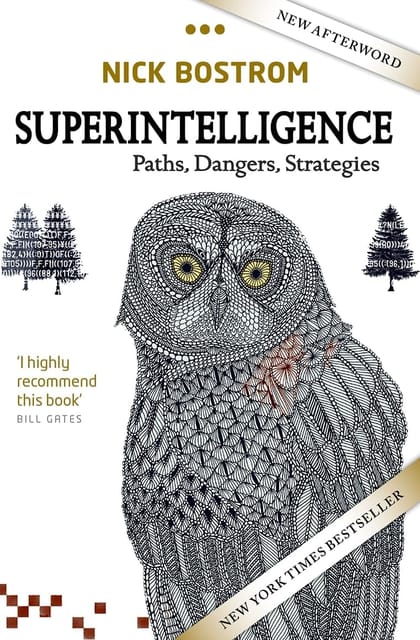
9780198739838 69f89c6bd94de5ba5a98de7d SUPERINTELLIGENCE https://www.midlandbookshop.com/s/607fe93d7eafcac1f2c73ea4/69f8891fed9a1d2a66cd9603/71uvmcdce9l-_sl1159_.jpg
The human brain has some capabilities that the brains of other animals lack. It is to these distinctive capabilities that our species owes its dominant position. Other animals have stronger muscles or sharper claws, but we have cleverer brains. If machine brains one day come to surpass human brains in general Intelligence, then this new superintelligence could become very powerful. As the fate of the gorillas now depends more on us humans than on the gorillas themselves, so the fate of our species then would come to depend on the actions of the machine superintelligence. But we have one advantage: we get to make the first move. Will it be possible to construct a seed AI or otherwise to engineer initial conditions so as to make an intelligence explosion survival? How could one achieve a controlled detonation? To get closer to an answer to this Question, we must make our way through a fascinating landscape of topics and considerations. Read the book and learn about oracles, genies, singletons; about boxing methods, tripwires and mind crime; about humanity's cosmic endowment and differential technological development; indirect normativity, instrumental convergence, whole brain emulation and technology couplings; Malthusian economics and dystopian evolution; artificial intelligence and biological cognitive enhancement and collective intelligence. This profoundly ambitious and original book picks its way carefully through a vast tract of forbiddingly difficult intellectual terrain. Yet the writing is so lucid that it somehow makes it all seem easy. After an utterly engrossing journey that takes us to the frontiers of thinking about the human condition and the future of intelligent life, we find in Nick bostrom's work nothing less than a reconceptualization of the essential task of our time.

About the author

NICK BOSTROM is a Professor at Oxford University, where he is the founding director of the Future of Humanity Institute. Bostrom is the world’s most cited philosopher aged 50 or under. He is the author of more than 200 publications, including Anthropic Bias (2002), Global Catastrophic Risks (2008), Human Enhancement (2009), and Superintelligence: Paths, Dangers, Strategies (2014), a New York Times bestseller which sparked the global conversation about the future of AI. His work has pioneered many of the ideas that frame current thinking about humanity’s future (such as the concept of an existential risk, the simulation argument, the vulnerable world hypothesis, astronomical waste, the unilateralist’s curse, etc.), while some of his recent work concerns the moral status of digital minds. His writings have been translated into more than 30 languages; he is a repeat main-stage TED speaker; and he has been interviewed more than 1,000 times by media outlets around the world. He has been on Foreign Policy’s Top 100 Global Thinkers list twice and was included in Prospect’s World Thinkers list, the youngest person in the top 15. He has an academic background in theoretical physics, AI, and computational neuroscience as well as philosophy.

9780198739838
in stockINR 399
1 1
SUPERINTELLIGENCE

SUPERINTELLIGENCE

ISBN: 9780198739838
₹399
₹499   (20% OFF)


Details
  • ISBN: 9780198739838
  • Author: Nick Bostrom
  • Format: Paperback
  • Publisher: Oxford University Press
  • Publication Date: 2016
SHARE PRODUCT

Book Description

The human brain has some capabilities that the brains of other animals lack. It is to these distinctive capabilities that our species owes its dominant position. Other animals have stronger muscles or sharper claws, but we have cleverer brains. If machine brains one day come to surpass human brains in general Intelligence, then this new superintelligence could become very powerful. As the fate of the gorillas now depends more on us humans than on the gorillas themselves, so the fate of our species then would come to depend on the actions of the machine superintelligence. But we have one advantage: we get to make the first move. Will it be possible to construct a seed AI or otherwise to engineer initial conditions so as to make an intelligence explosion survival? How could one achieve a controlled detonation? To get closer to an answer to this Question, we must make our way through a fascinating landscape of topics and considerations. Read the book and learn about oracles, genies, singletons; about boxing methods, tripwires and mind crime; about humanity's cosmic endowment and differential technological development; indirect normativity, instrumental convergence, whole brain emulation and technology couplings; Malthusian economics and dystopian evolution; artificial intelligence and biological cognitive enhancement and collective intelligence. This profoundly ambitious and original book picks its way carefully through a vast tract of forbiddingly difficult intellectual terrain. Yet the writing is so lucid that it somehow makes it all seem easy. After an utterly engrossing journey that takes us to the frontiers of thinking about the human condition and the future of intelligent life, we find in Nick bostrom's work nothing less than a reconceptualization of the essential task of our time.

About the author

NICK BOSTROM is a Professor at Oxford University, where he is the founding director of the Future of Humanity Institute. Bostrom is the world’s most cited philosopher aged 50 or under. He is the author of more than 200 publications, including Anthropic Bias (2002), Global Catastrophic Risks (2008), Human Enhancement (2009), and Superintelligence: Paths, Dangers, Strategies (2014), a New York Times bestseller which sparked the global conversation about the future of AI. His work has pioneered many of the ideas that frame current thinking about humanity’s future (such as the concept of an existential risk, the simulation argument, the vulnerable world hypothesis, astronomical waste, the unilateralist’s curse, etc.), while some of his recent work concerns the moral status of digital minds. His writings have been translated into more than 30 languages; he is a repeat main-stage TED speaker; and he has been interviewed more than 1,000 times by media outlets around the world. He has been on Foreign Policy’s Top 100 Global Thinkers list twice and was included in Prospect’s World Thinkers list, the youngest person in the top 15. He has an academic background in theoretical physics, AI, and computational neuroscience as well as philosophy.

User reviews

  0/5