Shop No.20, Aurobindo Palace Market, Hauz Khas, Near Church +91 9818282497 | 011 26867121 110016 New Delhi IN
Midland The Book Shop ™
Shop No.20, Aurobindo Palace Market, Hauz Khas, Near Church +91 9818282497 | 011 26867121 New Delhi, IN
+919871604786 https://www.midlandbookshop.com/s/607fe93d7eafcac1f2c73ea4/69591829db7aed90e0608dfb/without-tag-line-480x480.png" [email protected]
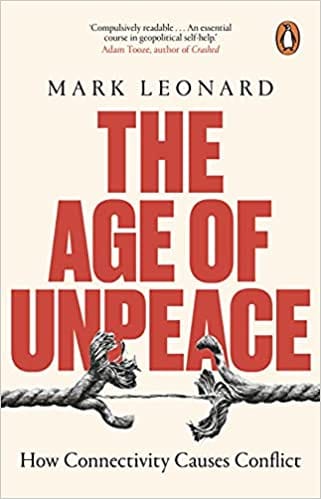
9780552178273 64009f578fd1b6185fef2a5f The Age Of Unpeace How Connectivity Causes Conflict https://www.midlandbookshop.com/s/607fe93d7eafcac1f2c73ea4/64009f588fd1b6185fef2a82/41ik-n4b-ml-_sx319_bo1-204-203-200_.jpg
In the three decades since the end of the Cold War, global leaders have been integrating the world's economy, transport and communications, breaking down borders in the hope of making war impossible.
 

Review

The "age of unpeace" [is] an apt phrase for an era in which wars between states are uncommon but conflict is endemic... Leonard adroitly captures evolving trends in geopolitics over the past decade... Leonard's argument is all the more compelling because of the way his own beliefs have evolved. New Statesman

Thought-provoking... If Leonard is right, then every trade deal or every new technology that brings people closer will also make the world a more dangerous place. - Irish Times

Leonard is a creative and well-connected thinker, and his timely, insightful book is useful for its explanations of the differing ideological viewpoints found in Beijing, Brussels and Washington, with an interesting section on Chinese thinkers in particular. Just as important, he explains why the conflicts in our global era remain so different from those in the cold war, in particular given the role being played by new technologies from quantum computing to machine learning as a new focus for geopolitical contestation. -- James Crabtree - Financial Times

Mark Leonard... has been a force in foreign policy thinking for a quarter century... rich in data and anecdote... If you're feeling intellectually disoriented after the fall of Kabul, start here.

-- Matthew d'Ancona, Tortoise

Compulsively readable, Mark Leonard's globe-trotting book not only offers us a fascinating and disturbing panorama, it redefines realism for an age of massive and toxic connectivity. Rather than fleeing into anachronistic visions of grand architecture and Cold War rhetoric, it demands that we face our actual problem. An essential course in geopolitical self-help. -- Adam Tooze, author of Crashed: How a Decade of Financial Crises Changed the World

About the Author

Mark Leonard is the Director and Co-Founder of the European Council on Foreign Relations, a council of 300 European leaders including serving and former presidents, prime ministers, economics and foreign ministers, and the author of Why Europe Will Run the 21st Century (2005) and What Does China Think? (2008). He lives in London and Berlin.

9780552178273
out of stock INR 479
1 1
The Age Of Unpeace How Connectivity Causes Conflict

The Age Of Unpeace How Connectivity Causes Conflict

ISBN: 9780552178273
₹479
₹699   (31% OFF)


Back In Stock Shortly - Fill The Book Request Form

Details
  • ISBN: 9780552178273
  • Author: Mark Leonard
  • Publisher: Penguin
  • Pages: 256
  • Format: Paperback
SHARE PRODUCT

Book Description

In the three decades since the end of the Cold War, global leaders have been integrating the world's economy, transport and communications, breaking down borders in the hope of making war impossible.
 

Review

The "age of unpeace" [is] an apt phrase for an era in which wars between states are uncommon but conflict is endemic... Leonard adroitly captures evolving trends in geopolitics over the past decade... Leonard's argument is all the more compelling because of the way his own beliefs have evolved. New Statesman

Thought-provoking... If Leonard is right, then every trade deal or every new technology that brings people closer will also make the world a more dangerous place. - Irish Times

Leonard is a creative and well-connected thinker, and his timely, insightful book is useful for its explanations of the differing ideological viewpoints found in Beijing, Brussels and Washington, with an interesting section on Chinese thinkers in particular. Just as important, he explains why the conflicts in our global era remain so different from those in the cold war, in particular given the role being played by new technologies from quantum computing to machine learning as a new focus for geopolitical contestation. -- James Crabtree - Financial Times

Mark Leonard... has been a force in foreign policy thinking for a quarter century... rich in data and anecdote... If you're feeling intellectually disoriented after the fall of Kabul, start here.

-- Matthew d'Ancona, Tortoise

Compulsively readable, Mark Leonard's globe-trotting book not only offers us a fascinating and disturbing panorama, it redefines realism for an age of massive and toxic connectivity. Rather than fleeing into anachronistic visions of grand architecture and Cold War rhetoric, it demands that we face our actual problem. An essential course in geopolitical self-help. -- Adam Tooze, author of Crashed: How a Decade of Financial Crises Changed the World

About the Author

Mark Leonard is the Director and Co-Founder of the European Council on Foreign Relations, a council of 300 European leaders including serving and former presidents, prime ministers, economics and foreign ministers, and the author of Why Europe Will Run the 21st Century (2005) and What Does China Think? (2008). He lives in London and Berlin.
User reviews

  0/5