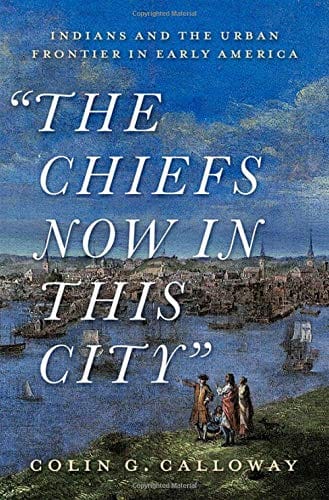
During the years of the Early Republic, prominent Native leaders regularly traveled to American cities-Albany, Boston, Charleston, Philadelphia, Montreal, Quebec, New York, and New Orleans-primarily on diplomatic or trade business, but also from curiosity and adventurousness. They were frequently referred to as "the Chiefs now in this city" during their visits, which were sometimes for extended periods of time. Indian people spent a lot of time in town. Colin Calloway, National Book Award finalist and one of the foremost chroniclers of Native American history, has gathered together the accounts of these visits and from them created a new narrative of the country's formative years, redefining what has been understood as the "frontier."
Calloway's book captures what Native peoples observed as they walked the streets, sat in pews, attended plays, drank in taverns, and slept in hotels and lodging houses. In the Eastern cities they experienced an urban frontier, one in which the Indigenous world met the Atlantic world. Calloway's book reveals not just what Indians saw but how they were seen. Crowds gathered to see them, sometimes to gawk; people attended the theatre to watch “the Chiefs now in this city” watch a play.
Their experience enriches and redefines standard narratives of contact between the First Americans and inhabitants of the American Republic, reminding us that Indian people dealt with non-Indians in multiple ways and in multiple places. The story of the country's beginnings was not only one of violent confrontation and betrayal, but one in which the nation's identity was being forged by interaction between and among cultures and traditions.
Review
"Colin Calloway illuminates how early American cities provided a shared space for Native and colonial peoples, an urban frontier where trade, diplomacy, and entertainment were more likely to break out than war or violence. His book memorably reconstructs these urban encounters from the Indians' point of view, recapturing the sights, sounds, and smells of a distinct chapter in European-Indian relations." -Timothy Shannon, Gettysburg College "Colin Calloway has again crafted a contribution to early American history that is both wide-sweeping and full of insight. Not only does he capture the multidimensional and influential presence of Indigenous people in colonial towns and cities across eastern North America, he invites the reader to experience those urban places from the perspective of their American Indian visitors and residents." -Daniel H. Usner, author of American Indians in Early New Orleans: From Calumet to Raquette "As he has done in previous books, the author provides an extensive review and analysis of the available literature, offering a fresh view of the lives of Native Americans during the early years of the new republic while correcting many common misconceptions, particularly in relation to hospitality, civility, and justice. Calloway shows how 'colonial communities depended on connections to Indian country for their existence, growth, and prosperity.' Calloway also explores the perils faced by Native Americans on these journeys, including violence, racism, and disease. A welcome Native-focused history of Colonial America." -Kirkus Reviews "In this eye-opening history, National Book Award finalist Calloway (The Indian World of George Washington) dispels popular notions about the absence of Indigenous peoples from towns and cities in colonial America...With an abundance of colorful anecdotes drawn from contemporaneous newspaper accounts and letters, this scholarly yet accessible account will appeal to fans of early American history." -Publishers Weekly
About the Author
Colin G. Calloway is John Kimball Jr. 1943 Professor of History and Native American Studies at Dartmouth College. He is the author of several books, most recently The Indian World of George Washington (OUP 2018), which was a National Book Award Finalist, and which won the Excellence in American History Book Award from the National Society of the Daughters of the American Revolution and the George Washington Book Prize.





 +91 9818282497
(2).png)