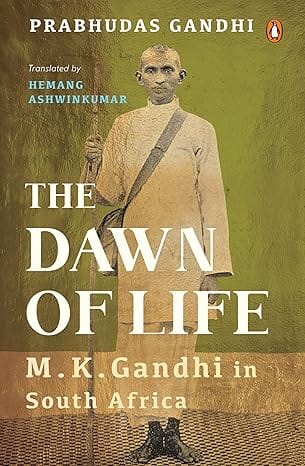
Prabhudas Gandhi was born in 1901 in Porbandar to Chhaganlal Gandhi and Kashiben and like many members of his family, spent his childhood in South Africa at the Phoenix Ashram.
The memoir, Jeevan nu Parodh in Gujarati was serialized in a hand-written journal called Madhpudo (The Beehive) that Prabhudas edited at Sabaramati Ashram and published as a book in 1948 in the bloodied aftermath of independence. Awarded the Narmad Suvarna Chandak award, The Dawn of Life is an engaging and elaborate account of Gandhi’s imagination of swaraj, both personal and collective. It flows from the memory of a young Prabhudas who migrated to Phoenix Settlement in 1905 to join his father and uncle Maganlal Gandhi. It has a ring of innocence, which is as refreshing as it is deceptive, for the author forces the reader to look within and confront her fears, prejudices and violent impulses. Being made available to English readership after more than a century since its original inscription, the book pleads for the recovery of a dawn that has remained shrouded far too long in the pitch-dark of communalism, casteism and chauvinisms of various kinds.
Translated by Hemang Ashwinkumar, this memoir is an unique witness to the history of India and of the subcontinent.
About the Author
Prabhudas Gandhi (1901–1995), grandnephew of Mahatma Gandhi, and son of Chhaganlal Gandhi, was a Gujarati writer, translator and Gandhian activist. Spending his childhood at Phoenix Ashram in South Africa, he absorbed Gadhian ideals of satyagraha, service and simplicity early on. Returning to India in 1914, he studied at Gurukul Kangadi and Shantiniketan, before joining Kochrab Ashram as one of its first inmates. He participated in major movements-Champaran, Bardoli, Quit India-and was repeatedly imprisoned. His works include Jivan nu Parodh, which was awarded the Narmad Suvarna Chandrak in 1948. His life reflected Gandhian values in action-literature, reform and service.
Hemang Ashwinkumar is a bi-lingual poet, translator, editor and critic working in Gujarati and English. His poetry and translations have appeared in places like World Literat




 +91 9818282497
(2).png)