Shop No.20, Aurobindo Palace Market, Hauz Khas, Near Church +91 9818282497 | 011 26867121 110016 New Delhi IN
Midland The Book Shop ™
Shop No.20, Aurobindo Palace Market, Hauz Khas, Near Church +91 9818282497 | 011 26867121 New Delhi, IN
+919871604786 https://www.midlandbookshop.com/s/607fe93d7eafcac1f2c73ea4/69591829db7aed90e0608dfb/without-tag-line-480x480.png" [email protected]
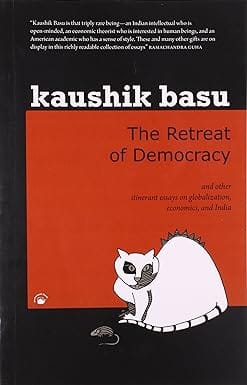
9788178243269 656d85886f2617e070b4309e The Retreat Of Democracy https://www.midlandbookshop.com/s/607fe93d7eafcac1f2c73ea4/656d85896f2617e070b430af/81ggza-a4ql-_sy385_.jpg
This accessible and stimulating book on some of the major political and economic issues of our time will delight all readers and astonish anyone who thinks economics is unconnected with literary elegance. An eminent Professor of Economics with extensive research in theoretical economics at Cornell, Kaushik Basu has over the past decade also consolidated his already considerable reputation as a writer who can explain complex issues with disarming ease. This book contains an expanded and reworked selection of his best journalistic writings on politics and economic themes since the late 1990s. The book begins with the author’s widely-cited essays on globalization and democracy. These argue that while economic globalization is occurring at breakneck speed and offers large potential benefits, political globalization has been painfully slow. This represents a dangerous combination of events, a byproduct of which can be the retreat of global democracy and the emergence of political instability. The book goes on to traverse a wide terrain-ideas in economics, anthropological observations on social norms, the role of culture and travel in India and abroad. Two recurring themes crisscross the essays. First, that the ultimate objective of policymaking must be the progress of the most disadvantaged; yet simultaneously that to ignore market laws and individual incentives is to court failure. Second, that for the Successful crafting of economic policy it is important to recognize markets as embedded in specific cultures and social norms. Included here-alongside essays on major economists such as Amartya Sen and Joseph Stiglitz, are humorous essays on everyday encounters with Indian bureaucracy. These function in part as allegories of the Kafkaesque stranglehold of political structures on the individual. They caution us against the presumptions of individual freedom on which traditional economics is founded.


About the Author

Kaushik Basu is the Carl Marks Professor of Economics and Chairman of the Department of Economics at Cornell University. He has to his credit a large number of monographs, edited volumes, and essay collections on development economics and democracy.
9788178243269
out of stock INR 476
1 1
The Retreat Of Democracy

The Retreat Of Democracy

ISBN: 9788178243269
₹476
₹595   (20% OFF)


Back In Stock Shortly - Fill The Book Request Form

Details
  • ISBN: 9788178243269
  • Author: Kaushik Basu
  • Publisher: Permanent Black
  • Pages: 290
  • Format: Paperback
SHARE PRODUCT

Book Description

This accessible and stimulating book on some of the major political and economic issues of our time will delight all readers and astonish anyone who thinks economics is unconnected with literary elegance. An eminent Professor of Economics with extensive research in theoretical economics at Cornell, Kaushik Basu has over the past decade also consolidated his already considerable reputation as a writer who can explain complex issues with disarming ease. This book contains an expanded and reworked selection of his best journalistic writings on politics and economic themes since the late 1990s. The book begins with the author’s widely-cited essays on globalization and democracy. These argue that while economic globalization is occurring at breakneck speed and offers large potential benefits, political globalization has been painfully slow. This represents a dangerous combination of events, a byproduct of which can be the retreat of global democracy and the emergence of political instability. The book goes on to traverse a wide terrain-ideas in economics, anthropological observations on social norms, the role of culture and travel in India and abroad. Two recurring themes crisscross the essays. First, that the ultimate objective of policymaking must be the progress of the most disadvantaged; yet simultaneously that to ignore market laws and individual incentives is to court failure. Second, that for the Successful crafting of economic policy it is important to recognize markets as embedded in specific cultures and social norms. Included here-alongside essays on major economists such as Amartya Sen and Joseph Stiglitz, are humorous essays on everyday encounters with Indian bureaucracy. These function in part as allegories of the Kafkaesque stranglehold of political structures on the individual. They caution us against the presumptions of individual freedom on which traditional economics is founded.


About the Author

Kaushik Basu is the Carl Marks Professor of Economics and Chairman of the Department of Economics at Cornell University. He has to his credit a large number of monographs, edited volumes, and essay collections on development economics and democracy.

User reviews

  0/5