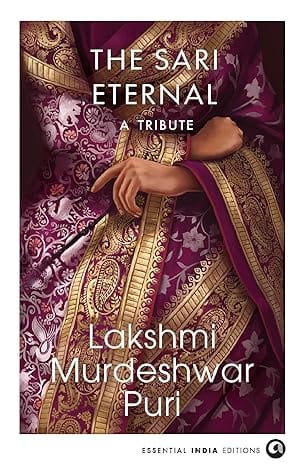
Throughout history, the sari has been linked inextricably to the idea of Indian womanhood. It is the oldest surviving garment in the world, originating in the Indus Valley civilization some 5,000 years ago. In The Sari Eternal, award-winning writer Lakshmi Murdeshwar Puri explores how the unstitched fabric has evolved over time in the country’s cultural imagination. From the Banarasi to the Kanjivaram, the Sambalpuri to the Paithani, the sari unites the plural India that wears it.
Puri begins her book with the story of her childhood in Delhi and Kathmandu, featuring her mother Malati, who was a proud wearer of the sari. Later, as a college-goer, she, like other young women of the time, was inspired to wear the sari in the image of Indira Gandhi. She also recounts how, as an Indian diplomat abroad, she subverted Western assumptions of what made for the correct attire for formal occasions by doing what was considered unorthodox and wearing a sari instead of a business suit or gown.
She then explores the history of the sari—its significance in the sacred literature of the Vedic period; in the sculptures of Sanchi, Khajuraho, and Konark; and in the paintings of Raja Ravi Varma, Jamini Roy, and M. F. Husain, to name a few. The sari as a symbol of the feminine shakti is typified in the figures of goddesses like Lakshmi, Saraswati, and Parvati, as well as in Indian queens, freedom fighters, contemporary politicians, entrepreneurs, and actors, all the way through to Gen-Z influencers.
Ranging far and wide in its exploration of the garment, The Sari Eternal is a luminous account of how the sari is a crucial part of the cultural and spiritual ethos of India.








 +91 9818282497
(2).png)