
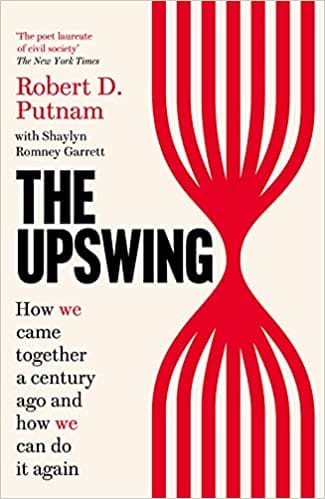
The Upswing How We Came Together A Century Ago And How We Can Do It Again
ISBN:
9781800750371
₹479
₹599
(20% OFF)
Back In Stock Shortly - Fill The Book Request Form
Details
- ISBN: 9781800750371
- Author: Robert D Putnam Shaylyn Romney Garrett
- Publisher: Swift
- Pages: 448
- Format: Paperback
Book Description
'Putnam's book speaks for the many millions who don't think the way zealots do' Guardian
The Upswing is Robert D. Putnam's brilliant analysis of economic, social, cultural and political trends from the Gilded Age to the present, showing how America went from an individualistic ‘I’ society to a more communitarian ‘We’ society and then back again, and how we can all learn from that experience.
In the late nineteenth century, America was highly individualistic, starkly unequal, fiercely polarised and deeply fragmented, just as it is today. However, as the twentieth century dawned, America became - slowly, unevenly, but steadily - more egalitarian, more cooperative, more generous; a society 'on the upswing,' more focused on responsibilities to each other and less focused on narrow self-interest. Over the course of the 1960s, however, these trends reversed once again, leading to today's disarray.
In a sweeping overview of more than a century of history, Putnam and Romney Garrett draw on inspiring lessons for our time from an earlier era, when a dedicated group of reformers righted the ship, creating once again a society based on community. Engaging, revelatory and timely, this is Putnam's most ambitious work yet, with a relevance right across the anglophone world. It is an unmissable contribution to the debate about where we want society to go.
Review
'Putnam's book speaks for the many millions who don't think the way zealots do' - Guardian
‘An ambitious book, impressively written, easy to read, meticulously researched and imbued throughout with the authors’ concern for the fate of their country’ - Irish Times
‘Sweeping yet remarkably accessible’ - The Wall Street Journal
‘Offers superb, often counterintuitive insights’ -The New York Times
About the Author
Robert D. Putnam is the Malkin Research Professor of Public Policy at Harvard University and a former Dean of the John F. Kennedy School of Government. He has written fourteen books, including the bestselling Our Kids and Bowling Alone, and has consulted for the last four US Presidents. In 2012, President Obama awarded him the National Humanities Medal. His research program, the Saguaro Seminar, is dedicated to fostering civic engagement in America. Visit RobertDPutnam.com.
Shaylyn Romney Garrett is a writer and award-winning social entrepreneur. She is a founding contributor to ‘Weave: The Social Fabric Project,’ an Aspen Institute initiative. She also contributed to Robert D. Putnam and David E. Campbell's American Grace. Shaylyn holds a degree in Government from Harvard University, and is a returned Peace Corps volunteer. Visit ShaylynRomneyGarrett.com.
Shaylyn Romney Garrett is a writer and award-winning social entrepreneur. She is a founding contributor to ‘Weave: The Social Fabric Project,’ an Aspen Institute initiative. She also contributed to Robert D. Putnam and David E. Campbell's American Grace. Shaylyn holds a degree in Government from Harvard University, and is a returned Peace Corps volunteer. Visit ShaylynRomneyGarrett.com.






 +91 9818282497
(2).png)