Review
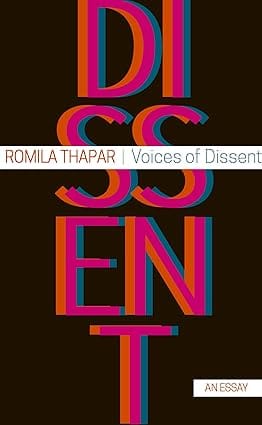
"Where this book shines is in its discussion of how dissent often arises from within cultures, and not from outside, restructuring social relations and enabling mutation of knowledge through the questioning of institutions. . . . The book raises some significant questions, not only for the political establishment but also for dissenters. Does dissent seek resolution of conflict, sharing of power, annihilation of tradition, or merely a recognition of plurality in thought? . . . If dissent gives way to accommodation, is that a win-win situation or a selling out? Can ideological purity coexist with political pragmatism?" - Business Standard
"Dissent, expressed against the state as much as institutional forms of religion, creates traditions of thinking that are always available as a resource. Hence, when Gandhi thinking against colonial violence thinks through the idea of satyagraha, he draws upon a library of dissent with its vocabulary and forms. . . . Thapar does not make an argument for passive inheritance. At each historical juncture, the reimagining of an ethical conception of equality and compassion draws upon a rich vein of dissentient thought. Democracy survives because of dissent. Forms of political and social orthodoxy are contingent; and the battle against them is always ongoing." - India Today
"Thapar is to be congratulated for her indomitable courage, her meticulous research, her skill in translating
complex and difficult issues into communicable language, and above all the clarity of argument that brings various strands neatly together in the concluding section." - Pacific Affairs
About the Author
Romila Thapar is emeritus professor of history at the Jawaharlal Nehru University, New Delhi, and she was previously general president of the Indian History Congress. She is a fellow of the British Academy and holds honorary doctorates from Calcutta University, Oxford University, and the University of Chicago, among others. She is an Honorary Fellow of Lady Margaret Hall, Oxford, and SOAS, London. In 2008, she was awarded the prestigious Kluge Prize by the Library of Congress.











 +91 9818282497
(2).png)