Shop No.20, Aurobindo Palace Market, Hauz Khas, Near Church +91 9818282497 | 011 26867121 110016 New Delhi IN
Midland The Book Shop ™
Shop No.20, Aurobindo Palace Market, Hauz Khas, Near Church +91 9818282497 | 011 26867121 New Delhi, IN
+919871604786 https://www.midlandbookshop.com/s/607fe93d7eafcac1f2c73ea4/69591829db7aed90e0608dfb/without-tag-line-480x480.png" [email protected]
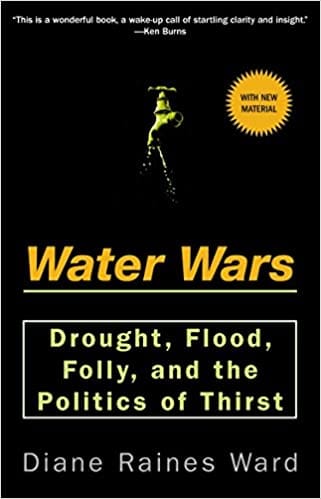
9781573229951 628f73a9bc37840d3e07c0c9 Water Wars Drought Flood Folly And The Politics Of Thirst https://www.midlandbookshop.com/s/607fe93d7eafcac1f2c73ea4/628f73aabc37840d3e07c0fc/41ma32kkrpl-_sx319_bo1-204-203-200_.jpg
Updated with new material

Every day, we hear alarming news about droughts, pollution, population growth, and climate change—which threaten to make water, even more than oil, the cause of war within our lifetime. Diane Raines Ward reaches beyond the headlines to illuminate our most vexing problems and tells the stories of those working to solve them: hydrologists, politicians, engineers, and everyday people. Based on ten years of research spanning five continents, Water Wars offers fresh insight into a subject to which our fate is inextricably bound.


Review

"Thorough and thoughtful." —Detroit Free-Press

"An engaging story...[with] plenty to inspire and alarm." —Business Week

"Riveting...I will never turn on the tap again without thinking about where the water comes from and where it goes." —Ken Burns, producer/director of the "Civil War", "Baseball", and "Jazz" documentaries

"Clear, jargon free...comprehensive." —The Baltimore Sun

"A wonderful book [with] splendid insight." —Environmental News

"Important [and] impressive." —Ottawa Citizen

About the Author

Diane Raines Ward is a journalist whose work has appeared in SmithsonianNewsweekConnoisseur, and International Wildlife. She and her husband, Geoffrey C. Ward, co-wrote the book Tiger-Wallahs: Encounters with the Men Who Tried to Save the Greatest of the Great Cats. Together they run a nonprofit organization dedicated to conservation efforts in India.

Excerpt. © Reprinted by permission. All rights reserved.

“This is a wonderful book, a wake-up call of startling clarity and insight, with a flood of facts and anecdotes that place the abstract into riveting human perspective. I will never turn on the tap again without thinking about where the water comes from and where it goes.”

—Ken Burns, producer and director of the Civil War, Baseball, and Jazz documentaries

“Critical decisions about water . . . will have to be made in the future. Water Wars can help us make those decisions wisely.”

BookPage

“Clear, jargon-free . . . Water Wars chronicles not only ambitious construction projects but also the ambitious personalities behind them.”

The Baltimore Sun

“Famed as a water planet, Earth has too much in some places, too little in others, and everywhere the crisis of matching water with people. Water Wars is a brisk and personable introduction to a once and future struggle that is not going away.”

—Stephen J. Pyne, author of How the Canyon Became Grand

Water Wars is a . . . wonderful book. I do not know Diane Raines Ward, but I suspect she is a solid journalist with a great thirst for knowledge both broad and deep. She spent ten years circling the globe to beautifully describe many of the world’s most fascinating water development problems and projects and the people who masterminded—and mismanaged—them. . . . Splendid insight . . . thoughtful . . . informative.”

Environmental News

“No matter what your stance is on various water management issues, Ward’s descriptions of the mechanicals of control are fascinating. . . .[Her book] offers provocative insights on old and new problems. . . . She’s also not afraid to travel, to learn and talk to the kind of people whose work shoes are rubber irrigator boots, all of which adds a refreshing spin. Water Wars is . . . both a good primer on water management and an enlightened, engaging analysis of its woes.”

Las Vegas Mercury

“Diane Ward describes the competition for this scarce resource vividly, and with remarkable balance. A book for everyone to read.”

—Robert O. Collins, professor of history emeritus, University of California, Santa Barbara, and author of Documents from the African Past and The Nile

“For years we worried over not having enough food to feed the hungry and enough oil to power civilization. Now, says Diane Ward, in this eye-opening investigative book, we’d better come to grips with an equally stark reality—that we are running out of fresh water. Water Wars presents a panoramic look at the next great crisis looming on the horizon, and what we need to do to address it. It should be read and widely discussed while there is still time to change course.”

—Jeremy Rifkin, author of The End of Work and The Hydrogen Economy

“An engaging story . . . Many of the twentieth century’s greatest victories are double-edged when it comes to water. Ward talks to countless people caught up in the contradictions . . . At once compelling and sad . . . [with] plenty to inspire and alarm.”

BusinessWeek

“A warning about the worldwide struggle to manage water resources in an era of growing demand and climactic instability . . . [Ward] pursues a far-reaching itinerary in order to evoke the global nature of the crisis. . . . An informed discourse about the vital historical relationship between humans and water, and an overview of a possible global dilemma.”

Kirkus Reviews


Preface

It’s been the hottest year on record here in America. And the driest since 1895. And not just here. Drought has recently devastated crops in Russia, Australia, and Mexico; Brazil, Argentina, and India; southern Europe, the Balkans, the Arabian Peninsula, and large parts of northern and southern Africa.

When I was researching Water Wars in Pakistan a decade ago, I was astonished to read at least one newspaper story about water conflicts in that country each day. Now, in a single day, Google churns out whole lists of alerts about worldwide water protests and water riots to my in-box. In central India, tribal people have been standing in neck-deep water for weeks to protest a dam that threatens to drown their homes, while thousands of middle-class city dwellers march through the streets of the south Indian city of Bangalore, protesting withdrawals by a neighboring state of precious water from the Cauvery River. There have been riots over water in Egypt, Peru, and South Africa. Australians rail against mine drilling that will pollute aquifers. Water shortages have brought angry, frustrated protestors onto the streets from the Dominican Republic to Chew Valley Lake in England to the Modesto Irrigation District in California.

That’s just the past two weeks. Much of next year’s unrest will concern the shortages and soaring food prices that this year’s drought losses ensure. We use more water than ever and its cost is spiking in tandem with demand. While we may not yet be in the grip of a truly global water crisis, its fingers are on our throats. Local crises are multiplying everywhere.

The past thirteen years have been among the warmest on record. Glaciers and sea ice are steadily shrinking: Scientists have found a sixty-mile swath of algae flourishing beneath Artic ice where the sea should be too cold for anything to grow; “It’s like finding the Amazon rain forest in the Mojave desert,” says one of the scientists who discovered it. There are more floods now, nastier storms, more erratic monsoons, unexpected cold flashes. Catastrophic heat waves and droughts, once rare, happen more often, last longer, are more severe than ever before, and will profoundly affect our water systems. There are hundreds of thousands of water refugees around the world.

Scientists fear that this is the “new normal.” Not long ago I was talking with the Associated Press reporter Art Max, who has covered conferences on climate change at Kyoto and Rio. He was complaining that the summer had been oppressively hot. I muttered something about its not being “usual.” “There isn’t any ‘usual’ anymore,” he said.

Ten years ago, I wrote Water Wars because I wanted to understand where we were with water in the world, what has worked and what has not, and whether or not we were in trouble. For this brief update I’ve wanted to understand what a decade has done to the answers I found then. There have been some steps forward, more than a little slippage, and some unexpected changes.

Jaw-dropping engineering projects are omnipresent. Remember that big dam-builder that environmentalists loved to hate, the World Bank? It’s now a bit-player, approving no more than four dams a year. Currently, the world’s biggest dam-builder is Sinohydro, a Chinese firm usually financed by the Exim Bank of China, now at work in Ghana, Gabon, Zambia, the Republic of Congo, and Nigeria, often in exchange for electricity and blocks of natural resources including oil. It is most ominously at work on the Nile River, constructing dams both in Ethiopia and the Sudan that threaten Egypt’s survival. Sinohydro, also building in Southeast Asia and Latin America, is involved in 195 hydro projects in 60 countries. Other Chinese builders are constructing 105 more.

Meanwhile, on the Chinese mainland, they are building the largest river diversion the world has ever seen, taking water, lots of it, out of southern rivers and running it more than two thousand miles north to cities along the Yellow River in three massive canal-and-tunnel systems. Because much of the water is polluted, 426 water treatment plants are being built on the 700-mile eastern route alone.

The report card for the projects I wrote about is mixed. The Dutch continue to maintain their water defenses; who could ever doubt they would? The mammoth GAP project in Turkey has nine functioning dams now, but construction has mercifully slowed on the thirteen dams remaining on the drawing boards. Drought- and flood-tormented farmers struggle more than ever along the canals in Pakistan. The riparians along Australia’s Murray Darling Basin still argue over every cubic foot, as do people along the Colorado and the Jordan, the Mekong and the Nile. Preservation of the Florida Everglades has made legislative progress but implementation has stalled badly for lack of funding.

Water harvesting has become a common practice in India, bringing relief to individuals, apartment complexes, and smaller communities. Some parts of the Aral Sea have been restored. So have half of the Shatt Al-Arab marshes that Saddam Hussein sought to destroy. River basins that cross state or national boundaries continue to do best when they cooperate with organizations of the affected riparians: The International Mekong River Commission has recently denied Laos the right to build a giant dam that would have done downstream damage to millions in Vietnam and Cambodia.

But let’s be clear. At the same time that we face rising demands on our water, we continue to treat it with reckless disregard, using up our fresh, cheap groundwater at a rate that outpaces the rate at which we multiply ourselves. The world’s population doubled during the last half of the twentieth century while global water use tripled and our water sources grew more and more foul.

As I tried to show in this book, while it’s always easier to create messes than to clean up after them, there are engineers, scientists, and environmentalists who know how to put things right. We know how to improve our overuse of water, clean up the delivery systems, reclaim wastewater, and save our rivers and oceans. And the ability of the earth to heal, if left alone, is downright soothing. But water decisions remain in the hands of politicians. If you don’t have the energy to tackle politicians yourself, you might consider helping someone who will—organizations like the Environmental Defense Fund, Earth Justice, Natural Resources Defense Council, the Sierra Club, or Water.org. My personal preference is for those that litigate. Local organizations such as the Hudson River Watertrail Association are as ubiquitous as water protests all around the globe. “Water,” wrote Emily Dickinson, “is taught by thirst.”

In the late nineties I stood on a dusty plot of ground under the shadow of the Ranthambhore escarpment in northern India. It was rocky, barren ground, and for sale. “You should buy this land and build a house,” said my friend Dr. Goverdhan Singh Rathore, whose late father, Fateh Singh Rathore, makes an appearance in this book. I shook my head, wanting to get out of the dust, thorns, and scrub to have a bath and a drink of water.

Dr. Rathore bought that land and other devastated land around it. He began planting trees and digging ponds and small lakes to store monsoon rains. He put up solar panels for electricity and used wastewater to irrigate trees, catching every drop and treating it like the purest gold.

That once-barren plot is now lush, green, and teeming with new life—a dozen different kinds of native trees, axis deer, langur monkeys. Birds whirl overhead and crocodiles have taken up residence in the man-made ponds. I’ve heard tigers call nearby.

It is, in short, paradise. My husband and I go there every year, for rest and serenity, but also to take courage. It’s a green haven in a dry land, created because the Rathores, father and son, understood that, like all of us on this planet, we can only live here in grace if we take care of the land and water around us.

DIANE RAINES WARD, OCTOBER 2012

Introduction

SWEET WATER


You never miss the water till the well runs dry.


TRADITIONAL BLUES

When I was a little girl, my family used to get its drinking water with a cast-iron hand pump that sat on our front porch. It was too tall for me to work the handle hard enough to bring up water from our well, but I remember that whenever I drank a glass, it was cold and good. Because of that pump I made a simple assumption: people everywhere had wells under their houses that held all the water they would ever need.

An embarrassing number of years passed before I thought much about where people got their water. On a hot day in North Yemen, climbing down a rocky path from the hilltop town of Kawkaban several miles to the plain below, I passed a dozen village women, headed straight up, carrying large, heavy pots of water on their heads. My Yemeni companion told me that the women made that trek every day throughout the year. “Allah go with you,” the women called generously. I was shocked at how hard they had to work for something that, for me, poured at the twist of a tap.

I’ve since learned that my assumptions about people and water were way off. Forty percent of the world’s population carry their water from wells, rivers, ponds, or puddles outside of their homes. More significantly, many do not have enough—1.4 billion, almost twenty percent of those living on the planet, don’t have access to an adequate supply of clean water. This isn’t because there isn’t enough water to meet all of our needs. Human beings only use a quarter of the world’s fresh water. But water is seldom found just where we want it to be or in desirable quantities. Most fresh water sits in glaciers or deep aquifers, or runs off into oceans, far from the demands of our sprawling civilization.

“If you end the oil supply, the motor stops,” I was told by Turkish Minister of State Kamran Inan, in Ankara in 1989. “But if you stop the water supply, life stops.” How well we use our accessible water is becoming more and more important to how we live on this planet. Managing water is at the very heart of life in dry places—from Los Angeles to Lagos, from Damascus to Australia’s Murray Darling River Basin—where the margin between survival and disaster is narrow, and even small changes have an impact far more drastic than those in wetter, more secure territory. I have seen the words GIVE US WATER splashed in bright red paint over a village wall in the Khyber Pass; GOD BRING US WATER scrawled across houses in southeastern Turkey; and PRAY FOR RAIN painted on a truck in Texas, where a four-year drought has made the ground so dry that sparks from car mufflers start fires and water tankers are part of everyday life. Across the world, twenty-three thousand square miles, a chunk of land roughly the size of the state of West Virginia, turns to desert every year.

At the same time, an overload of water endangers other people and places. Venice is sinking as the sea rises, and Holland’s delta is threatened as it never has been before. More than ten thousand people drowned in violent flooding in the Indian state of Orissa in late 1999. In Mozambique, after severe rains in the spring of 2000, catastrophic floods killed thousands and displaced half a million. Most of the world’s people live in coastal areas or on floodplains, where they are increasingly at risk from floods, among the most frequent and most destructive of all natural disasters.

As humanity grows thirstier in the earth’s driest places, or is threatened by flooding rivers and encroaching seas in wetter ones, the steady rise in population puts stress on the land and the water. It took all of history up to 1830 to put a billion people on the planet but only one hundred years to add the second billion. The third arrived in just forty-four years and the most recent billion came in a scant twelve years. Women are having fewer babies in many places and there is real hope that the population will stabilize in this century, but there are now six billion of us and we add the equivalent of a New York City to the planet each month. Ninety million people a year. Think of a million lives lost in a famine or war—those numbers are replaced in four days.

As our numbers swell, we use more and more water, dramatically increasing withdrawals from rivers and aquifers. Since the middle of the last century, while the population doubled, water use has tripled. At the same time, we have dirtied that water with human, industrial, and agricultural wastes. We now face the need to feed unheard-of numbers of people on the earth while at the same time accommodating the toll exacted by growing so much food—increases in fertilizers, pesticides, salination, deforestation, erosion, and overgrazing. More than half the world’s major rivers are either polluted or going dry. Half the planet’s wetlands were lost in the twentieth century, and freshwater systems all over the world are losing their ability to support human, animal, and plant life.

Each year my husband and I visit the Ranthambhore Project Tiger Preserve in the state of Rajasthan in India. The dividing line between public and private land there is dramatic—green landscape begins sharply at the forest line while the land outside the park has been cut clean. The trees have not been felled by monstrous, greedy people but by women searching for wood to cook their family’s supper. In rural India, where wood is still the common household fuel, 837,000 acres of forest are eaten away each year. That treeless landscape haunts me. It represents people without choices. More than a billion people live in India, and it’s become increasingly difficult for them to stay alive without devouring their land and water. As hundreds of millions of people move into India’s middle class, they—like their counterparts in the developed world—will consume still more food, more heat, more energy, and more water, if they can get it.

In the tree-lined streets of New Delhi, I went to the Centre for Policy Research to talk with a man who has written a great deal about water, B. G. Verghese. India’s thirsty millions weigh heavily on his mind. “Today the population is almost three times the size it was at the time of Independence,” he tells me. “It’s taken us three thousand years to get to a billion, but it’s not going to take very long to add another billion. The consequences of this growth are already beginning to be with us.

“When the population was small, requirements were limited,” he says. “It could be dealt with. You managed or you moved. Those options are no longer available. The overwhelming growth of our cities calls for the provision of water for life and for quality of life.”

My husband, who lived in New Delhi shortly after India achieved independence, in 1947, tells me that there used to be low jungle around the pleasant neighborhood where Verghese’s office is now. Jackals called at night; there were gray partridges in the bushes, and an occasional wild boar wandered across a front lawn. It takes hours of driving to find anything like jungle now. The growth of the city, like that of India itself, has spiraled out of control. Once leisurely and elegant, New Delhi, while still beguiling in many ways, has become an overstuffed metropolis, straining at every corner. New Delhi friends talk constantly of pollution, traffic, and illness. There are two Delhis, however, New and Old, and the old city is worse, choked with people and vehicles and plagued by persistent outbreaks of typhoid, dengue, and malaria.

A friend who lives in Old Delhi, Shadiram Sharma, says that while this city once was heaven, it is now most surely hell. Each day, two hundred million liters of raw, untreated sewage pour into the Yamuna River as it moves through the city. This situation is repeated around the country. “Fifty percent of India’s morbidity is because of water,” Verghese tells me. “If we don’t have more water, cholera, gastrointestinal diseases, diarrhea, dysentery, malaria, skin diseases, eye diseases, and the epidemics we already have will all become more severe. There will be social and political incidents.”

One of modern India’s gravest concerns is its mounting need for electricity. The Indian subcontinent, struggling with growth and development, is one of the largest users of power in the world, and power shortages, brownouts, and voltage fluctuations are an everyday matter. In parts of Delhi, Old and New, the air is thick with smoke and noise from gas generators used to light houses when the city supply fails. But Verghese believes that however serious India’s energy crisis is, the most frightening issue the country faces is its water shortage. “There are alternatives to energy,” he says. “But there are no alternatives for water apart from recycling and desalination. And desalination is not an easy option in continental-size countries. Well, I’ve got water, so maybe my supply is all right, but what about the guy who has no water, what happens to him? Who’s to be responsible? Will he say, ‘Well, it’s OK, my good friend Verghese has water. I shall sacrifice myself for him?’ I don’t see him saying that. Why should he?”

Verghese sees a further trap lying in his countrymen’s faith in the waters that have sustained them so long. “The name Ganges evokes sustained civilization,” he warns. “And if the celestial hosts could live off the Ganges water, why not we mortals?” Verghese insists that such faith fails to take into account the conditions necessary for survival, much less what is needed for a good quality of life or what is required to maintain the natural systems of the world. “When you are terribly poor, the environment comes down the line,” he says. “Survival comes first.” In 1985, 750 Indian villages were without any water source whatsoever. Eleven years later, 65,000 villages found themselves in the same predicament. Sitting in the midst of eleven million people, B. G. Verghese knows that without storage, without control, ever greater numbers of people are going to be in crisis. “I don’t think we can easily dispose of these matters,” he sighs. “Rains are seasonal. They are not evenly distributed over time or landscape. We have to plan for it. It can no longer just happen.”

No one would contest Verghese’s concerns about the heartbreakingly poor people living just across the Yamuna River. He lives in a pleasant neighborhood of a city already facing terrible water stress. I live in the pleasant neighborhood of a city farther from those stresses, but I know that B. G. Verghese is ultimately speaking for all of us: “The growing pressure of this population is the core of the problem,” he says, “and anyone who doesn’t look at this is being very, very shortsighted. The next century is going to see a water crisis, and that crisis will be much more difficult to cope with and much more complex than the energy crisis has ever been.”

American environmentalist Joe Podgor agrees. “There is a fundamental ecological principle, a law of nature, called ‘carrying capacity,’” he explains. “A biological system can only provide so much food for the protein-eaters, so much biomass for the grazers in the form of plant life, and only so much water to go around. It’s the law of diminishing returns. You cannot invite an unlimited number of people to a dinner table at which there are twelve place settings and one pot of soup. There is a limit to growth. That’s the carrying capacity.”

We live within a system of finite resources. There isn’t much we can do to alter the actual quantity of water on the earth. In a finite liquid cycle, the sun’s energy sucks up water from the earth and sends it back again as rain, sleet, or snow. But although this supply of water is largely fixed in amount, a great deal can be done to alter its location and quality. Our access to fresh, clean water has been radically transformed by interventions—dams, storages, diversions, overuse, and pollution. The effects of water use and misuse are, with increasing frequency, felt far from their source. Those who believe the water problems of other areas won’t affect them ought to consider that water-short California produces about half of the United States’ fruits and vegetables and much of its dairy products. We should understand that draining the Everglades has meant less rainfall for Miami, and that industrial effluent poured into the Rhine in Germany must be cleaned up in the Netherlands.

At the beginning of this new century, a third of all countries suffer water stress. Overpumping of aquifers has dropped water to critical levels from Athens to Osaka. In Bangkok, Jakarta, Manila, and Mexico City, groundwater has been so depleted that the ground underneath the cities is collapsing. In the American West, towns purchase land solely to gain rights to the water under it, and Los Angeles periodically hires “Drought Busters” to apprehend “perps” washing sidewalks or watering lawns. Taiz, a lovely city deep in the mountains of Yemen, receives piped water once every three weeks. Not long ago, eight people there died in a feud over a water well.

As the supply of water fails, its costs rise. In Onitsha, Nigeria, poorer householders spend almost twenty percent of their income on water. In Sydney, Australia, water theft, which can be reported on a twenty-four-hour hotline, carries a fine of $20,000. In Bombay, local mafias chain up the water taps and charge residents by the bucket.

B. G. Verghese’s predictions about water stress leading to violent outbursts have already become a reality on his own subcontinent. In 1991, in Karnataka, eighteen people were killed and another thirty thousand displaced in riots protesting the government’s releases of Cauvery River water. That same year, five thousand Bangladeshis rioted in Dhaka, smashing cars and stoning police to protest water shortages that they blamed on India’s theft of water from the Ganges River. Recently in Tamil Nadu, armed robbers commandeered a train, holding passengers and security guards at bay, in order to steal the water out of the toilet tanks using buckets and cans.

Unrest is not limited to the Indian subcontinent. In some troubled spots, the means of controlling water—the works themselves—have been targeted by rioters or competing armies. In August 1998, in the Congo, rebel soldiers seized the Inga Dam, cutting off electricity and water to Kinshasa. Later that same year, rebels in Lesotho took over

9781573229951
out of stock INR 719
1 1
Water Wars Drought Flood Folly And The Politics Of Thirst

Water Wars Drought Flood Folly And The Politics Of Thirst

ISBN: 9781573229951
₹719
₹899   (20% OFF)


Back In Stock Shortly - Fill The Book Request Form

Details
  • ISBN: 9781573229951
  • Author: Diane Raines Ward
  • Publisher: Riverhead Books
  • Pages: 320
  • Format: Paperback
SHARE PRODUCT

Book Description

Updated with new material

Every day, we hear alarming news about droughts, pollution, population growth, and climate change—which threaten to make water, even more than oil, the cause of war within our lifetime. Diane Raines Ward reaches beyond the headlines to illuminate our most vexing problems and tells the stories of those working to solve them: hydrologists, politicians, engineers, and everyday people. Based on ten years of research spanning five continents, Water Wars offers fresh insight into a subject to which our fate is inextricably bound.


Review

"Thorough and thoughtful." —Detroit Free-Press

"An engaging story...[with] plenty to inspire and alarm." —Business Week

"Riveting...I will never turn on the tap again without thinking about where the water comes from and where it goes." —Ken Burns, producer/director of the "Civil War", "Baseball", and "Jazz" documentaries

"Clear, jargon free...comprehensive." —The Baltimore Sun

"A wonderful book [with] splendid insight." —Environmental News

"Important [and] impressive." —Ottawa Citizen

About the Author

Diane Raines Ward is a journalist whose work has appeared in SmithsonianNewsweekConnoisseur, and International Wildlife. She and her husband, Geoffrey C. Ward, co-wrote the book Tiger-Wallahs: Encounters with the Men Who Tried to Save the Greatest of the Great Cats. Together they run a nonprofit organization dedicated to conservation efforts in India.

Excerpt. © Reprinted by permission. All rights reserved.

“This is a wonderful book, a wake-up call of startling clarity and insight, with a flood of facts and anecdotes that place the abstract into riveting human perspective. I will never turn on the tap again without thinking about where the water comes from and where it goes.”

—Ken Burns, producer and director of the Civil War, Baseball, and Jazz documentaries

“Critical decisions about water . . . will have to be made in the future. Water Wars can help us make those decisions wisely.”

BookPage

“Clear, jargon-free . . . Water Wars chronicles not only ambitious construction projects but also the ambitious personalities behind them.”

The Baltimore Sun

“Famed as a water planet, Earth has too much in some places, too little in others, and everywhere the crisis of matching water with people. Water Wars is a brisk and personable introduction to a once and future struggle that is not going away.”

—Stephen J. Pyne, author of How the Canyon Became Grand

Water Wars is a . . . wonderful book. I do not know Diane Raines Ward, but I suspect she is a solid journalist with a great thirst for knowledge both broad and deep. She spent ten years circling the globe to beautifully describe many of the world’s most fascinating water development problems and projects and the people who masterminded—and mismanaged—them. . . . Splendid insight . . . thoughtful . . . informative.”

Environmental News

“No matter what your stance is on various water management issues, Ward’s descriptions of the mechanicals of control are fascinating. . . .[Her book] offers provocative insights on old and new problems. . . . She’s also not afraid to travel, to learn and talk to the kind of people whose work shoes are rubber irrigator boots, all of which adds a refreshing spin. Water Wars is . . . both a good primer on water management and an enlightened, engaging analysis of its woes.”

Las Vegas Mercury

“Diane Ward describes the competition for this scarce resource vividly, and with remarkable balance. A book for everyone to read.”

—Robert O. Collins, professor of history emeritus, University of California, Santa Barbara, and author of Documents from the African Past and The Nile

“For years we worried over not having enough food to feed the hungry and enough oil to power civilization. Now, says Diane Ward, in this eye-opening investigative book, we’d better come to grips with an equally stark reality—that we are running out of fresh water. Water Wars presents a panoramic look at the next great crisis looming on the horizon, and what we need to do to address it. It should be read and widely discussed while there is still time to change course.”

—Jeremy Rifkin, author of The End of Work and The Hydrogen Economy

“An engaging story . . . Many of the twentieth century’s greatest victories are double-edged when it comes to water. Ward talks to countless people caught up in the contradictions . . . At once compelling and sad . . . [with] plenty to inspire and alarm.”

BusinessWeek

“A warning about the worldwide struggle to manage water resources in an era of growing demand and climactic instability . . . [Ward] pursues a far-reaching itinerary in order to evoke the global nature of the crisis. . . . An informed discourse about the vital historical relationship between humans and water, and an overview of a possible global dilemma.”

Kirkus Reviews


Preface

It’s been the hottest year on record here in America. And the driest since 1895. And not just here. Drought has recently devastated crops in Russia, Australia, and Mexico; Brazil, Argentina, and India; southern Europe, the Balkans, the Arabian Peninsula, and large parts of northern and southern Africa.

When I was researching Water Wars in Pakistan a decade ago, I was astonished to read at least one newspaper story about water conflicts in that country each day. Now, in a single day, Google churns out whole lists of alerts about worldwide water protests and water riots to my in-box. In central India, tribal people have been standing in neck-deep water for weeks to protest a dam that threatens to drown their homes, while thousands of middle-class city dwellers march through the streets of the south Indian city of Bangalore, protesting withdrawals by a neighboring state of precious water from the Cauvery River. There have been riots over water in Egypt, Peru, and South Africa. Australians rail against mine drilling that will pollute aquifers. Water shortages have brought angry, frustrated protestors onto the streets from the Dominican Republic to Chew Valley Lake in England to the Modesto Irrigation District in California.

That’s just the past two weeks. Much of next year’s unrest will concern the shortages and soaring food prices that this year’s drought losses ensure. We use more water than ever and its cost is spiking in tandem with demand. While we may not yet be in the grip of a truly global water crisis, its fingers are on our throats. Local crises are multiplying everywhere.

The past thirteen years have been among the warmest on record. Glaciers and sea ice are steadily shrinking: Scientists have found a sixty-mile swath of algae flourishing beneath Artic ice where the sea should be too cold for anything to grow; “It’s like finding the Amazon rain forest in the Mojave desert,” says one of the scientists who discovered it. There are more floods now, nastier storms, more erratic monsoons, unexpected cold flashes. Catastrophic heat waves and droughts, once rare, happen more often, last longer, are more severe than ever before, and will profoundly affect our water systems. There are hundreds of thousands of water refugees around the world.

Scientists fear that this is the “new normal.” Not long ago I was talking with the Associated Press reporter Art Max, who has covered conferences on climate change at Kyoto and Rio. He was complaining that the summer had been oppressively hot. I muttered something about its not being “usual.” “There isn’t any ‘usual’ anymore,” he said.

Ten years ago, I wrote Water Wars because I wanted to understand where we were with water in the world, what has worked and what has not, and whether or not we were in trouble. For this brief update I’ve wanted to understand what a decade has done to the answers I found then. There have been some steps forward, more than a little slippage, and some unexpected changes.

Jaw-dropping engineering projects are omnipresent. Remember that big dam-builder that environmentalists loved to hate, the World Bank? It’s now a bit-player, approving no more than four dams a year. Currently, the world’s biggest dam-builder is Sinohydro, a Chinese firm usually financed by the Exim Bank of China, now at work in Ghana, Gabon, Zambia, the Republic of Congo, and Nigeria, often in exchange for electricity and blocks of natural resources including oil. It is most ominously at work on the Nile River, constructing dams both in Ethiopia and the Sudan that threaten Egypt’s survival. Sinohydro, also building in Southeast Asia and Latin America, is involved in 195 hydro projects in 60 countries. Other Chinese builders are constructing 105 more.

Meanwhile, on the Chinese mainland, they are building the largest river diversion the world has ever seen, taking water, lots of it, out of southern rivers and running it more than two thousand miles north to cities along the Yellow River in three massive canal-and-tunnel systems. Because much of the water is polluted, 426 water treatment plants are being built on the 700-mile eastern route alone.

The report card for the projects I wrote about is mixed. The Dutch continue to maintain their water defenses; who could ever doubt they would? The mammoth GAP project in Turkey has nine functioning dams now, but construction has mercifully slowed on the thirteen dams remaining on the drawing boards. Drought- and flood-tormented farmers struggle more than ever along the canals in Pakistan. The riparians along Australia’s Murray Darling Basin still argue over every cubic foot, as do people along the Colorado and the Jordan, the Mekong and the Nile. Preservation of the Florida Everglades has made legislative progress but implementation has stalled badly for lack of funding.

Water harvesting has become a common practice in India, bringing relief to individuals, apartment complexes, and smaller communities. Some parts of the Aral Sea have been restored. So have half of the Shatt Al-Arab marshes that Saddam Hussein sought to destroy. River basins that cross state or national boundaries continue to do best when they cooperate with organizations of the affected riparians: The International Mekong River Commission has recently denied Laos the right to build a giant dam that would have done downstream damage to millions in Vietnam and Cambodia.

But let’s be clear. At the same time that we face rising demands on our water, we continue to treat it with reckless disregard, using up our fresh, cheap groundwater at a rate that outpaces the rate at which we multiply ourselves. The world’s population doubled during the last half of the twentieth century while global water use tripled and our water sources grew more and more foul.

As I tried to show in this book, while it’s always easier to create messes than to clean up after them, there are engineers, scientists, and environmentalists who know how to put things right. We know how to improve our overuse of water, clean up the delivery systems, reclaim wastewater, and save our rivers and oceans. And the ability of the earth to heal, if left alone, is downright soothing. But water decisions remain in the hands of politicians. If you don’t have the energy to tackle politicians yourself, you might consider helping someone who will—organizations like the Environmental Defense Fund, Earth Justice, Natural Resources Defense Council, the Sierra Club, or Water.org. My personal preference is for those that litigate. Local organizations such as the Hudson River Watertrail Association are as ubiquitous as water protests all around the globe. “Water,” wrote Emily Dickinson, “is taught by thirst.”

In the late nineties I stood on a dusty plot of ground under the shadow of the Ranthambhore escarpment in northern India. It was rocky, barren ground, and for sale. “You should buy this land and build a house,” said my friend Dr. Goverdhan Singh Rathore, whose late father, Fateh Singh Rathore, makes an appearance in this book. I shook my head, wanting to get out of the dust, thorns, and scrub to have a bath and a drink of water.

Dr. Rathore bought that land and other devastated land around it. He began planting trees and digging ponds and small lakes to store monsoon rains. He put up solar panels for electricity and used wastewater to irrigate trees, catching every drop and treating it like the purest gold.

That once-barren plot is now lush, green, and teeming with new life—a dozen different kinds of native trees, axis deer, langur monkeys. Birds whirl overhead and crocodiles have taken up residence in the man-made ponds. I’ve heard tigers call nearby.

It is, in short, paradise. My husband and I go there every year, for rest and serenity, but also to take courage. It’s a green haven in a dry land, created because the Rathores, father and son, understood that, like all of us on this planet, we can only live here in grace if we take care of the land and water around us.

DIANE RAINES WARD, OCTOBER 2012

Introduction

SWEET WATER


You never miss the water till the well runs dry.


TRADITIONAL BLUES

When I was a little girl, my family used to get its drinking water with a cast-iron hand pump that sat on our front porch. It was too tall for me to work the handle hard enough to bring up water from our well, but I remember that whenever I drank a glass, it was cold and good. Because of that pump I made a simple assumption: people everywhere had wells under their houses that held all the water they would ever need.

An embarrassing number of years passed before I thought much about where people got their water. On a hot day in North Yemen, climbing down a rocky path from the hilltop town of Kawkaban several miles to the plain below, I passed a dozen village women, headed straight up, carrying large, heavy pots of water on their heads. My Yemeni companion told me that the women made that trek every day throughout the year. “Allah go with you,” the women called generously. I was shocked at how hard they had to work for something that, for me, poured at the twist of a tap.

I’ve since learned that my assumptions about people and water were way off. Forty percent of the world’s population carry their water from wells, rivers, ponds, or puddles outside of their homes. More significantly, many do not have enough—1.4 billion, almost twenty percent of those living on the planet, don’t have access to an adequate supply of clean water. This isn’t because there isn’t enough water to meet all of our needs. Human beings only use a quarter of the world’s fresh water. But water is seldom found just where we want it to be or in desirable quantities. Most fresh water sits in glaciers or deep aquifers, or runs off into oceans, far from the demands of our sprawling civilization.

“If you end the oil supply, the motor stops,” I was told by Turkish Minister of State Kamran Inan, in Ankara in 1989. “But if you stop the water supply, life stops.” How well we use our accessible water is becoming more and more important to how we live on this planet. Managing water is at the very heart of life in dry places—from Los Angeles to Lagos, from Damascus to Australia’s Murray Darling River Basin—where the margin between survival and disaster is narrow, and even small changes have an impact far more drastic than those in wetter, more secure territory. I have seen the words GIVE US WATER splashed in bright red paint over a village wall in the Khyber Pass; GOD BRING US WATER scrawled across houses in southeastern Turkey; and PRAY FOR RAIN painted on a truck in Texas, where a four-year drought has made the ground so dry that sparks from car mufflers start fires and water tankers are part of everyday life. Across the world, twenty-three thousand square miles, a chunk of land roughly the size of the state of West Virginia, turns to desert every year.

At the same time, an overload of water endangers other people and places. Venice is sinking as the sea rises, and Holland’s delta is threatened as it never has been before. More than ten thousand people drowned in violent flooding in the Indian state of Orissa in late 1999. In Mozambique, after severe rains in the spring of 2000, catastrophic floods killed thousands and displaced half a million. Most of the world’s people live in coastal areas or on floodplains, where they are increasingly at risk from floods, among the most frequent and most destructive of all natural disasters.

As humanity grows thirstier in the earth’s driest places, or is threatened by flooding rivers and encroaching seas in wetter ones, the steady rise in population puts stress on the land and the water. It took all of history up to 1830 to put a billion people on the planet but only one hundred years to add the second billion. The third arrived in just forty-four years and the most recent billion came in a scant twelve years. Women are having fewer babies in many places and there is real hope that the population will stabilize in this century, but there are now six billion of us and we add the equivalent of a New York City to the planet each month. Ninety million people a year. Think of a million lives lost in a famine or war—those numbers are replaced in four days.

As our numbers swell, we use more and more water, dramatically increasing withdrawals from rivers and aquifers. Since the middle of the last century, while the population doubled, water use has tripled. At the same time, we have dirtied that water with human, industrial, and agricultural wastes. We now face the need to feed unheard-of numbers of people on the earth while at the same time accommodating the toll exacted by growing so much food—increases in fertilizers, pesticides, salination, deforestation, erosion, and overgrazing. More than half the world’s major rivers are either polluted or going dry. Half the planet’s wetlands were lost in the twentieth century, and freshwater systems all over the world are losing their ability to support human, animal, and plant life.

Each year my husband and I visit the Ranthambhore Project Tiger Preserve in the state of Rajasthan in India. The dividing line between public and private land there is dramatic—green landscape begins sharply at the forest line while the land outside the park has been cut clean. The trees have not been felled by monstrous, greedy people but by women searching for wood to cook their family’s supper. In rural India, where wood is still the common household fuel, 837,000 acres of forest are eaten away each year. That treeless landscape haunts me. It represents people without choices. More than a billion people live in India, and it’s become increasingly difficult for them to stay alive without devouring their land and water. As hundreds of millions of people move into India’s middle class, they—like their counterparts in the developed world—will consume still more food, more heat, more energy, and more water, if they can get it.

In the tree-lined streets of New Delhi, I went to the Centre for Policy Research to talk with a man who has written a great deal about water, B. G. Verghese. India’s thirsty millions weigh heavily on his mind. “Today the population is almost three times the size it was at the time of Independence,” he tells me. “It’s taken us three thousand years to get to a billion, but it’s not going to take very long to add another billion. The consequences of this growth are already beginning to be with us.

“When the population was small, requirements were limited,” he says. “It could be dealt with. You managed or you moved. Those options are no longer available. The overwhelming growth of our cities calls for the provision of water for life and for quality of life.”

My husband, who lived in New Delhi shortly after India achieved independence, in 1947, tells me that there used to be low jungle around the pleasant neighborhood where Verghese’s office is now. Jackals called at night; there were gray partridges in the bushes, and an occasional wild boar wandered across a front lawn. It takes hours of driving to find anything like jungle now. The growth of the city, like that of India itself, has spiraled out of control. Once leisurely and elegant, New Delhi, while still beguiling in many ways, has become an overstuffed metropolis, straining at every corner. New Delhi friends talk constantly of pollution, traffic, and illness. There are two Delhis, however, New and Old, and the old city is worse, choked with people and vehicles and plagued by persistent outbreaks of typhoid, dengue, and malaria.

A friend who lives in Old Delhi, Shadiram Sharma, says that while this city once was heaven, it is now most surely hell. Each day, two hundred million liters of raw, untreated sewage pour into the Yamuna River as it moves through the city. This situation is repeated around the country. “Fifty percent of India’s morbidity is because of water,” Verghese tells me. “If we don’t have more water, cholera, gastrointestinal diseases, diarrhea, dysentery, malaria, skin diseases, eye diseases, and the epidemics we already have will all become more severe. There will be social and political incidents.”

One of modern India’s gravest concerns is its mounting need for electricity. The Indian subcontinent, struggling with growth and development, is one of the largest users of power in the world, and power shortages, brownouts, and voltage fluctuations are an everyday matter. In parts of Delhi, Old and New, the air is thick with smoke and noise from gas generators used to light houses when the city supply fails. But Verghese believes that however serious India’s energy crisis is, the most frightening issue the country faces is its water shortage. “There are alternatives to energy,” he says. “But there are no alternatives for water apart from recycling and desalination. And desalination is not an easy option in continental-size countries. Well, I’ve got water, so maybe my supply is all right, but what about the guy who has no water, what happens to him? Who’s to be responsible? Will he say, ‘Well, it’s OK, my good friend Verghese has water. I shall sacrifice myself for him?’ I don’t see him saying that. Why should he?”

Verghese sees a further trap lying in his countrymen’s faith in the waters that have sustained them so long. “The name Ganges evokes sustained civilization,” he warns. “And if the celestial hosts could live off the Ganges water, why not we mortals?” Verghese insists that such faith fails to take into account the conditions necessary for survival, much less what is needed for a good quality of life or what is required to maintain the natural systems of the world. “When you are terribly poor, the environment comes down the line,” he says. “Survival comes first.” In 1985, 750 Indian villages were without any water source whatsoever. Eleven years later, 65,000 villages found themselves in the same predicament. Sitting in the midst of eleven million people, B. G. Verghese knows that without storage, without control, ever greater numbers of people are going to be in crisis. “I don’t think we can easily dispose of these matters,” he sighs. “Rains are seasonal. They are not evenly distributed over time or landscape. We have to plan for it. It can no longer just happen.”

No one would contest Verghese’s concerns about the heartbreakingly poor people living just across the Yamuna River. He lives in a pleasant neighborhood of a city already facing terrible water stress. I live in the pleasant neighborhood of a city farther from those stresses, but I know that B. G. Verghese is ultimately speaking for all of us: “The growing pressure of this population is the core of the problem,” he says, “and anyone who doesn’t look at this is being very, very shortsighted. The next century is going to see a water crisis, and that crisis will be much more difficult to cope with and much more complex than the energy crisis has ever been.”

American environmentalist Joe Podgor agrees. “There is a fundamental ecological principle, a law of nature, called ‘carrying capacity,’” he explains. “A biological system can only provide so much food for the protein-eaters, so much biomass for the grazers in the form of plant life, and only so much water to go around. It’s the law of diminishing returns. You cannot invite an unlimited number of people to a dinner table at which there are twelve place settings and one pot of soup. There is a limit to growth. That’s the carrying capacity.”

We live within a system of finite resources. There isn’t much we can do to alter the actual quantity of water on the earth. In a finite liquid cycle, the sun’s energy sucks up water from the earth and sends it back again as rain, sleet, or snow. But although this supply of water is largely fixed in amount, a great deal can be done to alter its location and quality. Our access to fresh, clean water has been radically transformed by interventions—dams, storages, diversions, overuse, and pollution. The effects of water use and misuse are, with increasing frequency, felt far from their source. Those who believe the water problems of other areas won’t affect them ought to consider that water-short California produces about half of the United States’ fruits and vegetables and much of its dairy products. We should understand that draining the Everglades has meant less rainfall for Miami, and that industrial effluent poured into the Rhine in Germany must be cleaned up in the Netherlands.

At the beginning of this new century, a third of all countries suffer water stress. Overpumping of aquifers has dropped water to critical levels from Athens to Osaka. In Bangkok, Jakarta, Manila, and Mexico City, groundwater has been so depleted that the ground underneath the cities is collapsing. In the American West, towns purchase land solely to gain rights to the water under it, and Los Angeles periodically hires “Drought Busters” to apprehend “perps” washing sidewalks or watering lawns. Taiz, a lovely city deep in the mountains of Yemen, receives piped water once every three weeks. Not long ago, eight people there died in a feud over a water well.

As the supply of water fails, its costs rise. In Onitsha, Nigeria, poorer householders spend almost twenty percent of their income on water. In Sydney, Australia, water theft, which can be reported on a twenty-four-hour hotline, carries a fine of $20,000. In Bombay, local mafias chain up the water taps and charge residents by the bucket.

B. G. Verghese’s predictions about water stress leading to violent outbursts have already become a reality on his own subcontinent. In 1991, in Karnataka, eighteen people were killed and another thirty thousand displaced in riots protesting the government’s releases of Cauvery River water. That same year, five thousand Bangladeshis rioted in Dhaka, smashing cars and stoning police to protest water shortages that they blamed on India’s theft of water from the Ganges River. Recently in Tamil Nadu, armed robbers commandeered a train, holding passengers and security guards at bay, in order to steal the water out of the toilet tanks using buckets and cans.

Unrest is not limited to the Indian subcontinent. In some troubled spots, the means of controlling water—the works themselves—have been targeted by rioters or competing armies. In August 1998, in the Congo, rebel soldiers seized the Inga Dam, cutting off electricity and water to Kinshasa. Later that same year, rebels in Lesotho took over
User reviews

  0/5