
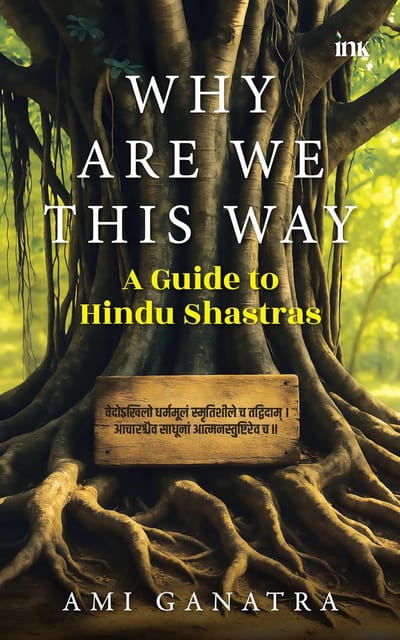
Why Are We This Way A Guide To Hindu Shastras
ISBN:
9789365478440
₹399
₹499
(20% OFF)
Details
- ISBN: 9789365478440
- Author: Ami Ganatra
- Publisher: Ink
- Pages: 304
- Format: Paperback
Book Description
Bharat is among the world’s oldest living civilizations— one whose continuity is not confined to museums or manuscripts but lives and breathes in everyday life: in prayers and mantras that trace back to the Vedas, in the stories of heroes and gods from the Itihasas and Puranas, and in the worldview shaped by the Dharmashastras and Darshanas. Unlike traditions centred on a single canonical book, Hindu dharma is a vast repository of wisdom: the Vedas, Upanishads, Smritis, Puranas, Agamas, Itihasas, and more. Yet, despite inheriting this extraordinary legacy, many today remain unaware of, or confused about, its scope, structure, and spirit. Why Are We This Way is an invitation to rediscover that inheritance—a clear, accessible introduction to Hindu scriptures and the worldview they gave rise to. It does not claim to be exhaustive, nor does it offer rigid conclusions. Instead, it provides a structured gateway into Hindu texts—a foundation upon which readers can build their own journey of understanding. Along the way, it traces how Indian thought, belief, and narrative evolved organically over time—absorbing, refining, and reshaping itself in response to changing realities. The tone of the book may be Hindu-centric, but it is intended for all seekers, beginners, and those curious about India’s civilizational experience. It can be read as a primer on Hindu scriptures, a reference guide, or simply an honest attempt to understand and articulate what it means to be shaped by this ancient, living tradition.
About the Author
Dr Shyamala Vatsa is a medical doctor and psychiatrist based in Bengaluru, Karnataka. She lives with her husband, and their two adult children have long flown the nest. Over the years, she has written extensively on mental health to raise awareness and challenge stigma. In 2012, she contributed a fortnightly column to the newspaper DNA, demystifying common mental illnesses and emphasizing that these conditions often have biological roots—and that there is no shame in seeking help.
In 2016, she wrote a series of articles for the mental health platform White Swan Foundation, aimed at helping readers recognize signs of mental illness in adolescents, so that genuine cases would not be dismissed as typical teenage behaviour.
She is the author of A Little Book for the Hindu Child (2005) and Invisible Patterns (2008), both of which explain the basic tenets of Hinduism in ways that resonate with a child’s life and understanding.
She has been blogging on topics related to mental health and general interest since 2012. Her blog can be found at drshyamalavatsa.wordpress.com
Related Books



₹1,199
₹1,499
(20% OFF)

 +91 9818282497
(2).png)