Shop No.20, Aurobindo Palace Market, Hauz Khas, Near Church +91 9818282497 | 011 26867121 110016 New Delhi IN
Midland The Book Shop ™
Shop No.20, Aurobindo Palace Market, Hauz Khas, Near Church +91 9818282497 | 011 26867121 New Delhi, IN
+919871604786 https://www.midlandbookshop.com/s/607fe93d7eafcac1f2c73ea4/69591829db7aed90e0608dfb/without-tag-line-480x480.png" [email protected]
9788119314669 698ed5082ee776b0a189aae8 108 Portraits of Indian Textiles https://www.midlandbookshop.com/s/607fe93d7eafcac1f2c73ea4/698ed411b41a50983dafbb14/410ngufxjcl.jpg

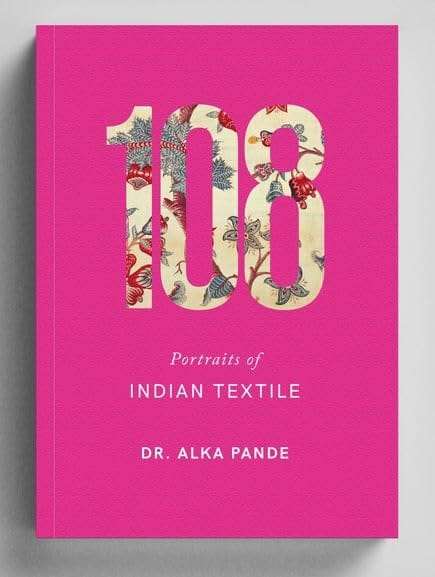
108 Portraits of Indian Textiles
Indian textiles have a long, rich and layered history, from weaves of the Indus Valley Civilization—as seen in the shawl draped across the bearded priest king—to sacred painted cloths of religious icons. Not just Dhaka muslins, prized in ancient Greece and Rome, other Indian textiles too reached royal courts across the world. Hand-block printing, ajrak, tie-and dye, phulkari and kantha embroidery, intricate techniques of chanderi, kalamkari, jamdani, ikat weaves, chintz, paisley and floral motifs, Kashmiri carpets and cashmere shawls, among others, present an exciting journey in the mapping of Indian textiles.

In this fascinating exploration into the complex warp and weft of India, the author also delineates costume styles. From premodern times when men and women were draped in three pieces of unstitched fabrics, the book traces cross-cultural influences of the medieval period, particularly Central Asian, which introduced the stitched trouser, upper garment and drape. The modern period included further influences from colonizers: the British, French, Dutch and Portuguese.

In contemporary India, while fashion designers started noting global trends, traditional textiles and weaves are often incorporated and have a following among connoisseurs, while the draped saree and current interpretations of the three-piece outfit still hold their own. The author draws attention to the finer points of draped clothing and the stitched costumes of stylish chooridars and Mughal angrakhas, luxurious silks and cottons, natural pigments and dyes, brocades and zardozi, complemented with a finely curated selection of visuals of ancient sculptures, paintings and textiles.

About the author

Alka Pande is a distinguished Indian art historian, author, and curator whose work has played a significant role in shaping contemporary discourse on Indian art, aesthetics, and cultural heritage. With a background in art history and museum studies, she has been closely associated with the Indira Gandhi National Centre for the Arts (IGNCA), New Delhi, where she has contributed extensively to research, exhibitions, and cultural documentation. Alka Pande is widely known for her insightful writings on Indian visual traditions, symbolism, and material culture, particularly her pioneering work on jewellery, body adornment, and the philosophy of beauty in Indian art. As a prolific author, she has written several acclaimed books that blend scholarly depth with accessible narrative, making complex cultural ideas engaging for a wider readership. Her curatorial practice reflects a deep sensitivity to history, craft, and contemporary artistic expression. Through her academic, literary, and curatorial contributions, Alka Pande continues to enrich the understanding of India’s diverse artistic and cultural legacy
9788119314669
in stockINR 1199
Dr Alka Pande
1 1
108 Portraits of Indian Textiles

108 Portraits of Indian Textiles

ISBN: 9788119314669
₹1,199


Details
  • ISBN : 9788119314669
  • Author : Alka Pande
  • Publisher : Arthshila Trust
  • Publication date : 2024
  • Format : Paperback
SHARE PRODUCT

Book Description

108 Portraits of Indian Textiles
Indian textiles have a long, rich and layered history, from weaves of the Indus Valley Civilization—as seen in the shawl draped across the bearded priest king—to sacred painted cloths of religious icons. Not just Dhaka muslins, prized in ancient Greece and Rome, other Indian textiles too reached royal courts across the world. Hand-block printing, ajrak, tie-and dye, phulkari and kantha embroidery, intricate techniques of chanderi, kalamkari, jamdani, ikat weaves, chintz, paisley and floral motifs, Kashmiri carpets and cashmere shawls, among others, present an exciting journey in the mapping of Indian textiles.

In this fascinating exploration into the complex warp and weft of India, the author also delineates costume styles. From premodern times when men and women were draped in three pieces of unstitched fabrics, the book traces cross-cultural influences of the medieval period, particularly Central Asian, which introduced the stitched trouser, upper garment and drape. The modern period included further influences from colonizers: the British, French, Dutch and Portuguese.

In contemporary India, while fashion designers started noting global trends, traditional textiles and weaves are often incorporated and have a following among connoisseurs, while the draped saree and current interpretations of the three-piece outfit still hold their own. The author draws attention to the finer points of draped clothing and the stitched costumes of stylish chooridars and Mughal angrakhas, luxurious silks and cottons, natural pigments and dyes, brocades and zardozi, complemented with a finely curated selection of visuals of ancient sculptures, paintings and textiles.
About the author

Alka Pande is a distinguished Indian art historian, author, and curator whose work has played a significant role in shaping contemporary discourse on Indian art, aesthetics, and cultural heritage. With a background in art history and museum studies, she has been closely associated with the Indira Gandhi National Centre for the Arts (IGNCA), New Delhi, where she has contributed extensively to research, exhibitions, and cultural documentation. Alka Pande is widely known for her insightful writings on Indian visual traditions, symbolism, and material culture, particularly her pioneering work on jewellery, body adornment, and the philosophy of beauty in Indian art. As a prolific author, she has written several acclaimed books that blend scholarly depth with accessible narrative, making complex cultural ideas engaging for a wider readership. Her curatorial practice reflects a deep sensitivity to history, craft, and contemporary artistic expression. Through her academic, literary, and curatorial contributions, Alka Pande continues to enrich the understanding of India’s diverse artistic and cultural legacy

User reviews

  0/5