
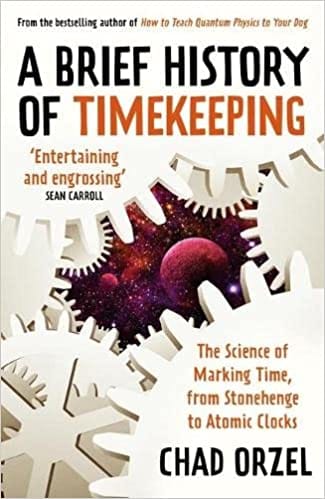
A Brief History Of Timekeeping The Science Of Marking Time From Stonehenge To Atomic Clocks
ISBN:
9780861542154
₹399
₹499
(20% OFF)
Back In Stock Shortly - Fill The Book Request Form
Details
- ISBN: 9780861542154
- Author: Chad Orzel
- Publisher: One World
- Pages: 336
- Format: Paperback
Book Description
Press the snooze button on your alarm once too often and you soon remember the importance of good timekeeping. That need to tell the time connects you to over five thousand years of human history, from the first solstice markers at Newgrange to quartz crystal oscillating in your watch today. Science underpins time: measuring the movement of Sun, Earth and Moon, and unlocking the mysteries of quantum mechanics and relativity theory – the key to ultra-precise atomic clocks. Yet time is also socially decided: the Gregorian calendar we use today came out of fraught politics, while the ancient Maya used sophisticated astronomical observations to produce a calendar system unlike any other. In his quirky and accessible style, Chad Orzel reveals the wondrous physics that makes time something we can set, measure and know.
Review
‘Each day in 2019, Chad Orzel informs us, is nearly two milliseconds longer than days were in 1870. And they feel even longer. This entertaining and engrossing book takes us through our long struggle to measure time with precision. Filled with amazing devices, it’s ultimately a story of the triumph of human ingenuity.’
-- Sean Carroll, author of Something Deeply Hidden‘I came away from this brisk, chatty book feeling that the history of chronometry is a triumph of progress. With infectious enthusiasm [Orzel] catalogues the feats of skill and effort that have gone into marking time… Orzel dives deep into the nitty-gritty of physics, astronomy and engineering, but writes lucidly and leavens his material with jokes and anecdotes… ultimately, one comes away with a sense of awe at what human ingenuity can achieve… stimulating.’
-- Daily Telegraph‘A lively introduction to timekeeping, from the Newgrange passage-tomb to caesium-133 and its possible replacements… As a professor of physics and the author of several popular science books, Orzel is an experienced teacher of science to non-scientists… His account of relativity should be comprehensible even to the single-cultured humanist. Orzel’s research is impressive and he is able to debunk various myths… so much is on offer in Chad Orzel’s book.’
-- TLS‘In A Brief History of Timekeeping, Chad Orzel… turns his enthusiasm for time travel to something more tangible: how humans through the ages have measured the passage of time… Throughout the book, Orzel scoots backwards and forwards in time, treating us to illustrations of spectacular forgotten timepieces… The author’s enthusiasm doesn’t wane as he moves into the digital era, explaining how quartz-based wristwatches “democratised” time and serve as temporal “tuning forks” for the masses… As Orzel’s book makes clear, time, and its measurement, stands still for no one.’
-- George Bass, New Scientist‘A deliciously detailed journey through the astonishing ticks and tocks of timekeeping, from neolithic henges and Mayan number systems to cinnamon-filled sandglasses, tuning fork wristwatches, and even the northern lights. Equal parts mesmerizing and fascinating, Orzel’s beautifully clear explanations of physics illuminate subjects from planets to quantum engineering. By the end it is clear that time may never be on our side, but keeping track of it has opened up the universe for us.’
-- Caleb Scharf, author of The Copernicus Complex‘As Chad Orzel shows in his informative new book, while the pace of modern life seems to march briskly in step with the rhythms of various clocks, keeping accurate time has been a mainstay of history – a driving force for astronomical measurements, and eventually classical and relativistic physics. A Brief History of Timekeeping offers the quintessential account of all the factors that make up ways we record time – from the relatively slow progression of daily and lunar cycles to the near-instantaneous speed of atomic transitions. Orzel’s fascinating chronicle of how we measure the seconds, days, and years that set the stride of our life’s journey is well worth making the time to read – and that literary adventure will fly by, no doubt.’
-- Paul Halpern, author of Flashes of Creation‘Today’s best atomic clocks can track time with a precision of one part in a billion – but getting to this point, as Chad Orzel’s entertaining new book shows, has been an incredible adventure. It’s a history of technology, of course, but we also learn about the underlying science, from the ancient astronomers who first made sense of the motions of the sun, moon, and stars to those who unveiled relativity and quantum mechanics in the last century. If you like science, history, and fun in equal measure, A Brief History of Timekeeping is for you.’
-- Dan Falk, science journalist, author and broadcaster‘A fascinating intersection of science, history, and theology. I never expected to lose track of time reading a book about time.’
-- James Breakwell, comedy writer, creator of @XplodingUnicorn on Twitter, and author of How to Be a Man (Whatever That Means)‘Orzel gives us the grand tour of something we all take for granted. It’s about time.’
-- Chris Ferrie, author of Where Did the Universe Come From?About the Author
Chad Orzel is an associate professor at the department of physics and astronomy at Union College. He has written for Forbes, the Daily Mail.








 +91 9818282497
(2).png)