Shop No.20, Aurobindo Palace Market, Hauz Khas, Near Church +91 9818282497 | 011 26867121 110016 New Delhi IN
Midland The Book Shop ™
Shop No.20, Aurobindo Palace Market, Hauz Khas, Near Church +91 9818282497 | 011 26867121 New Delhi, IN
+919871604786 https://www.midlandbookshop.com/s/607fe93d7eafcac1f2c73ea4/69591829db7aed90e0608dfb/without-tag-line-480x480.png" [email protected]
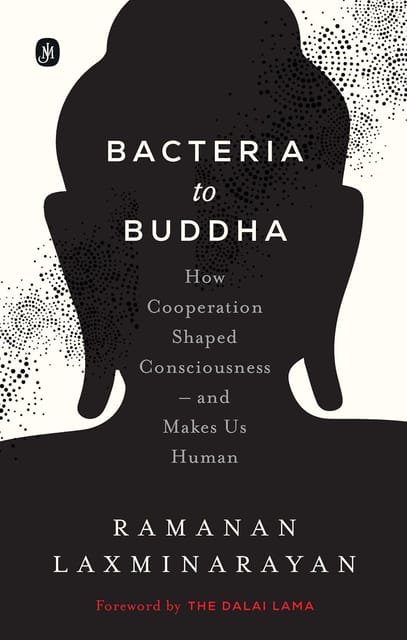
9789357315203 6aabdb45e0dda74810b55cf3 Bacteria To Buddha How Cooperation Shaped Consciousness And Makes Us Human https://www.midlandbookshop.com/s/607fe93d7eafcac1f2c73ea4/6aabdb46e0dda74810b55cfb/71kxlnieqtl-_sl1500_.jpg

What if consciousness evolved not simply to think, but to cooperate?

From the first cells that learned to share energy to human societies that share meaning, life became more complex because organisms learned to work together.

In this provocative book, Ramanan Laxminarayan argues that consciousness emerged as one of evolution's solutions to the challenge of sustaining cooperation. Our brains, emotions and neurochemistry evolved to build trust, repair conflict and maintain the relationships on which survival depended.

This perspective reframes some of humanity's oldest questions. Empathy and compassion become more than moral virtues; they are among evolution's greatest innovations. Meditation is more than a spiritual practice; it is a way of restoring the balance that keeps cooperation alive.

As AI increasingly mediates how we learn, communicate and relate to one another, the greatest danger may not be that machines will outthink us, but that they will weaken the human bonds that sustain consciousness.

Drawing on evolutionary biology, neuroscience and contemplative traditions, Bacteria to Buddha offers a new account of how cooperation shaped consciousness and how it makes us human.

About the Author

RAMANAN LAXMINARAYAN is an engineer, economist and epidemiologist whose work focuses on shared global resources, including antimicrobial effectiveness, pandemic preparedness and vaccine access. He is president of the One Health Trust, a global research organization based in Washington, D.C. and Bangalore, and a Senior Research Scholar at Princeton University.

He has advised governments, the World Health Organization and the United Nations on global health policy and served on the antimicrobial resistance working group of the U.S. President's Council of Advisors on Science and Te

9789357315203
in stock INR 639
1 1

Bacteria To Buddha How Cooperation Shaped Consciousness And Makes Us Human

ISBN: 9789357315203
₹639
₹799   (20% OFF)


Details
  • ISBN: 9789357315203
  • Author: Ramanan Laxminarayan
  • Publisher: John Murray Learning
  • Pages: 280
  • Format: Hardback
SHARE PRODUCT

Book Description

What if consciousness evolved not simply to think, but to cooperate?

From the first cells that learned to share energy to human societies that share meaning, life became more complex because organisms learned to work together.

In this provocative book, Ramanan Laxminarayan argues that consciousness emerged as one of evolution's solutions to the challenge of sustaining cooperation. Our brains, emotions and neurochemistry evolved to build trust, repair conflict and maintain the relationships on which survival depended.

This perspective reframes some of humanity's oldest questions. Empathy and compassion become more than moral virtues; they are among evolution's greatest innovations. Meditation is more than a spiritual practice; it is a way of restoring the balance that keeps cooperation alive.

As AI increasingly mediates how we learn, communicate and relate to one another, the greatest danger may not be that machines will outthink us, but that they will weaken the human bonds that sustain consciousness.

Drawing on evolutionary biology, neuroscience and contemplative traditions, Bacteria to Buddha offers a new account of how cooperation shaped consciousness and how it makes us human.

About the Author

RAMANAN LAXMINARAYAN is an engineer, economist and epidemiologist whose work focuses on shared global resources, including antimicrobial effectiveness, pandemic preparedness and vaccine access. He is president of the One Health Trust, a global research organization based in Washington, D.C. and Bangalore, and a Senior Research Scholar at Princeton University.

He has advised governments, the World Health Organization and the United Nations on global health policy and served on the antimicrobial resistance working group of the U.S. President's Council of Advisors on Science and Te

User reviews

  0/5