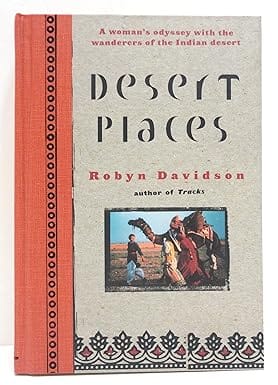
The Rebari are a nomadic tribe in India's Thar Desert. Like nomads everywhere, the Rebari are being forced into accepting a more sedentary life. Their traditional trading and pilgrimage routes have been transected by borders and canals or blocked by atomic bomb testing sites and irrigated farm lands. But once a year, they arrive in Pushkar, partly as a pilgrimmage to bathe in the most sacred lake in India, partly to buy and sell their animals, partly to enjoy the biggest annual fair in Asia. Robyn Davidson crossed the pathless Thar Desert with the Rebari. Interwoven with the journey of the Rebari is the story of Minu, a highly spirited upperclass Indian woman, forced into an arranged marriage with the ex-king of Ghanerao, locked up in the women's quarters of the palace and subject both to the strict laws of Purdah and to psychological warfare with her in-laws.
Amazon.com Review
As Robyn Davidson writes in Desert Places, the Thar, a 230,000-square-mile expanse of formidably dry country in northwestern India, is a harsh land of "granite outcroppings, naked but for a few gullies of monsoon forest or a single, white-painted elephant stationed on a summit eternally surveying the farmlands below." Among the people who populate the Thar are the Rabari, who are quickly becoming modernized and dispossessed, wanderers on the fringes of urban civilization, people who are at home nowhere. After making a false start as a book of adventure travel, Desert Places becomes a work of cultural ecology and of amateur anthropology, reporting on the final days of a traditional nomadic culture once utterly at home in an inhospitable land.
Compared with her native Australia, the setting for her best-known book, Tracks (1981), India seemed unbearably congested, dirty, and frenetic to Davidson. But passionately interested in nomadic life and acutely aware of its imminent demise, she was determined to travel with the Rabari, the subcontinent's few remaining traditional nomads, as they herded their sheep across the blistering northwest wasteland. What seemed like a reasonable undertaking soon degenerated into myriad frustrations and infuriating confrontations. The first white-skinned person seen in the region, Davidson was mobbed by aggressive crowds everywhere she went. She could not speak the language and felt "stripped" of her humanity, a freak among the hardworking, brusque Rabari. Her total immersion in their grueling existence exacted a toll on her body, but it was her soul that was tormented the most as she struggled to remain open-minded in spite of her outrage at India's fathomless capacity for suffering. As courageous on paper as on desert sands, Davidson will both disturb and exhilarate readers with the acuity of her observations, the sting of her wit, and the candor of her emotions. Donna Seaman










 +91 9818282497
(2).png)