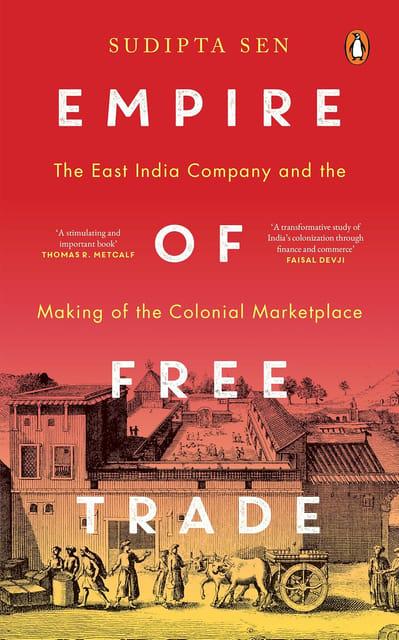
On the eve of British rule in India, bustling marketplaces of the lower Ganga plains and coastal Bengal served as the nodes of an extensive and dynamic network of inland and maritime trade. Indigenous commerce was embedded in intricate social, political and religious practices, which the officials and agents of the English East India Company began to infringe and subvert to advance their own mercantile and political interests.
In Empire of Free Trade, Sudipta Sen shows how such marketplaces became the early sites of conflict between the Company and the ruling Nawabs of Bengal-regional heads of the Mughal Empire,
whose authority the British would ultimately usurp. After it took over the reins of administration, the Company was able to extend its control over trade routes and market exchange by reinforcing the
departments of police and customs.
The book challenges current histories of the period that describe the Company as a trading corporation drawn unprepared into the exigencies of warfare and taxation or portray early British rule as
just another version of a regime founded on the participation of local landed elites and mercantile groups. It argues instead that the Company, encouraged by its military victories in the second half of the eighteenth century, began to build a powerful and intrusive state in India. It was able to undermine, through stringent fiscal and legal measures, the hierarchies and norms of Indian market culture, justifying their intervention in the name of economic reform and free trade . The chaos and disorder that resulted from this dismantling
helped prepare the way for the eventual assimilation of Bengal and northern India into the British Empire.
Sudipta Sen is chair and professor of the Department of History and professor of Middle East/South Asia Studies at the University
of California, Davis. A historian of late Mughal and early British India and the British Empire, his recent work focuses on environmental history and the history of early British rule in India. Sen has taught at Beloit College, University of California, Berkeley and Syracuse University. A recipient of the Daniel Patrick Moynihan Prize for his contribution to research and teaching at
the Maxwell School of Citizenship and Public Affairs, Syracuse University, he was awarded the Sir William Jones Memorial Medal by the Asiatic Society of India for his lifetime contribution to history and Asian studies in 2022. His publications include Empire of Free Trade: The East India Company and the Making
of the Colonial Marketplace (University of Pennsylvania Press, 1998); Distant Sovereignty: National Imperialism and the Origins of British India (Routledge UK, 2002); Ganges: The Many Pasts of an Indian River (Yale University Press, 2018; Penguin Random House, Delhi, 2019); Terra Aqua: The Amphibious Lifeworlds of Coastal and Maritime South Asia, co-edited

On the eve of British rule in India, bustling marketplaces of the lower Ganga plains and coastal Bengal served as the nodes of an extensive and dynamic network of inland and maritime trade. Indigenous commerce was embedded in intricate social, political and religious practices, which the officials and agents of the English East India Company began to infringe and subvert to advance their own mercantile and political interests.
In Empire of Free Trade, Sudipta Sen shows how such marketplaces became the early sites of conflict between the Company and the ruling Nawabs of Bengal-regional heads of the Mughal Empire,
whose authority the British would ultimately usurp. After it took over the reins of administration, the Company was able to extend its control over trade routes and market exchange by reinforcing the
departments of police and customs.
The book challenges current histories of the period that describe the Company as a trading corporation drawn unprepared into the exigencies of warfare and taxation or portray early British rule as
just another version of a regime founded on the participation of local landed elites and mercantile groups. It argues instead that the Company, encouraged by its military victories in the second half of the eighteenth century, began to build a powerful and intrusive state in India. It was able to undermine, through stringent fiscal and legal measures, the hierarchies and norms of Indian market culture, justifying their intervention in the name of economic reform and free trade . The chaos and disorder that resulted from this dismantling
helped prepare the way for the eventual assimilation of Bengal and northern India into the British Empire.
Sudipta Sen is chair and professor of the Department of History and professor of Middle East/South Asia Studies at the University
of California, Davis. A historian of late Mughal and early British India and the British Empire, his recent work focuses on environmental history and the history of early British rule in India. Sen has taught at Beloit College, University of California, Berkeley and Syracuse University. A recipient of the Daniel Patrick Moynihan Prize for his contribution to research and teaching at
the Maxwell School of Citizenship and Public Affairs, Syracuse University, he was awarded the Sir William Jones Memorial Medal by the Asiatic Society of India for his lifetime contribution to history and Asian studies in 2022. His publications include Empire of Free Trade: The East India Company and the Making
of the Colonial Marketplace (University of Pennsylvania Press, 1998); Distant Sovereignty: National Imperialism and the Origins of British India (Routledge UK, 2002); Ganges: The Many Pasts of an Indian River (Yale University Press, 2018; Penguin Random House, Delhi, 2019); Terra Aqua: The Amphibious Lifeworlds of Coastal and Maritime South Asia, co-edited
Subscribe to get Email Updates!
Thanks for subscribing.
Your response has been recorded.
"We Believe In The Power of Books" Our mission is to make books accessible to everyone, and to cultivate a culture of reading and learning. We strive to provide a wide range of books, from classic literature, sci-fi and fantasy, to graphic novels, biographies and self-help books, so that everyone can find something to read.
Whether you’re looking for your next great read, a gift for someone special, or just browsing, Midland is here to make your book-buying experience easy and enjoyable.
(2).png)