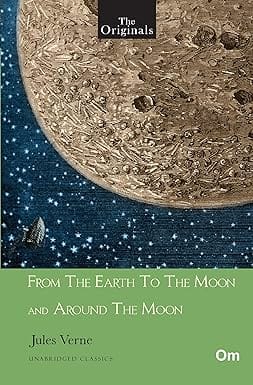
“It is better for us to see the destination we wish to reach, than the point of departure.” From the Earth to the Moon (1865) is a novel by French writer Jules Verne. Verne wrote a sequel to this novel titled Around the Moon five years later. From the Earth to the Moon and Around the Moon feature the efforts of the Baltimore Gun Club, a post-Civil War society of weapon lovers, to build the Columbiad space gun and travel to the moon. The gun is meant to launch three people—the Club’s president, his Philadelphian rival, and a French poet—in a projectile that will pull off a moon landing. The story is memorable for many reasons, among which is the fact that Verne presented some rough calculations about the requirements for the cannon in it. Even though there was little empirical data on the subject at the time, some of Verne’s figures turned out to be accurate. From the Earth to the Moon was adapted as the opera Le voyage dans la lune in 1875 with music by Jacques Offenbach.
About the Author
Jules Gabriel Verne (1828−1905) was a French novelist, poet, essayist and playwright, who has also been the world’s second- most translated writer since 1979. Popular for writing about air, underwater and space travel much before submarines or air travel became a reality, Verne was a visionary. Early in life, he began writing for magazines and his collaboration with Pierre-Jules Hetzel led to the creation of the ‘Voyages Extraordinaires’ series that included Journey to the Center of the Earth (1864), 20,000 Leagues Under the Sea (1870) and Around the World in 80 Days (1873). In his work, Verne imagined a more harmonious and humanitarian society. English translations of Verne’s novels began in 1869, with William Lackland’s translation of Five Weeks in a Balloon (originally published in 1863), and continued throughout his writing career. On Verne and his influence on literature, Ray Bradbury remarked, “We are all, in one way or another, the children of Jules Verne.”









 +91 9818282497