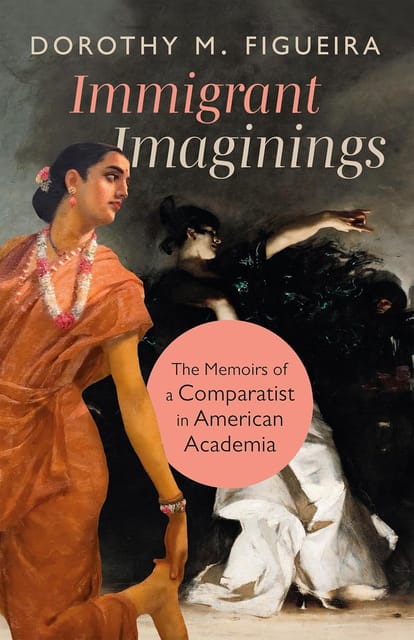
Irreverent yet moving memoirs of a comparative literature scholar whose immigrant inheritance shaped her education, her engagement with India and her experience of American academia.
Dorothy M. Figueira started life in a working-class immigrant household in upstate New York. Her father came from British Guiana; her mother was Italian American. Neither had much formal education. They gave their children faith in learning, coupled with the courage to stand their ground. That inheritance led Figueira to comparative literature, to the Classics, French and German literatures, and Sanskrit. It sustained her through a long career in American academia.
In Immigrant Imaginings, Figueira looks back at the people who formed her and the institutions that tried to define her. There are the Italian grandparents who believed fiercely in the American Dream, and the bookish father who taught her that knowledge was a form of dignity. At the center is her formidable mother, who refused to let a school decide that her daughter should become a hairdresser. The family story later extends to two daughters adopted from India, and to the complicated inheritance they had to make their own.
The book is also an unsparing account of university life. Figueira recalls its casual racism and sexual patronage, as well as intellectual fashions and bureaucratic absurdities. She is hired as a Target of Opportunity, a beneficiary of affirmative action. Yet she refuses to be confined to the subjects her colleagues believe her background fits her to teach. To them, her independence makes her the wrong kind of brilliant.
Written in a learned, irreverent voice, these memoirs follow an outsider who claimed her place without learning to flatter power. They ask a serious question: what do immigration and education make possible, and what can they never erase?
Dorothy M. Figueira is a Distinguished Research Professor at the University of Georgia (USA). She studied at Vassar College (BA, 1976), cole Pratique en Sciences Sociales (MA, 1977), Harvard University (MTS, 1979) and the University of Chicago (PhD, 1985). Her scholarly interests include religion and literature, translation theory, exoticism, myth theory and travel narratives. She is the author of Translating the Orient (1991), The Exotic: A Decadent Quest (1994), Aryans, Jews, Brahmins: Theorizing Authority through Myths of Identity (2002), Otherwise Occupied: Pedagogies of Alterity and the Brahminization of Theory (2008), The Hermeneutics of Suspicion: Cross-Cultural Encounters with India (2015) and The Afterlives of the Bhagavad Gita: Readings in Translation (2023). She has edited La Production de l Autre (1999), Cybernetic Ghosts (2004), Art and Resistance: Studies in Indian Theatre (2019),

Irreverent yet moving memoirs of a comparative literature scholar whose immigrant inheritance shaped her education, her engagement with India and her experience of American academia.
Dorothy M. Figueira started life in a working-class immigrant household in upstate New York. Her father came from British Guiana; her mother was Italian American. Neither had much formal education. They gave their children faith in learning, coupled with the courage to stand their ground. That inheritance led Figueira to comparative literature, to the Classics, French and German literatures, and Sanskrit. It sustained her through a long career in American academia.
In Immigrant Imaginings, Figueira looks back at the people who formed her and the institutions that tried to define her. There are the Italian grandparents who believed fiercely in the American Dream, and the bookish father who taught her that knowledge was a form of dignity. At the center is her formidable mother, who refused to let a school decide that her daughter should become a hairdresser. The family story later extends to two daughters adopted from India, and to the complicated inheritance they had to make their own.
The book is also an unsparing account of university life. Figueira recalls its casual racism and sexual patronage, as well as intellectual fashions and bureaucratic absurdities. She is hired as a Target of Opportunity, a beneficiary of affirmative action. Yet she refuses to be confined to the subjects her colleagues believe her background fits her to teach. To them, her independence makes her the wrong kind of brilliant.
Written in a learned, irreverent voice, these memoirs follow an outsider who claimed her place without learning to flatter power. They ask a serious question: what do immigration and education make possible, and what can they never erase?
Dorothy M. Figueira is a Distinguished Research Professor at the University of Georgia (USA). She studied at Vassar College (BA, 1976), cole Pratique en Sciences Sociales (MA, 1977), Harvard University (MTS, 1979) and the University of Chicago (PhD, 1985). Her scholarly interests include religion and literature, translation theory, exoticism, myth theory and travel narratives. She is the author of Translating the Orient (1991), The Exotic: A Decadent Quest (1994), Aryans, Jews, Brahmins: Theorizing Authority through Myths of Identity (2002), Otherwise Occupied: Pedagogies of Alterity and the Brahminization of Theory (2008), The Hermeneutics of Suspicion: Cross-Cultural Encounters with India (2015) and The Afterlives of the Bhagavad Gita: Readings in Translation (2023). She has edited La Production de l Autre (1999), Cybernetic Ghosts (2004), Art and Resistance: Studies in Indian Theatre (2019),
Subscribe to get Email Updates!
Thanks for subscribing.
Your response has been recorded.
"We Believe In The Power of Books" Our mission is to make books accessible to everyone, and to cultivate a culture of reading and learning. We strive to provide a wide range of books, from classic literature, sci-fi and fantasy, to graphic novels, biographies and self-help books, so that everyone can find something to read.
Whether you’re looking for your next great read, a gift for someone special, or just browsing, Midland is here to make your book-buying experience easy and enjoyable.
(2).png)