
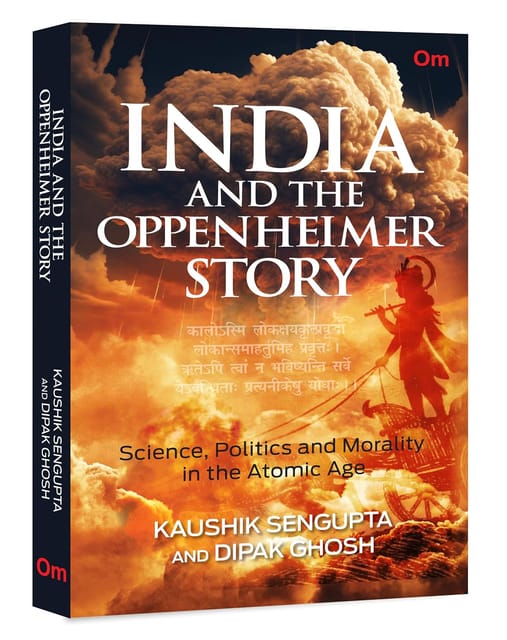
India And The Oppenheimer Story Science, Politics And Morality In The Atomic Age
ISBN:
9789363959415
₹319
₹399
(20% OFF)
Details
- ISBN: 9789363959415
- Author: Kaushik Sengupta
- Publisher: Om Books
- Pages: 284
- Format: Paperback
Book Description
When the father of the atomic bomb turned to an Indian scripture to grasp the meaning of unimaginable power, history entered a moral crossroads the world is still navigating. India and the Oppenheimer Story: Science, Politics and Morality in the Atomic Age offers a sweeping, incisive account of the nuclear age anchored by one of its most haunting cultural intersections: J. Robert Oppenheimer s invocation of the Bhagavad Gita at the first atomic test. As the desert sky over New Mexico lit up during the Trinity explosion, Oppenheimer reached instinctively for Krishna s words, not as rhetorical flourish, but as a philosophical lens through which an American physicist interpreted a civilizational moment. Oppenheimer turned to ancient wisdom to make sense of existential technology, a gesture that underscores the book s relevance today. As we face our own modern crossroads from artificial intelligence to genetic engineering and climate change the need for clear moral frameworks is as urgent now as it was in the New Mexico desert in 1945. This book places his invocation within a broader Indian intellectual lineage, revealing how the Gita s meditations on duty, detachment, and moral burden shaped Oppenheimer s self-understanding amid the pressures of the Manhattan Project. Moving far beyond biography, the narrative traces the scientific breakthroughs, political rivalries, and ethical crises that defined the race to build, and later escalate, nuclear weapons. It examines why Germany failed to develop the bomb, how the hydrogen bomb deepened ideological divides, and why Oppenheimer s dissent cost him dearly. The book also restores overlooked contributors, including women scientists, and confronts the human toll in Japan. Balanced, accessible, and deeply reflective, this is an essential guide to the entangled legacies of science, geopolitics, and the ancient Indian text that whispered to a man standing at the dawn of the atomic age.
About the Author
Kaushik Sengupta is a trained experimental particle physicist and software engineer with a strong interest in communicating research to wider audiences. He has worked at SUNY Buffalo and Louisiana State University on high-energy physics experiments with international collaborators, including NASA, and later developed expertise in mathematical computing and software design.
Prof. Dipak Ghosh, a gold medallist and PhD in high-energy physics, has published over 400 papers, guided more than 75 PhD scholars, and held senior academic positions at Jadavpur University. Founder of the Sir C.V. Raman Centre for Physics and Music, he now works as Emeritus Professor, studying music s effects on the human brain, and is a recipient of the Sir C.V. Raman Award.
Prof. Dipak Ghosh, a gold medallist and PhD in high-energy physics, has published over 400 papers, guided more than 75 PhD scholars, and held senior academic positions at Jadavpur University. Founder of the Sir C.V. Raman Centre for Physics and Music, he now works as Emeritus Professor, studying music s effects on the human brain, and is a recipient of the Sir C.V. Raman Award.
Related Books




₹1,759
₹2,199
(20% OFF)




 +91 9818282497
(2).png)