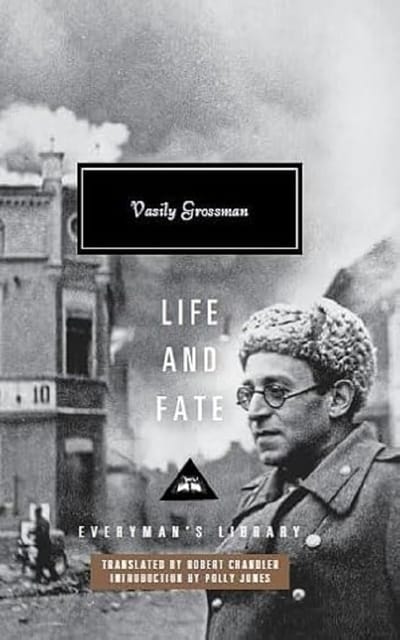
Based around the pivotal WWII battle of Stalingrad (1942-3), where the German advance into Russia was eventually halted by the Red Army, and around an extended family, the Shaposhnikovs, and their many friends and acquaintances, Life and Fate recounts the experience of characters caught up in an immense struggle between opposing armies and ideologies. Nazism and Communism are appallingly similar, 'two poles of one magnet', as a German camp commander tells a shocked old Bolshevik prisoner. At the height of the battle Russian soldiers and citizens alike are at last able to speak out as they choose, and without reprisal - an unexpected and short-lived moment of freedom. Grossman himself was on the front line as a war correspondent at Stalingrad - hence his gripping battle scenes, though these are more than matched by the drama of the individual conscience struggling against massive pressure to submit to the State. He knew all about this from experience too. His central character, Viktor Shtrum, eventually succumbs, but each delay and act of resistance is a moral victory. Though he writes unsparingly of war, terror and totalitarianism, Grossman also tells of the acts of 'senseless kindness' that redeem humanity, and his message remains one of hope. He dedicates his book, the labour of ten years, and which he did not live to see published, to his mother, who, like Viktor Shtrum's, was killed in the holocaust at Berdichev in Ukraine in September 1941.
About the Author
Vasily Grossman was born in 1905. In 1941, he became a war reporter for the Red Army newspaper Red Star and came to be regarded as a legendary war hero. Life and Fate, his masterpiece, was considered a threat to the totalitarian regime, and Grossman was told that there was no chance of the novel being published for another 200 years. Grossman died in 1964.
Robert Chandler's translations from Russian include works by Alexander Pushkin, Andrey Platonov, Vasily Grossman and Hamid Ismailov. He is the editor and main translator of Russian Short Stories from Pushkin to Buida and Russian Magic Tales from Pushkin to Platonov, and together with Boris Dralyuk and Irina Mashinski he co-edited The Penguin Book of Russian Poetry.








 +91 9818282497
(2).png)