
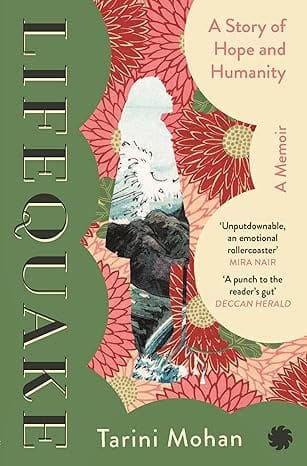

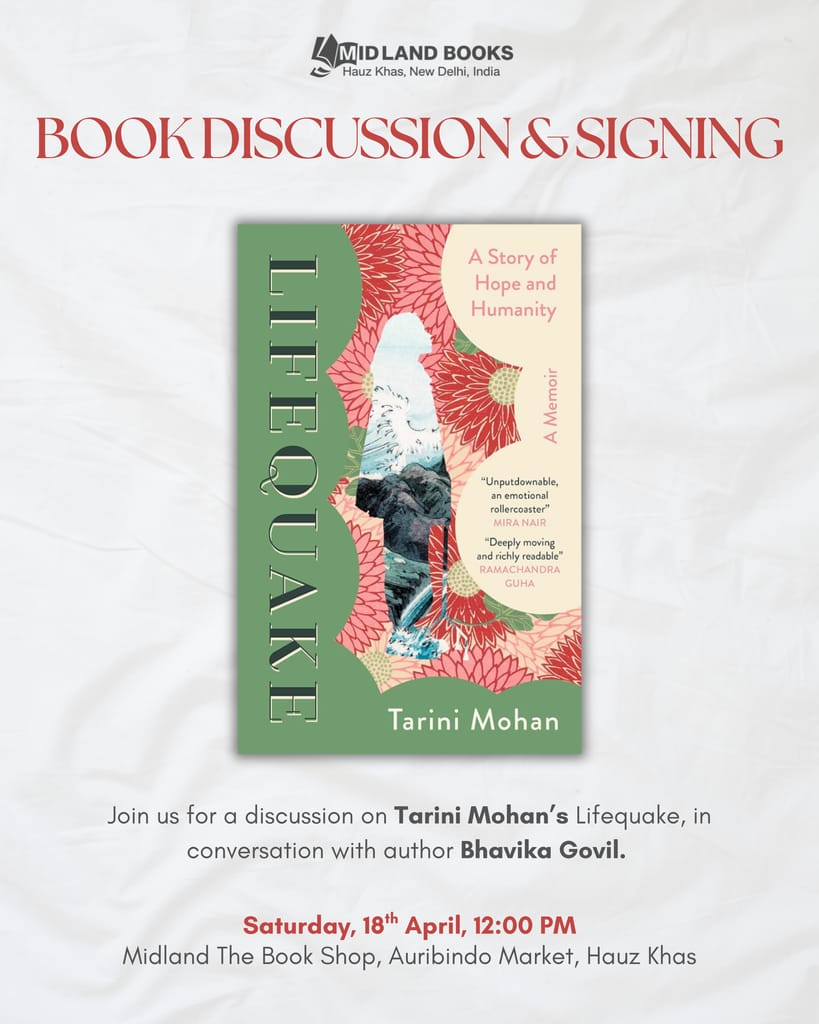


Lifequake A Story Of Hope And Humanity
ISBN:
9789353458140
₹479
₹599
(20% OFF)
Details
- ISBN: 9789353458140
- Author: Tarini Mohan
- Publisher: Juggernaut
- Pages: 296
- Format: Paperback
Book Description
Related Books

₹1,759
₹2,199
(20% OFF)





User reviews
1 Review
A Story of Hope and Humanity: A Personal Reflection on Tarini Mohan’s Lifequake I met Tarini Mohan over Zoom before I read her book. I had seen her name in the Wellesley directory haphazardly and sent a note. She replied with warmth, and a few days later she appeared on my screen—steady, mild, her speech deliberate but her mind quick. She spoke of her story without decoration and of her recovery without fanfare. By the time the call ended, something in me had settled. I asked how I could support her work. She said, “Welcome to read my book.” I did. Now I am asking you to do the same. Lifequake is not a memoir about tragedy. It is a memoir about after. The motorcycle taxi crash in Kampala, the three-month coma, the brain injury she describes as a “tornado”—these are the seismic event. The book’s true subject is the landscape that emerges once the shaking stops. Tarini wakes to a body that no longer obeys her. Her right arm is “locked in a cage,” her right leg “mutinous” in its brace. Her speech comes out mangled. And yet her long-term memory is intact. This is the first of the memoir’s many paradoxes, and she spends the rest of the book teaching us that paradox is not an obstacle to living—it is the shape of a life rebuilt on new terms. The Architecture of Memory Memory is a puzzle the brain’s personal library. Tarini describes emotions as the librarian, determining which books are easiest to locate. She pieces together the accident from the accounts of others, “bit by bit,” and her own memories return in fragments—faces, places, the taste of hot chocolate fudge from Nirula’s. What moved me is how she treats memory as a collaborative act. She rebuilds her past with help from friends and family. There is no single, authoritative version of what happened. There is only the story she assembles, with enormous effort and love, into something that can carry her forward. This is not a book about the accident. It is a book about the narrative that comes after—the slow, painstaking work of fitting the shards into a shape that makes sense. She does this with a candour, realism, and often, unexpectedly, funny. In my own writing, I have been drawn to the moment when a system stops pretending to be inpenetrable and begins to tell the truth about its fractures. Tarini does this on every page. The Body as Geography She calls the experience a tornado, but what she describes is closer to what I see as a resonance shift—a violent re-tuning of the entire instrument. The body becomes a landscape of recalcitrant geographies. She describes her physical therapy room as a “gym” she fantasises about resigning from—and does, in one of the book’s most triumphant moments, calling the PT department to announce, “I’m resigning from the gym.” The nurse, understanding, hands her the receiver. Agency is a muscle too. What Tarini understands is that physical recovery is never only physical. Every attempt to move a hand is a negotiation with identity. “This wasn’t who I’d been, wasn’t who I was inside, or who I wanted to be,” she writes. “I didn’t want to live curled up on my parents, or anyone else’s lap.” That sentence holds a universe of grief and defiance. She is mourning not just a body but a self—the self that strode through Wall Street, that moved to Uganda with a hunger for meaning, that danced with a boy named Nikhil to a bad speaker in a cluttered Harvard dorm room. And yet, even in the grief, there is steel. The Loyalists No account of this book would be complete without the parents. The bond between Tarini and her father, “Papa,” is one of the memoir’s most moving threads. He calls her “Pom,” a nickname from childhood, and his faith in her—“Papa’s Pom is a champion!”—becomes the bedrock on which she rebuilds. But it is her mother, “Mama,” who holds the vigil. She sings the notes of a Bharatanatyam piece, tapping the rhythm with a teaspoon on the bedframe, calling her daughter back from the fog. “Find your way back to your Mama,” she whispers. “There is no life without you.” To see these two forms of love—the mother’s constancy, the father’s methodical optimism—is to understand that no recovery is solo. It is held, always, by others. The Question of Love The relationship with Nikhil is handled with extraordinary delicacy. He visits her in the Delhi hospital, and she is seized with a mixture of love and irritation—he shuts down her emotional outpouring, says they shouldn’t get “too sentimental.” She bristles, then corrects herself: “Calm down, Nikhil’s continued partnership is proof of his love for you.” The tension between what she needs and what he can give is never resolved neatly. It simply is, like the right hand that will never fully open. Love, after a lifequake, becomes another landscape that must be remapped. Her honesty here is one of the book’s quiet strengths. The World’s Pity and the Self’s Defiance One of the most searing passages is her dissection of pity. A stranger in an elevator speaks to her through her parents, as if she were a child. She learns to distinguish pity—passive, condescending, an end in itself—from concern and compassion, which are active, dignifying, rooted in connection rather than power. This is not theoretical. It is hard-won emotional intelligence. And it contains a lesson for all of us: the way we are seen shapes the way we are able to see ourselves. Tarini will not be pitied. She demands to be respected. And respect, for her, includes the right to be seen in her full complexity—as a woman, a daughter, a friend, a thinker, a dreamer, and yes, a person with a disability that is “only one part, even if an all-too-visible one, of who I am.” That line struck me with the force of a truth I have been circling for years: the visible thing is never the whole thing. The body is not the self. The limitation is not the identity. Determination as a Philosophy Determination as a substitute for a functioning brain. The phrase cuts to the memoir’s deepest tension. After the accident, Tarini decides to apply to business schools, to reclaim a trajectory violently interrupted. She worries her cognitive abilities are diminished and wonders, “Do they think determination is a substitute for a functioning brain?” The question is rhetorical, but the answer is complicated. Determination is not a substitute for a functioning brain. It is, however, the force that rewires the brain, that insists on trying when the neural pathways are damaged and the body refuses. She gets into the Yale School of Management. She works at the World Bank and in education policy. None of this is framed as fairy-tale triumph. Every achievement is shadowed by the knowledge of what it costs, of the assistance required. But she does it anyway. The Beauty of the Ordinary What shines through, finally, is not extraordinary recovery but the ordinary, stubborn, radiant will to live a life of meaning. Tarini loves jazz music’s horn section. She finds inspiration in cute coffee shops. She writes of soap bubbles, of the fragility of being in the world, and yet she does not retreat. She learns, slowly and incompletely, to fly with clipped wings—a phrase she uses, and one that I will carry. In her current work, she focuses on disability inclusion, turning her own experience into a force that reshapes institutions. This is the arc of a life lived in the key of acceptance—not passive resignation, but the active, daily embrace of what is, coupled with the fierce belief that what is can still be beautiful. A Meeting of Resonance When we spoke on Zoom, I was struck by how fully present she was. Her mind was quick, her humour warm and unassuming, her generosity unmistakable. She had learned something most of us never learn: to inhabit her life without apology, to accept help without diminishing herself, to understand that needing others is not a failure but a condition of being human. And she had learned that gratitude is not a posture but a practice—a daily, cellular decision to notice what is still beautiful, still possible, still intact. We spoke of Wellesley—the residential halls, the midnight library lights, the particular ambition the College instills: the deep hunger to do work that matters. And though unspoken, we both shared a moment of understanding of ambition forced to reckon with limitation—when the body, or circumstance, or simple fate intervenes and the script must be rewritten. Tarini did not present herself as a hero. She presented herself as a person who was given conditions she did not choose, and who decided, in the long and unglamorous aftermath, to keep choosing life, meaning and connection. That kind of courage is not flashy. It does not make headlines. It is the courage of the daily, the cellular, the incremental. It is the courage of those who wake each morning to an altered reality, and still find reasons to greet the day with a deep inhalation and joy. An Invitation I invite anyone who has held the weight of a path they never chose—in body, in circumstance, in the quiet grief of an unexpected life—to read this book and find in its pages both recognition and an outstretched hand. Read this if you have ever felt your life splinter, and needed to know that the pieces could be gathered into a new and unexpected shape. Read it if you have ever loved someone whose body or mind was changed forever. Read it if you carry, as I do, the weight of unchosen difficulties—whether in career, in health, in love, or in the task of accepting oneself as one actually is. Read it if you need to remember what courage actually looks like—not the grand, cinematic kind, but the daily, cellular kind, the kind that decides, again and again, that life is still beautiful. Is beautiful. Tarini Mohan has written a memoir that reaches far beyond the particulars of her own life. Not in the way she planned. But in a way that radiates outward, touching everyone who encounters her story. Her book is a gift. I hope you will receive it, and that it will teach you, as it taught me, to live today with a heart of appreciation—for what is here, for what is possible, and for the luminous fact of being alive. C. de FleuryApr 26, 2026 1:01:06 PM


 +91 9818282497
(2).png)