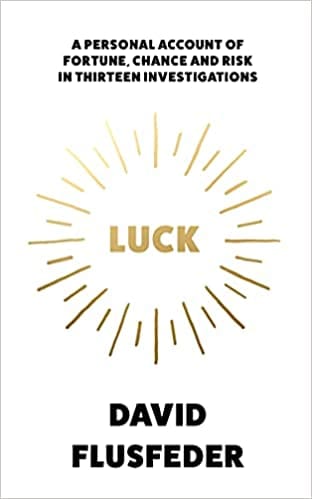
A fascinating, enchanting and painfully personal look at the meaning of luck, and the way in which it has shaped our shared history and continues to inflect our day to day lives.
What does it mean to be lucky? How might we mitigate the effects of bad luck and maximise those of good? Is there actually such a thing as ‘luck’-some force that intervenes between desire and its consummation, that impedes or hastens it?
To answer these questions, David Flusfeder sets out on a search for the definition of luck. This quest will take him to Siberia, Versailles, the Old Testament desert; play roulette in Baden-Baden with Dostoevsky; visit a Cambridge fairground with Wittgenstein; meet the sixteenth-century poet Thomas Bastard, who challenged Fortune, and lost; find Nietzsche on the slopes of Vesuvius; learn about the pioneers of probability; the twentieth-century art investigators of chance and possibility; and the intensely personal story of his father’s good fortune in escaping war-time Poland. Starting at the British Library in London, and following the dictates of an online randomiser that decided the chapter order, Flusfeder follows in the footsteps of some victors of luck and those who were defeated by it, from ancient times to the modern day.
Luck asks fundamental questions about the world, ourselves, our place in it. In these questions, about our relationships to fortune, to risk, to opportunity, to chance, destiny and fate, we find ourselves deciding who we are and how we might choose to live.
‘Luck is a wonderful intermingling of the historic, philosophical and literary, with tales of the author and his engaging, complicated, extraordinary father. A joy’ Philippe Sands
‘An extraordinary collection of insights into luck, skilfully combining personal stories and historical studies into a partly random structure. It has a glorious unpredictability, producing a stimulating feeling of uncertainty about what the next gem will turn out to be’ David Spiegelhalter
‘Thrilling, intelligent and wilfully unique, with the bonus ball of being unexpectedly moving, David Flusfeder’s thirteen investigations are the result of a lifetime of original thinking. I loved it’ James Runcie
‘This deep, particular and witty examination of the nature of luck and its role in human existence is an absolute joy, from random start to mysterious finish. A most unusual book’ Louisa Young
David Flusfeder is the author of six novels: Man Kills Woman (1993), Like Plastic (1996), which won the Encore Award, Morocco (2001), The Gift (2003), The Pagan House (2007) and A Film by Spencer Ludwig (2010).

A fascinating, enchanting and painfully personal look at the meaning of luck, and the way in which it has shaped our shared history and continues to inflect our day to day lives.
What does it mean to be lucky? How might we mitigate the effects of bad luck and maximise those of good? Is there actually such a thing as ‘luck’-some force that intervenes between desire and its consummation, that impedes or hastens it?
To answer these questions, David Flusfeder sets out on a search for the definition of luck. This quest will take him to Siberia, Versailles, the Old Testament desert; play roulette in Baden-Baden with Dostoevsky; visit a Cambridge fairground with Wittgenstein; meet the sixteenth-century poet Thomas Bastard, who challenged Fortune, and lost; find Nietzsche on the slopes of Vesuvius; learn about the pioneers of probability; the twentieth-century art investigators of chance and possibility; and the intensely personal story of his father’s good fortune in escaping war-time Poland. Starting at the British Library in London, and following the dictates of an online randomiser that decided the chapter order, Flusfeder follows in the footsteps of some victors of luck and those who were defeated by it, from ancient times to the modern day.
Luck asks fundamental questions about the world, ourselves, our place in it. In these questions, about our relationships to fortune, to risk, to opportunity, to chance, destiny and fate, we find ourselves deciding who we are and how we might choose to live.
‘Luck is a wonderful intermingling of the historic, philosophical and literary, with tales of the author and his engaging, complicated, extraordinary father. A joy’ Philippe Sands
‘An extraordinary collection of insights into luck, skilfully combining personal stories and historical studies into a partly random structure. It has a glorious unpredictability, producing a stimulating feeling of uncertainty about what the next gem will turn out to be’ David Spiegelhalter
‘Thrilling, intelligent and wilfully unique, with the bonus ball of being unexpectedly moving, David Flusfeder’s thirteen investigations are the result of a lifetime of original thinking. I loved it’ James Runcie
‘This deep, particular and witty examination of the nature of luck and its role in human existence is an absolute joy, from random start to mysterious finish. A most unusual book’ Louisa Young
David Flusfeder is the author of six novels: Man Kills Woman (1993), Like Plastic (1996), which won the Encore Award, Morocco (2001), The Gift (2003), The Pagan House (2007) and A Film by Spencer Ludwig (2010).
Subscribe to get Email Updates!
Thanks for subscribing.
Your response has been recorded.

"We Believe In The Power of Books" Our mission is to make books accessible to everyone, and to cultivate a culture of reading and learning. We strive to provide a wide range of books, from classic literature, sci-fi and fantasy, to graphic novels, biographies and self-help books, so that everyone can find something to read.
Whether you’re looking for your next great read, a gift for someone special, or just browsing, Midland is here to make your book-buying experience easy and enjoyable.