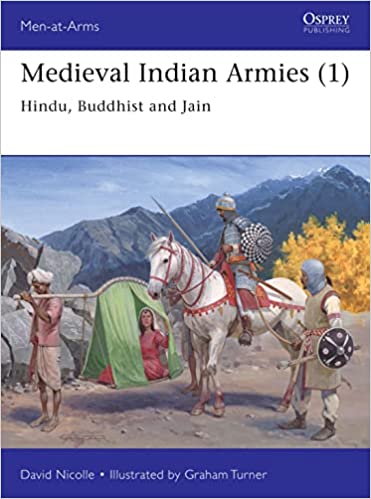
This fully illustrated study explores the armies of the Hindu, Buddhist and Jain states within what are now India, Pakistan, Bangladesh, Sri Lanka and Nepal during the period AD 500-1500, as well as Afghanistan until the early 13th century AD.
Following the emergence of a distinct 'medieval Indian' civilization in the Late Classical and Early Medieval periods, there was a prolonged struggle between this civilization and that of the eastern Islamic world, concluding with the rise of the Mughal Empire at the start of the 16th century. In this fully illustrated study, David Nicolle investigates the traditions and enduring conservatism of non-Islamic medieval Indian warfare, notably evident in recruitment patterns and the significance of archery and cavalry. The role and impact of war-elephants, both positive and negative, are also considered, as well as the influence of climate and weather (notably the seasonal monsoon) on warfare in this region. As well as assessing arms and armour - contrasting the advanced technology and high status of Indian weapons (especially swords) with the remarkable lack of metallic armour in the region during this period - the author also explores siege warfare and riverine and naval warfare in South Asia. This book assesses the contributing factors identified by those who have sought to explain why the huge wealth and substantial populations of the traditional non-Islamic Indian states did not prevent their persistent failure in the face of Islamic invasion and conquest.
Book Description
This fully illustrated study explores the armies of the Hindu, Buddhist and Jain states within what are now India, Pakistan, Bangladesh, Sri Lanka and Nepal during the period AD 500-1500, as well as Afghanistan until the early 13th century AD.
About the Author
David Nicolle is Visiting Research Fellow at the Institute of Medieval Studies, Nottingham University. He is the author of over a dozen books on medieval military history.
Graham Turner is a leading historical artist, specializing in the medieval period. He has illustrated numerous titles for Osprey, covering a wide variety of subjects from the dress of the 10th-century armies of the Caliphates, through the action of bloody medieval battles, to the daily life of the British Redcoat of the late 18th century. The son of the illustrator Michael Turner, Graham lives and works in Buckinghamshire, UK.









 +91 9818282497
(2).png)