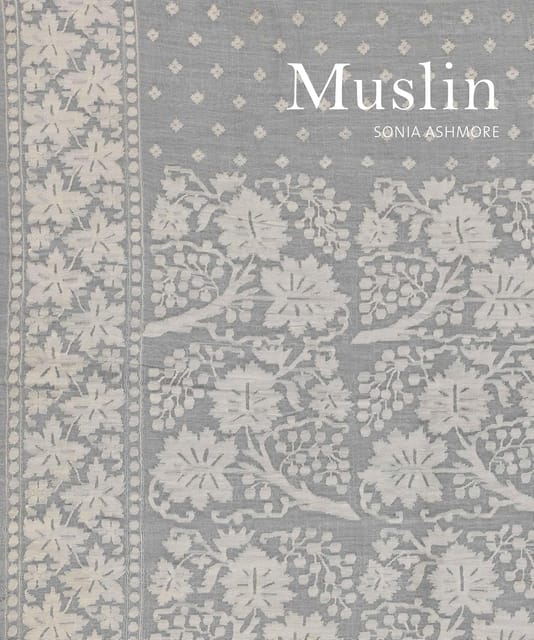
Muslin is a fabric of almost mythical reputation. Renowned for its extraordinary fineness, it was described in the seventeenth century as the shadow of a commodity , a phrase that captures its almost weightless, translucent quality. Yet behind its delicate beauty lies a more complex story, woven into the history of the East India Company, imperial trade, and colonial power.
An open-textured cotton cloth, muslin was woven to varying degrees of fineness depending on the quality of the yarn and the exceptional skill of its spinners and weavers. The name muslin is often attributed to the Venetian traveller Marco Polo, who linked it to the textile trade of Mosul in present-day Iraq, a major centre connecting India and the Mediterranean. Although this origin remains debated, the fabric itself has been associated with Bengal since ancient times, where it was known as mull or mulmul.
Drawing on the remarkable collections of the Victoria and Albert Museum, this book presents these exquisite textiles while exploring their rich cultural history, craftsmanship, and enduring legacy.
About the Author: Dr Sonia Ashmore is a design historian specialising in cultural exchange, design history, and the decorative arts, with particular expertise in the textiles of South Asia and Japan. During her tenure in the Victoria and Albert Museum s Research Department, she researched and helped catalogue its renowned South Asian textile collections, including exceptional muslin and jamdani examples. Now an independent scholar, lecturer, and founder trustee of the Muslin Trust, she continues her research on the textiles of the wider Bengal region.
Muslin is a fabric of almost mythical reputation. Renowned for its extraordinary fineness, it was described in the seventeenth century as the shadow of a commodity , a phrase that captures its almost weightless, translucent quality. Yet behind its delicate beauty lies a more complex story, woven into the history of the East India Company, imperial trade, and colonial power.
An open-textured cotton cloth, muslin was woven to varying degrees of fineness depending on the quality of the yarn and the exceptional skill of its spinners and weavers. The name muslin is often attributed to the Venetian traveller Marco Polo, who linked it to the textile trade of Mosul in present-day Iraq, a major centre connecting India and the Mediterranean. Although this origin remains debated, the fabric itself has been associated with Bengal since ancient times, where it was known as mull or mulmul.
Drawing on the remarkable collections of the Victoria and Albert Museum, this book presents these exquisite textiles while exploring their rich cultural history, craftsmanship, and enduring legacy.
About the Author: Dr Sonia Ashmore is a design historian specialising in cultural exchange, design history, and the decorative arts, with particular expertise in the textiles of South Asia and Japan. During her tenure in the Victoria and Albert Museum s Research Department, she researched and helped catalogue its renowned South Asian textile collections, including exceptional muslin and jamdani examples. Now an independent scholar, lecturer, and founder trustee of the Muslin Trust, she continues her research on the textiles of the wider Bengal region.
Subscribe to get Email Updates!
Thanks for subscribing.
Your response has been recorded.
"We Believe In The Power of Books" Our mission is to make books accessible to everyone, and to cultivate a culture of reading and learning. We strive to provide a wide range of books, from classic literature, sci-fi and fantasy, to graphic novels, biographies and self-help books, so that everyone can find something to read.
Whether you’re looking for your next great read, a gift for someone special, or just browsing, Midland is here to make your book-buying experience easy and enjoyable.
(2).png)