Shop No.20, Aurobindo Palace Market, Hauz Khas, Near Church +91 9818282497 | 011 26867121 110016 New Delhi IN
Midland The Book Shop ™
Shop No.20, Aurobindo Palace Market, Hauz Khas, Near Church +91 9818282497 | 011 26867121 New Delhi, IN
+919871604786 https://www.midlandbookshop.com/s/607fe93d7eafcac1f2c73ea4/69591829db7aed90e0608dfb/without-tag-line-480x480.png" [email protected]
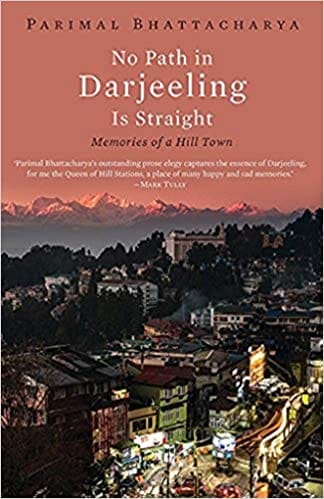
9789389231144 625e9296db14d6ec8e217327 No Path In Darjeeling Is Straight Memories Of A Hill Town https://www.midlandbookshop.com/s/607fe93d7eafcac1f2c73ea4/625e9298db14d6ec8e2174f9/51wgpnp0f-l-_sx322_bo1-204-203-200_.jpg
For a few years in the early 1990s at a time when the embers of a violent agitation for Gorkhaland were slowly dying down Parimal Bhattacharya taught at the Government College in Darjeeling. No Path in Darjeeling Is Straight is a memory of his time in the iconic town, and one of the finest works of Indian non-fiction in recent years. Parimal evocatively describes his arrival, through drizzle and impenetrable fog, at a place that was at odds with the grand picture of it he had painted for himself. And his first night there was spent sleepless in a ramshackle hotel above a butcher shop. Yet, as he tramped its roads and winding footpaths, Darjeeling grew on him. He sought out its history: a land of incomparable beauty originally inhabited by the Lepchas and other tribes; the British who took it for themselves in the mid-1800s so they could remember home; the Darjeeling Himalayan Railway once a vital artery, now a quaint toy train built in 1881; and the vast tea gardens with which the British replaced verdant forests to produce the fabled Orange Pekoe. In the enmeshed lives of his neighbours of various castes, tribes, religions and cultures lived at the measured pace of a small town, Parimal discovered a richly cosmopolitan society which endured even under threat from cynical politics and haphazard urbanization. He also found new friends: Benson, a colleague whose death from AIDS showed him the dark underbelly of the hill station; Pratap and Newton, whose homes and lives reflected the irreconcilable pulls of tradition and upward mobility; and Julia and Hemant, with whom he trekked the forests of the Singalila mountains in search of a vanished Lepcha village and a salamander long thought extinct. With empathy, and in shimmering prose, effortlessly merges travel, history, literature, memory, politics, and the pleasures of ennui into an unforgettable portrait of a place and its people.


About the Author

Parimal Bhattacharya is an associate professor in the Department of English, Maulana Azad College, Kolkata, and a bilingual writer, most recently, of Dodopakhider Gaan (Ababhash, 2019) and Bells of Shangri-La: Scholars, Spies, Invaders in Tibet (Speaking Tiger, 2019)

9789389231144
out of stock INR 239
1 1
No Path In Darjeeling Is Straight Memories Of A Hill Town

No Path In Darjeeling Is Straight Memories Of A Hill Town

ISBN: 9789389231144
₹239
₹299   (20% OFF)


Back In Stock Shortly - Fill The Book Request Form

Details
  • ISBN: 9789389231144
  • Author: Parimal Bhattacharya
  • Publisher: Speaking Tiger
  • Pages: 200
  • Format: Paperback
SHARE PRODUCT

Book Description

For a few years in the early 1990s at a time when the embers of a violent agitation for Gorkhaland were slowly dying down Parimal Bhattacharya taught at the Government College in Darjeeling. No Path in Darjeeling Is Straight is a memory of his time in the iconic town, and one of the finest works of Indian non-fiction in recent years. Parimal evocatively describes his arrival, through drizzle and impenetrable fog, at a place that was at odds with the grand picture of it he had painted for himself. And his first night there was spent sleepless in a ramshackle hotel above a butcher shop. Yet, as he tramped its roads and winding footpaths, Darjeeling grew on him. He sought out its history: a land of incomparable beauty originally inhabited by the Lepchas and other tribes; the British who took it for themselves in the mid-1800s so they could remember home; the Darjeeling Himalayan Railway once a vital artery, now a quaint toy train built in 1881; and the vast tea gardens with which the British replaced verdant forests to produce the fabled Orange Pekoe. In the enmeshed lives of his neighbours of various castes, tribes, religions and cultures lived at the measured pace of a small town, Parimal discovered a richly cosmopolitan society which endured even under threat from cynical politics and haphazard urbanization. He also found new friends: Benson, a colleague whose death from AIDS showed him the dark underbelly of the hill station; Pratap and Newton, whose homes and lives reflected the irreconcilable pulls of tradition and upward mobility; and Julia and Hemant, with whom he trekked the forests of the Singalila mountains in search of a vanished Lepcha village and a salamander long thought extinct. With empathy, and in shimmering prose, effortlessly merges travel, history, literature, memory, politics, and the pleasures of ennui into an unforgettable portrait of a place and its people.


About the Author

Parimal Bhattacharya is an associate professor in the Department of English, Maulana Azad College, Kolkata, and a bilingual writer, most recently, of Dodopakhider Gaan (Ababhash, 2019) and Bells of Shangri-La: Scholars, Spies, Invaders in Tibet (Speaking Tiger, 2019)

User reviews

  0/5